A smart building edge controller is the device layer that fragmented building systems have been missing — it translates protocols, runs local logic, and controls equipment from one chassis instead of three. This article focuses on the smart building edge controller, specifically the EM300 Modular Industrial Edge Controller, and explains how it works as a unified platform for BMS integration.
If you are an integrator or facility manager evaluating whether a smart building edge controller (EM300) fits your next retrofit or new-build project, the sections below compare it head-to-head against gateways, PLCs, and cloud-only BMS architectures — and show how the EM300 functions as a smart building edge controller across HVAC coordination, energy monitoring, and multi-building remote maintenance.
What Is a Smart Building Edge Controller?
A smart building edge controller is a single device that combines three capabilities traditionally split across separate hardware: protocol conversion (BACnet, Modbus, OPC UA, MQTT), local control logic execution, and direct I/O for equipment switching. Unlike a cloud BMS that sends every decision through a network round-trip, a smart building edge controller makes decisions in milliseconds where the equipment lives.
The EM300 is purpose-built for this role. It runs on a triple-core ARM Cortex-A7 (RK3506J) with 512MB RAM and 4GB storage, mounts on a DIN rail, and operates from -40°C to 85°C without a fan. For integrators, that means one device where there used to be three — a protocol gateway, a small PLC, and a remote access module consolidated into a single building automation controller.
How a Smart Building Edge Controller Improves BMS Integration
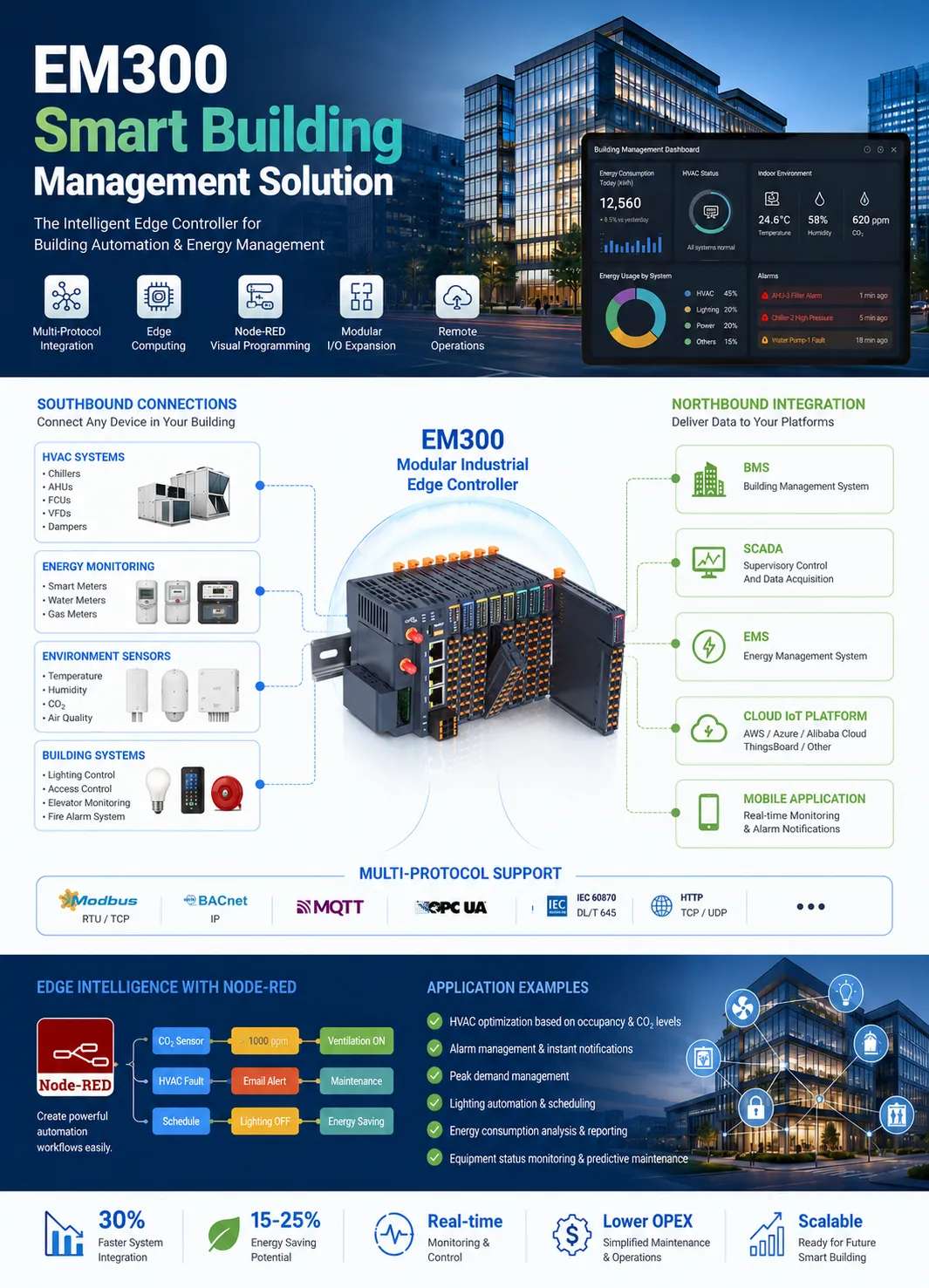
For years, building automation was split between two camps. PLCs delivered reliable local control but spoke only the languages their vendor supported. Cloud BMS platforms promised unified visibility but introduced seconds of latency and a hard dependency on network uptime. Neither side solved the core issue: buildings generate data from dozens of protocols, and decisions need to happen where the equipment lives.
A smart building edge controller like the EM300 closes this gap. It speaks BACnet, Modbus, OPC UA, and MQTT natively. It runs control logic locally through Node-RED. It buffers data when the network drops and resyncs when it returns. And it exposes I/O channels to switch relays and drive analog actuators directly — closing the loop between sensing and acting at the edge, which is where energy savings actually materialize.
| Building System | Typical Protocol | EM300 Support | Common Use Case |
|---|---|---|---|
| HVAC controllers | BACnet IP/MSTP | Yes | Temperature setpoint control, damper actuation |
| Power meters | Modbus TCP/RTU | Yes | Real-time energy consumption monitoring |
| VFDs & motor controls | Modbus RTU | Yes | Fan and pump speed regulation |
| SCADA / HMI systems | OPC UA | Yes | Data exchange with central monitoring |
| Cloud platforms | MQTT | Yes | Energy dashboards, remote alarms |
| Heat meters (CN) | CJ188 | Yes | District heating integration |
| Electricity meters (CN) | DLT645 | Yes | Tariff-aware energy logging |
| Fire/safety panels | Proprietary RS485 | JS custom parsing | Alarm signal forwarding |
For an integrator working on a retrofit — where the building already has a mix of BACnet HVAC, Modbus meters, and legacy RS485 devices — this means consolidating everything onto the EM300 as a single edge node. No three separate gateway models, no custom middleware. The smart building edge controller handles protocol translation natively, and the mappings are part of the Node-RED flow.
Smart Building Edge Controller vs Gateway vs PLC: Which Do You Need?
This is the comparison integrators ask for most often, and the answer depends on what you need the device to do. The table below maps the three architectures to their core function in building automation.
| Dimension | Industrial Gateway | PLC | Smart Building Edge Controller (EM300) |
|---|---|---|---|
| Core function | Monitoring (data forwarding) | Control (local logic) | Unified (monitor + control + protocol) |
| Protocol conversion | 1–2 protocols | Limited, vendor-specific | 10+ protocols, vendor-agnostic |
| Local control logic | Not supported (cloud-dependent) | Yes, vendor ladder logic | Yes, Node-RED visual programming |
| Direct I/O | None or fixed | Fixed at purchase | Modular, hot-swappable DI/DO/AI/AO |
| Cloud connectivity | Primary purpose | Requires a separate gateway | Built-in (MQTT, HTTP, VPN) |
| Remote maintenance | Limited (VPN/remote desktop) | Vendor-specific tools | Built-in VPN, P2P, IoTClient |
| Decision latency | Seconds (cloud round-trip) | Milliseconds | Milliseconds |
| Network outage behavior | Stops reporting | Keeps running | Keeps running + buffers data |
| Best fit | Pure monitoring, simple data forwarding | High-speed manufacturing, safety interlocks | BMS integration, building automation, retrofit |
The pattern is clear. A gateway monitors — it moves data from field devices to the cloud, but cannot act on that data locally. A PLC controls — it runs logic locally, but protocol support and cloud connectivity are usually afterthoughts. A smart building edge controller unifies both: it monitors like a gateway, controls like a PLC, and adds the protocol breadth and cloud connectivity that neither delivers natively.
For most modern BMS integration projects, the smart building edge controller (EM300) is the architecture that reduces device count and integration complexity. For safety-critical interlocks (fire suppression, elevator emergency circuits), a dedicated safety PLC remains the appropriate companion. For pure energy monitoring with no local control, a gateway may still suffice. The EM300 covers the broad middle where most building automation actually lives.
Smart Building Edge Controller vs Traditional Gateway
If you only need to forward data from field devices to a cloud platform, a gateway is sufficient and usually cheaper. If you need the device to make control decisions locally — adjust HVAC setpoints, switch relays, run demand-response logic — without depending on a cloud round-trip, a smart building edge controller is the right choice.
| Feature | Traditional Industrial Gateway | Smart Building Edge Controller (EM300) |
|---|---|---|
| Protocol conversion | 1–2 protocols per device | 10+ protocols |
| Local control logic | Not supported (cloud-dependent) | Node-RED, millisecond response |
| I/O capability | None or fixed | Modular, hot-swappable DI/DO/AI/AO |
| Remote maintenance | Limited (VPN/remote desktop) | Built-in VPN, P2P, IoTClient |
| Network resilience | Basic auto-reconnect | Auto-reconnect + buffering + retransmission |
| Power-off protection | Typically none | Optional UPS, 10s backup, safe shutdown |
A gateway moves data. A smart building edge controller moves data, makes decisions, and acts on them. That distinction is what matters when the building needs to react to its own conditions in real time.
Smart Building Edge Controller vs PLC: Can It Replace a PLC?
In most building management scenarios — HVAC coordination, demand response, energy monitoring, lighting scenes — the EM300 can replace a PLC. The Node-RED environment handles the logic, and the I/O modules handle direct equipment control. The exception is safety-critical interlocks, where a dedicated safety PLC remains the appropriate choice.
| Feature | Traditional PLC | Smart Building Edge Controller (EM300) |
|---|---|---|
| Programming environment | Vendor-specific ladder logic / structured text | Node-RED visual programming (lower barrier) |
| Protocol support | Often limited to the vendor ecosystem | 10+ protocols, vendor-agnostic |
| Cloud connectivity | Usually requires a separate gateway | Built-in (MQTT, HTTP, VPN) |
| Remote maintenance | Limited, vendor-specific tools | Built-in VPN, P2P, IoTClient |
| I/O expansion | Fixed at purchase | Modular, hot-swappable |
| Best fit | High-speed discrete manufacturing, safety interlocks | Building automation, energy management, and retrofit |
Smart Building Edge Controller vs Cloud BMS: Where Should Decisions Happen?
The right answer for most buildings is not “edge instead of cloud” — it is “edge for control, cloud for insight.” The smart building edge controller handles the control loop locally and pushes summarized data upstream. The cloud platform handles trend analysis, reporting across a portfolio, and remote configuration.
| Dimension | Cloud-Only BMS | Smart Building Edge Controller (EM300) |
|---|---|---|
| Decision latency | Seconds (network round-trip) | Milliseconds (local execution) |
| Network dependency | Hard — no link, no control | Soft — local logic runs offline |
| Protocol conversion | Limited (cloud-side translation) | Native at the edge |
| Data cost | All raw data uploaded | Filtered, aggregated data uploaded |
| Safety interlocks | Risky (latency, outage exposure) | Reliable (local execution) |
| Cloud platform role | Primary control + storage | Storage, analytics, remote config |
How a Smart Building Edge Controller Does Edge Computing
The EM300’s edge computing capability runs through a deeply integrated Node-RED environment. Node-RED is a flow-based visual programming tool originally developed by IBM — you build automation logic by dragging nodes onto a canvas and wiring them together. The EM300 ships with a customized version that includes nodes for supported protocols, I/O modules, and edge processing functions.
Here is how this works as a smart building edge controller in practice. Say you want a demand-response routine: when the building’s total power draw exceeds a threshold, the EM300 reduces the HVAC setpoint by 2°C and dims lighting in non-critical zones. The flow looks like a few nodes on a canvas: a Modbus node reads the main power meter every 15 seconds, a function node compares the value against the threshold, and if exceeded, BACnet write nodes adjust the HVAC controllers while DO modules switch lighting relays. The entire logic executes locally in milliseconds — no cloud involvement, no network dependency. When the network is up, the smart building edge controller pushes summarized data upstream. When the network is down, it keeps running and buffers data for automatic resync.
How a Smart Building Edge Controller Reduces HVAC Energy Waste
Energy waste in commercial buildings is overwhelmingly an HVAC problem. The U.S. Energy Information Administration attributes roughly 40–50% of commercial building energy use to HVAC, and a significant portion is wasted — equipment running during unoccupied hours, cooling empty zones, systems fighting each other due to uncoordinated setpoints.
The smart building edge controller addresses this by combining energy monitoring with HVAC control at the same edge node. Power meters feed consumption data via Modbus. The edge logic correlates that with occupancy signals from access control and adjusts HVAC operation accordingly. If the building is unoccupied, the EM300 shifts HVAC to setback mode locally — no cloud round-trip. Integrators who have deployed edge-based energy management routines like this typically report 15–30% reductions in HVAC energy waste, depending on the building’s baseline efficiency and how aggressively the control logic is tuned.
The key is that the smart building edge controller does not just monitor — it acts. DO channels and relay modules switch equipment directly. BACnet write commands adjust setpoints on connected HVAC controllers. This closes the loop between monitoring and control at the edge, which is where savings actually happen.
How a Smart Building Edge Controller Handles I/O Expansion
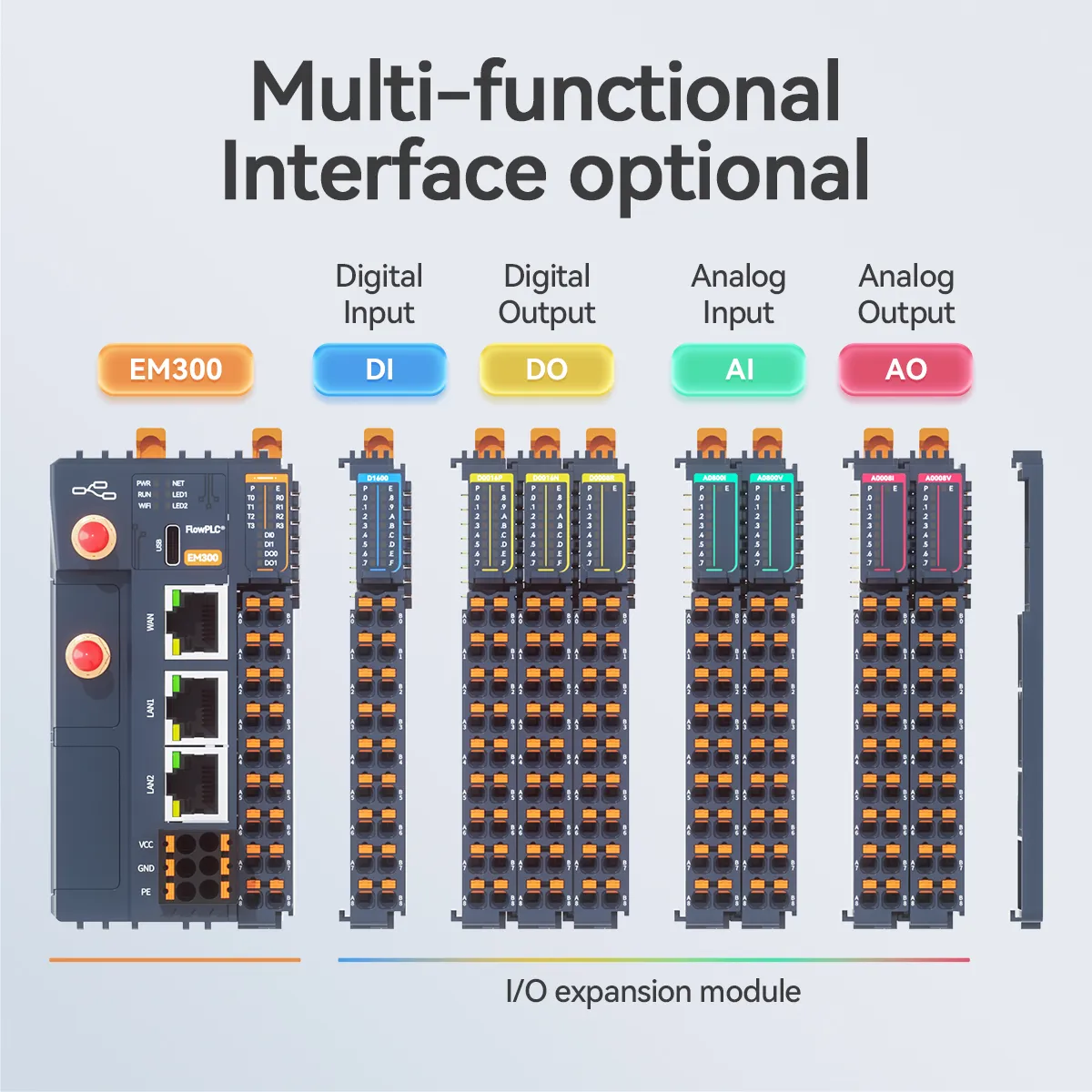
Building automation projects rarely fit a one-size-fits-all I/O count. The EM300 handles this through a modular, hot-swappable I/O system that lets the smart building edge controller adapt to each building’s requirements.
| Module Type | Channels | Typical Building Application |
|---|---|---|
| DI (Digital Input) | 2 built-in + expandable | Door contacts, occupancy sensors, dry contact alarms |
| DO (Digital Output) | 2 built-in + expandable | Lighting relays, fan on/off, pump start/stop |
| AI (Analog Input) | Expandable | Temperature sensors (0-10V / 4-20mA), pressure transducers |
| AO (Analog Output) | Expandable | Modulating valve actuators, VFD speed references |
Modules use a plug-in, tool-free design and support hot-swapping — a faulty module can be replaced without powering down the system.
How a Smart Building Edge Controller Enables Remote Maintenance
For facilities teams managing multiple buildings, remote troubleshooting is a major cost factor. Every truck roll costs time and money, and many issues turn out to be configuration problems that could be resolved remotely if access were available.
The smart building edge controller includes VPN tunneling and P2P direct connection, so an engineer can access the device — and all equipment connected to it — as if sitting in the mechanical room. The IOTClient companion software provides remote configuration, debugging, diagnostics, and firmware updates across all deployed units from one interface. The hardware watchdog reboots the device automatically if the OS hangs. The network auto-reconnect and data retransmission mechanism ensures data is not lost during brief outages. The optional UPS module provides up to 10 seconds of power-off protection — enough time to save parameter snapshots and send a final alert before a safe shutdown.
How a Smart Building Edge Controller Works in Real Deployments
Spec sheets describe capabilities. Deployments describe outcomes. Here is how engineers typically use the EM300 as a smart building edge controller in the field — described by engineering result, not dollar value.
Hospital HVAC retrofit. A regional hospital needed to integrate a 12-year-old BACnet HVAC system with newer Modbus power meters and an OPC UA-connected chiller plant. The original plan called for three gateways and a small PLC — roughly 18 days of integration work. The team consolidated onto two EM300 units instead: one for HVAC and chiller plant, one for metering and lighting. Node-RED flows handled the demand-response logic and occupancy-based setback. Integration time dropped to 9 days, and after-hours HVAC runtime decreased measurably because the control logic ran locally.
Factory energy-saving deployment. A manufacturing site with three production lines had Modbus VFDs on fans and pumps, but no visibility into how energy use tracked with the production schedule. An EM300 was installed at each line’s main panel, reading VFD status and main feeder power via Modbus and pushing aggregated 15-minute interval data via MQTT. The edge logic compared real-time kWh against the production schedule (sourced from the MES over OPC UA) and automatically dropped non-critical ventilation to setback mode during shift changes. Over the first quarter, HVAC-related energy consumption dropped by roughly 18% — driven by edge logic that ran whether or not the cloud was reachable.
Campus multi-building control. A corporate campus with seven buildings had been managed by seven separate BMS instances, each with its own vendor dashboard. The facilities team consolidated all buildings onto EM300 edge controllers, one per building, with a single cloud platform on top. Remote maintenance was the headline benefit: the team pushed configuration updates, debugged Node-RED flows, and updated firmware across all seven buildings from IOTClient without visiting any site. Truck rolls dropped sharply, and mean-time-to-repair improved because the first diagnostic pass happened remotely.
In each case, the smart building edge controller did the same thing: consolidated fragmented systems onto a single edge node, ran control logic locally, and reduced the integration complexity that has historically made BMS projects slow and expensive.
FAQ: Smart Building Edge Controller Questions Engineers Search For
Can a smart building edge controller replace a PLC?
In most building management scenarios — HVAC coordination, demand response, energy monitoring, lighting scenes — yes. The EM300’s Node-RED environment handles the logic, and the I/O modules handle direct equipment control. The exception is safety-critical interlocks (fire suppression, elevator emergency circuits), where a dedicated safety PLC remains the appropriate choice.
What is the difference between an edge controller and a gateway in BMS?
A gateway monitors — it forwards data from field devices to a cloud platform but cannot act on that data locally. An edge controller like the EM300 monitors, processes, and acts — it runs control logic locally in milliseconds, switches I/O directly, and keeps the building running during network outages. For BMS integration that requires real-time control, an edge controller is the right choice.
Is BACnet supported in smart building edge controllers?
Yes. The EM300 supports BACnet IP and MSTP natively, along with Modbus TCP/RTU, OPC UA, MQTT, CJ188, and DLT645. This covers the majority of HVAC controllers, power meters, and building automation equipment from vendors like Honeywell, Schneider, Johnson Controls, and Siemens.
Where is edge computing used in building automation?
Edge computing is used wherever a building needs to react to its own conditions in real time — HVAC setpoint adjustment based on occupancy, demand-response load shedding when power draw crosses a threshold, equipment staging based on sensor feedback, and fault detection that triggers local alarms. The EM300 runs this logic locally through Node-RED, so decisions happen in milliseconds rather than waiting for a cloud round-trip.
How does a smart building edge controller handle network outages?
The EM300 continues executing local control logic. Data is buffered locally and retransmitted to the cloud automatically once connectivity is restored. The building’s HVAC, lighting, and energy management routines keep running — they do not pause because the cloud is unreachable.
Is the EM300 smart building edge controller suitable for harsh environments?
The EM300 is rated for -40°C to 85°C operation with passive cooling (no fan) and carries CE certification with EMC protection, including ESD (±8kV air, ±4kV contact) and surge protection. It is suitable for mechanical rooms, utility closets, and outdoor enclosures.
Wrapping Up
The shift toward edge-based architecture in building management is a practical response to problems integrators and facility managers face every day: protocol silos, cloud latency, energy waste, and costly site visits. The smart building edge controller is the device layer that addresses all four — and the EM300 implements it in a single DIN-rail unit with the protocol breadth, local logic, modular I/O, and remote maintenance tools that real BMS integration projects require.
For integrators and building management teams evaluating edge controller options, the EM300 is worth considering as a unified platform that reduces integration complexity while improving real-time responsiveness — a building management system that is not just connected, but genuinely intelligent at the edge.

Agnes Wang is an IoT Solutions Specialist at IOTRouter, focusing on industrial IoT gateways, edge computing, and industrial automation solutions.
She specializes in industrial communication technologies, including Modbus, IEC 60870-5-104, MQTT, OPC UA, PLC integration, and remote monitoring applications. She contributes to technical articles and application guides covering industrial IoT solutions, protocol conversion, and edge computing.