

Search

Solve BMS Integration Complexity in Smart Buildings with EM300 Edge IO Controller

BMS Integration Solution1

BMS Integration Solution

Reduce Building Management System Integration Complexity and Lower System Costs

Background

A commercial building project faced fragmented BMS(Building Management System) integration across HVAC systems, energy meters, and heat meters, where each subsystem operated on different communication protocols such as BACnet, Modbus, and CJ188. This fragmentation significantly increased integration complexity and made system interoperability and data consistency difficult to maintain. For BMS system integrators, integration complexity is now the single biggest cost driver in building automation projects. It often exceeds hardware costs and deployment time combined.
This is where EM300 Edge IO Controller changes the architecture entirely — collapsing multiple disconnected layers into a single edge intelligence layer that unifies data acquisition, protocol conversion, and local control execution in real time. EM300 significantly reduces system complexity, shortens integration and debugging cycles, lowers hardware and deployment costs. Improving both system reliability and operational efficiency in building automation projects.

Client Requirements

Edge-based logic execution for HVAC control, scheduling, and alarm response ensures the system operates independently from cloud latency, improving responsiveness and reliability in building operations.

Modular I/O expansion allows additional sensors, switches, and control points to be added easily without replacing the main controller, reducing hardware redesign and upgrade costs.

Unified collection and management of temperature, humidity, CO₂ concentration, and energy consumption data.

Equipped with real-time automatic warning capabilities, the system triggers both audible and visual alarms when approaching or exceeding rated limits, prompting immediate corrective action.

Technical Solution

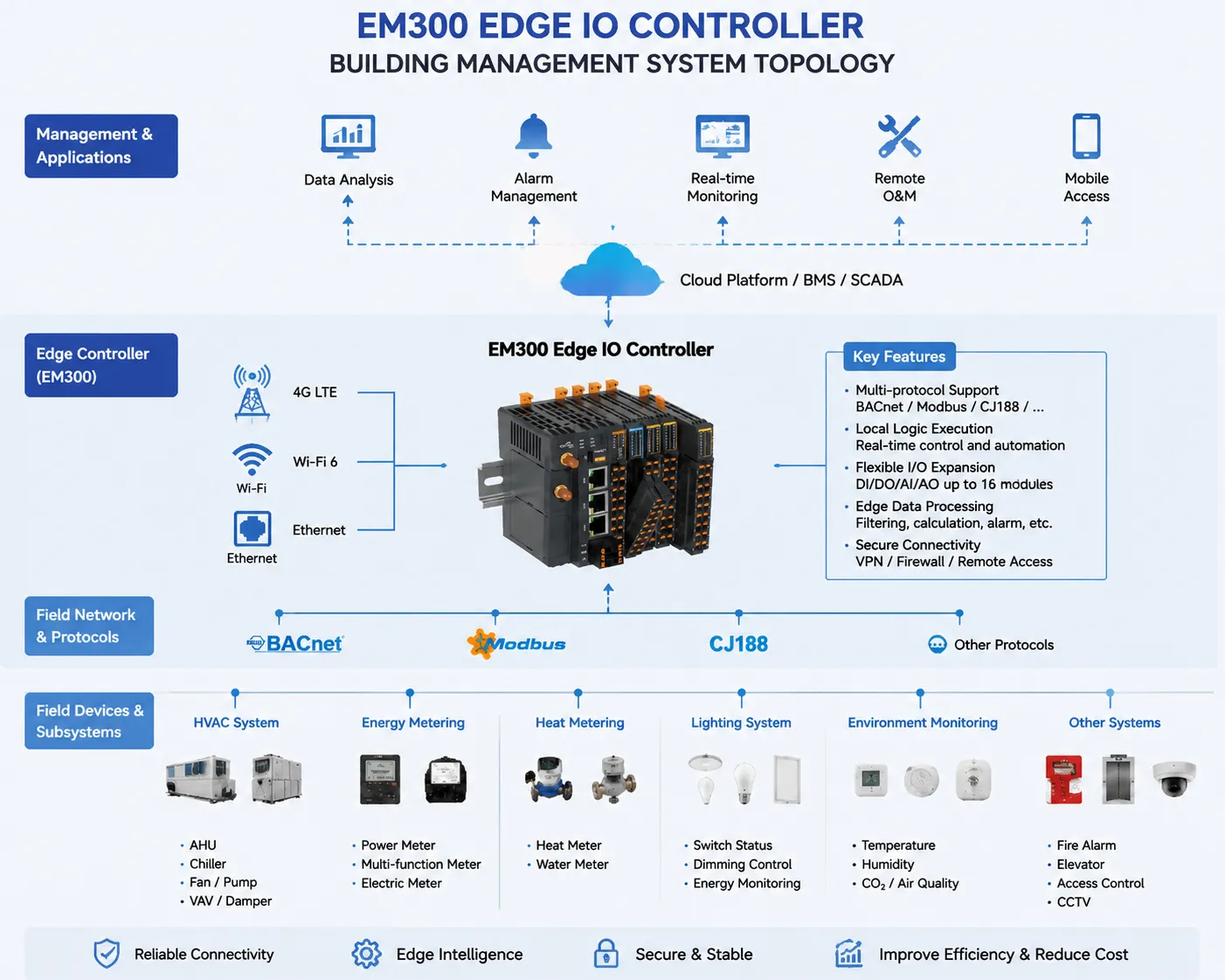
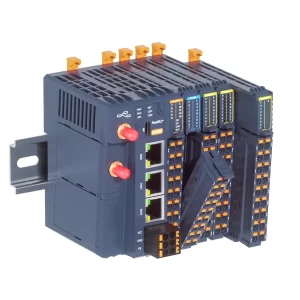
EM300 is IOTRouter's edge IO controller designed for smart buildings. A single device natively supports BACnet, MQTT, Modbus TCP, and OPC UA — the four dominant protocols in building automation. It integrates data acquisition, protocol conversion, logic control, and remote O&M into one compact unit. No more multiple gateways. One EM300 connects field devices, building automation systems, energy management platforms, and cloud services—all at once. Typical deployment architecture:

Typical deployment architecture-BMS (2)

At a commercial complex project, the EM300 was installed in the electrical distribution room's control cabinet. It connected directly to AHUs, meters, and heat meters via RS485 and Ethernet. After local data acquisition and protocol conversion, it fed data to the BAS via BACnet/IP and uploaded energy data to the cloud platform via MQTT. Installation took less than half a day—mount the DIN‑rail unit, terminate RS485 and Ethernet cables, power up, and configure. No cabinet modifications. No wiring changes. The onsite lead put it simply: "This used to take three boxes—a DDC, a protocol gateway, and a cloud gateway. Now one box does it all."

How EM300 Solves the Integration Problem

1. Four protocols native, no translation boxes
EM300 natively supports the four most common protocols in building and industrial automation: BACnet/IP, MQTT, Modbus TCP, and OPC UA.
AHUs on BACnet, meters on Modbus, cloud on MQTT, system integration on OPC UA—one device handles everything. No matter which brand you're connecting, the protocol library covers it.
2. Modular I/O: expand without replacing the main controller
Traditional DDC controllers have fixed I/O counts. Need one more temperature sensor or relay output? If you're out of points, you replace the controller, rewire, and reprogram.
EM300 uses modular I/O design—digital inputs, analog inputs, relay outputs—add whatever you need, when you need it. Up to 16 expansion modules, hot‑swappable. Add a sensor? Snap on an AI module. Need an extra relay? Snap on a DO module. No controller replacement. No reprogramming. No downtime.
3. Local logic, independent of the cloud
EM300 features a built‑in visual programming environment based on Node‑RED. Build control logic by dragging and dropping nodes—no coding required. HVAC schedules, valve adjustments based on temperature, energy threshold alarms—all execute locally, without cloud involvement.
During network outages, HVAC continues to run normally. Energy data is cached locally with timestamps and auto‑retransmitted when connectivity returns. No loss of control. No loss of data.
4. Built‑in Web configuration, browser‑based management
No special software to install. No complex command lines to memorize. Open a browser, enter the device IP, and complete all configuration from one dashboard. Local debugging and remote O&M all in the same interface.
5. Industrial‑grade design for 24/7 reliability
1) Operating temperature ‑40°C to 85°C, fanless design
2) Built‑in hardware watchdog—automatic recovery from system exceptions
3) Power‑loss protection—no data corruption during sudden outages

Before vs After: BMS Integration Upgrade with EM300

BMS Before vs After Comparison
Before (DDC + Gateway + Cloud Architecture) After (1× EM300 Edge Controller)
1 3 separate devices in series (DDC + protocol gateway + cloud gateway) Single EM300 edge controller
2 1–2 weeks deployment time due to complex integration 3 days rapid deployment
3 High hardware cost with multiple system layers More than 60% hardware cost reduction
4 Requires individual protocol configuration for each device Native multi-protocol support (BACnet / Modbus / CJ188)
5 Cloud-dependent control with multi-second latency Local edge control with millisecond response
6 Limited expansion, controller replacement required when I/O is insufficient Modular I/O expansion with hot-swappable modules
7 Multiple platforms required for operation & maintenance Unified browser-based configuration and management
8 Data loss risk during network outage Local cache + automatic retransmission
John Doe — Project lead, commercial complex building automation project
"We used to put three boxes in each electrical room—DDC, protocol gateway, cloud gateway. Now a single EM300 handles everything. Deployment went from two weeks to three days, and when we need more I/O points, we just snap on a module—no more replacing the whole controller for one extra sensor."

Why choose Edge IO Controller EM300? Engineering Decision Points

You can mix and match devices from different manufacturers—the EM300 speaks their protocols natively.
Modular I/O means you can add new sensors and actuators without replacing the core controller. The device you install today can handle tomorrow's expansion.
Fewer devices, local and remote control, and browser‑based management. These aren't technical niceties—they're practical decisions that keep buildings running and maintenance costs predictable.

Global Deployment Reference

Global Deployment Reference

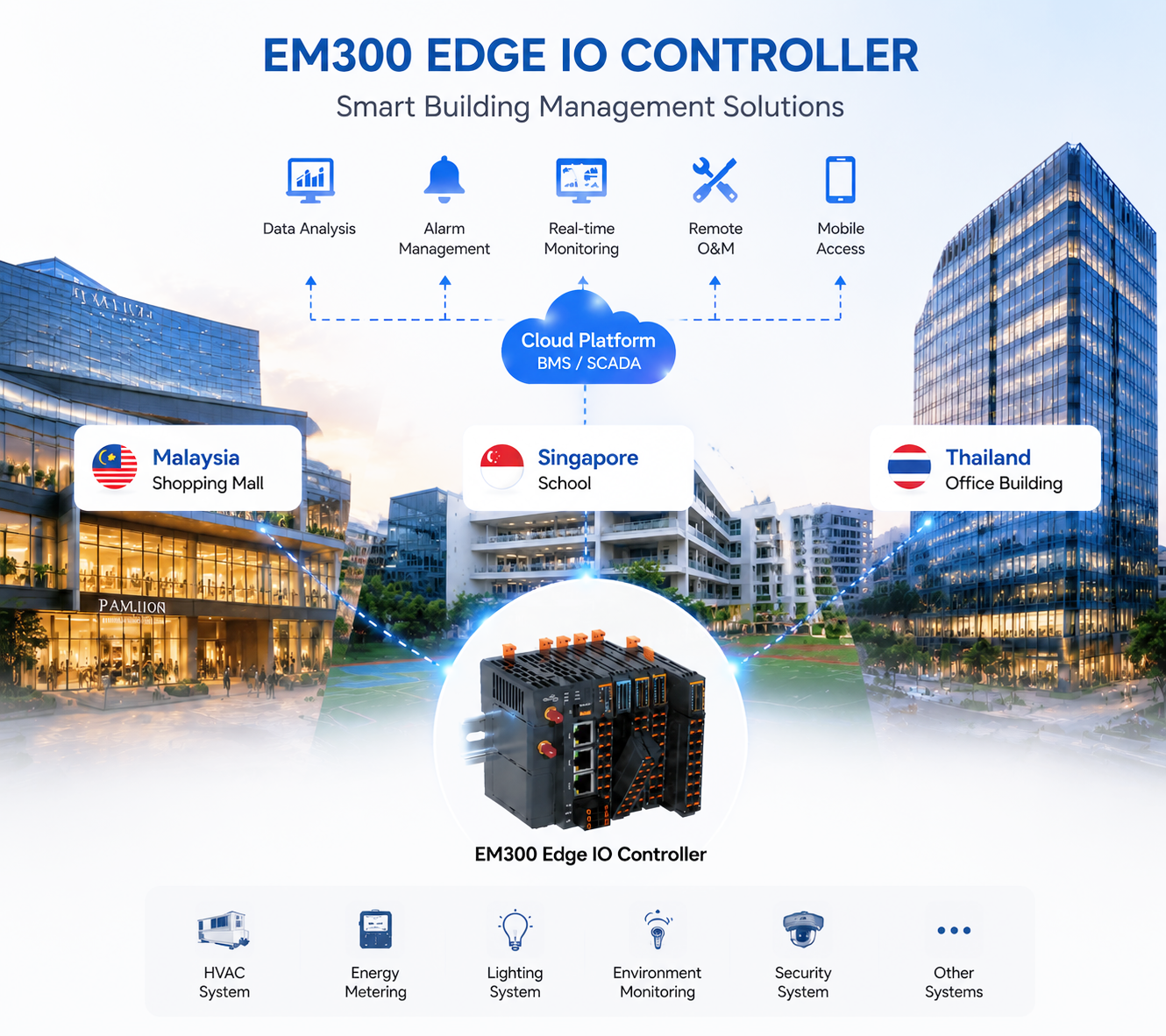
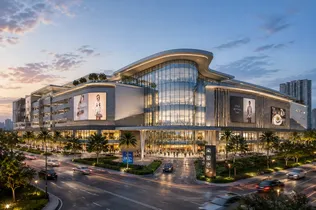
my Malaysia — Shopping Mall Application

A large commercial shopping center integrates multiple building systems including HVAC chillers, tenant electricity metering, lighting control, and water pump monitoring. These subsystems typically come from different vendors and use different communication protocols, making system integration complex and fragmented. EM300 is deployed as the edge integration controller to unify data collection from field devices and enable real-time coordination between energy metering systems and building management platforms, improving operational visibility and system responsiveness.
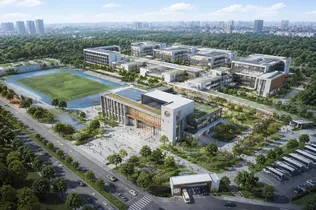

sg Singapore — School Campus Application

A university campus typically consists of multiple buildings with independent HVAC systems, classroom environmental controls, energy meters, and access monitoring systems. Without centralized integration, facility data is often siloed across different systems. EM300 is used to connect and standardize data from multi-building subsystems, enabling centralized monitoring and edge-based data processing for campus-wide building management and energy optimization.


th Thailand — Office Building Application

A commercial office building includes AHU systems, electrical distribution panels, elevator monitoring, and tenant energy sub-metering systems. These systems often operate independently and require integration into a unified BMS platform. EM300 acts as the edge integration layer to consolidate field data, enable protocol translation, and support real-time building automation logic, allowing centralized control and improved system reliability across the building infrastructure.
Quick FAQs

Q1: What does BMS stand for in this article?
BMS refers to Building Management System — the centralized platform that monitors and controls mechanical and electrical equipment in a facility. This article focuses on connecting field devices to the BMS platform efficiently.

Q2: What is edge computing in BMS systems?
Edge computing means processing data near the source—on the EM300 itself—rather than sending everything to the cloud. This gives you millisecond response times, keeps your building running during network outages, and reduces cloud bandwidth costs. For BMS applications, edge computing is the difference between reactive and proactive building management.

Q3: Can EM300 connect to my existing building equipment?
Yes. EM300 supports many kinds of protocols. 1. PLC Protocols: Siemens, MELSEC, Omron, LS Electric, Allen-Bradley, Delta, and more. 2. CNC Protocols: SIEMENS, MELSEC, Mazak, Heidenhain, Haas, KND, LNC, and more. 3. Industrial Protocols: Modbus/OPC UA/BACnet/IEC104(61850*)/CJ188/DLT645/HJ212…4. Network Protocols: MQTT/ HTTP /TCP/ UDP /WEBSOCKET. No translation box needed.

Q4: What if I need more I/O points later?
EM300 uses modular I/O design. Need an extra temperature sensor? Add an AI module. Need to control another fan? Add a DO module. Up to 16 modules, hot‑swappable. No controller replacement. No reprogramming. No downtime.

Q5: What happens during a network outage?
Nothing bad. Control logic runs locally — HVAC schedules, valve adjustments, alarms all execute on‑device regardless of cloud connectivity. Data is cached locally with timestamps and auto‑retransmitted when the network returns.

Related Products

Have a specific BMS integration challenge? Reach out.

I've worked through most of them across commercial buildings, campuses, and industrial facilities.