Industrial Edge Controller for Renewable Energy Stations
A 50 MW solar farm in Inner Mongolia runs 120 inverters across 12 combiner boxes, a BMS cabinet, and 40 environmental sensors — all speaking different protocols. When the O&M team tried to unify them with a standard protocol gateway, integration took 9 weeks and still left gaps in real-time visibility. Stories like this are why the IEA now tracks digital readiness as a bottleneck for renewable capacity additions, not just panel or battery supply.
The fix isn’t another gateway. It’s an industrial edge controller for renewable energy — a device that doesn’t just forward data but runs logic, normalizes protocols, and trips relays locally. The EM300 Modular Industrial Edge Controller from IOTRouter is built for exactly this role. Here’s where it fits, what it replaces, and how it performs across five real station types.
Why Renewable Energy Stations Need an Industrial Edge Controller
Protocol Fragmentation and Data Silos
Walk into any solar or storage station control room and count the protocol manuals. A typical site runs Modbus RTU on inverters, IEC 104 on the grid-tie point, DL/T 645 on meters, CAN on the BMS, and at least one vendor-proprietary protocol on the weather station. Five protocols, four vendors, zero shared data layer.
Without a dedicated industrial edge controller for renewable energy at the center, each device class reports to its own monitoring software. Operators toggle between three or four dashboards just to answer one question: is the station healthy? Integration projects stall for weeks while engineers write custom protocol bridges that break on the next firmware update.
Unreliable Communications in Remote Locations
Solar farms sit in deserts. Wind turbines perch on ridge lines. Storage containers live in industrial parks with spotty cellular coverage. A single 4G link drops, and the cloud-side Energy Management System goes blind — sometimes for hours before anyone notices.
This isn’t theoretical. A cable cut at a Gansu wind farm in 2023 left 30 turbines unmonitored for 6 hours. No fault detection, no curtailment optimization, no safety alerts. The station lost an estimated 18 MWh of generation that day. An industrial edge controller with multi-link failover and local data buffering would have kept critical monitoring alive through the outage.
High Maintenance Costs and Slow Fault Response
Field technicians drive 200 km between dispersed stations. A single inverter fault that should take 30 minutes to diagnose instead consumes a full day — drive time, access, manual data collection, and return. Multiply that across 50 stations, and labor becomes the single largest O&M line item.
Worse, without edge intelligence on-site, safety risks go undetected until they escalate. Battery thermal runaway progresses from first abnormal reading to irreversible damage in 30-90 seconds. By the time a cloud alert triggers and a technician arrives, the damage is already done. This is exactly the gap an industrial edge controller fills — detecting and acting on anomalies before they cross the line from incident to catastrophe.
Fragmented Control and Suboptimal Energy Dispatch
Solar, storage, EV chargers, and grid interconnections operate as independent subsystems. Charge and discharge decisions happen manually — an operator checks pricing, calls the station, and adjusts settings. Grid frequency regulation signals arrive faster than humans can respond. The result: higher curtailment, underutilized batteries, and revenue left on the table. Without an industrial edge controller unifying these subsystems locally, dispatch logic stays stuck in manual mode.
Inside the EM300 Industrial Edge Controller
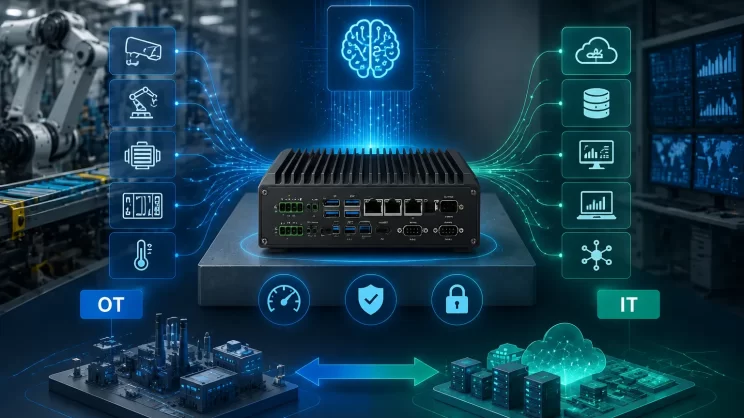
IOTRouter’s architecture follows three tiers: terminal device access → edge processing → cloud application. The EM300 sits at the edge, bridging field devices to cloud platforms while executing local computation and control that no passive gateway can match.
Terminal Device Layer
The industrial edge controller for renewable energy provides full connectivity to solar inverters, wind turbine master controllers, BMS, PCS, combiner boxes, smart meters, environmental sensors, weather stations, and PLCs — covering generation, storage, distribution, and consumption across the entire energy chain.
The EM300 as Edge Control Brain
The EM300 Modular Industrial Edge Controller replaces what used to require four separate boxes: a protocol converter, a data gateway, a small PLC, and a 4G router. Here’s what it does at the edge:
- Edge computing — local data processing and logic execution without cloud round trips
- Visual programming — built-in Node-RED for drag-and-drop workflow development
- Protocol conversion — 100+ industrial protocols across PLC, CNC, and IoT standards
- Industrial protocol support — Modbus RTU/TCP, OPC UA, IEC 104, DLT 645, BACnet, CJ188, HJ212, MQTT, and more
- Industrial routing — 4G Cat.1, Wi-Fi 6, Ethernet with VPN and firewall
- Expandable I/O — 4× RS485, 2× DI, 2× DO (relay), with modular AI/AO expansion
Unlike a basic renewable energy gateway that only forwards data upstream, this industrial edge controller executes control logic at the edge. For lightweight automation scenarios, it can reduce or eliminate the need for a separate PLC, cutting both hardware cost and integration complexity.
Key Hardware Specifications:
| Parameter | Specification |
|---|---|
| Processor | RK3506J, 3× Cortex-A7 @ 1.2GHz |
| RAM | 512 MB |
| Storage | 4 GB (expandable to 128 GB via Micro SD) |
| RS485 | 4 channels (isolated, ESD/surge protected) |
| Digital Input | 2 channels (NPN/PNP, 12V/24V) |
| Digital Output | 2 channels (relay, 2A @ 30VDC) |
| Ethernet | 1× WAN + 2× LAN (10/100 Mbps) |
| Wi-Fi | Wi-Fi 6 (802.11a/b/g/n/ac/ax), dual-band 2.4GHz + 5GHz |
| Cellular | 4G Cat.1 (global band options: CN/EU/LA) |
| Operating Temperature | -40°C to 85°C |
| Power Supply | 9–36V DC |
| Cooling | Fanless passive cooling |
| Certification | CE, EMC (ESD ±8kV / Surge ±1kV / EFT ±1kV) |
Why these specs matter in the field:
Four RS485 channels aren’t a luxury — they’re a necessity. A typical solar station needs at least two buses: one for inverters, one for meters and sensors. With four, you segment traffic by device type, reducing bus contention. At 9600 baud, polling 10 inverters on a single Modbus RTU bus takes roughly 0.8–1.2 seconds per full scan cycle. Split inverters onto their own bus and meters onto another, and you cut that cycle in half while keeping sensor data fresh.
The -40°C to 85°C range covers real deployment conditions. A rooftop junction box in Dubai hits 70°C at noon. A wind turbine nacelle in Inner Mongolia drops to -35°C in January. Fanless passive cooling means no moving parts to freeze, clog with dust, or fail after 18 months of 24/7 operation.
The 2× DO relay channels (2A @ 30VDC) are what separate an industrial edge controller from a data gateway. They can directly trip a contactor, sound an alarm, or initiate a shutdown sequence — no additional hardware, no PLC intermediary, no cloud round trip.
Cloud Application Layer
EM300 connects to enterprise EMS platforms, third-party cloud services, or IOTRouter’s own device management platform via IOTClient remote management software. Cloud-side functions include remote monitoring, fault alerting, energy consumption statistics, generation efficiency analysis, intelligent dispatching, O&M management, and data visualization across multiple stations. When paired with an energy management system, the EM300 functions as the energy management system gateway between field devices and cloud analytics — normalizing data at the edge so the cloud sees clean, structured inputs.
What an Industrial Edge Controller for Renewable Energy Does at the Edge
1. Protocol Compatibility Across 100+ Industrial Standards
EM300’s protocol library covers 100+ protocols across four categories:
- PLC communication: 100+ brands including Siemens, Mitsubishi, Omron, Allen-Bradley, Beckhoff, Keyence, Panasonic, Delta, XinJE, MegMeet, Yaskawa, Fatek, Vigor, Fuji, LS Electric, and Inovance. All mainstream PLCs supporting standard Modbus RTU/TCP are compatible.
- CNC communication: 10+ brands including Siemens, Fanuc, Haas, Brother, Heidenhain, Mazak, GSK, KND, SYNTEC, LNC, and Citizen.
- Industrial/IoT protocols: Modbus RTU/TCP, OPC UA, OPC DA, BACnet, IEC 104, IEC 61850* (optional), CJ188, DLT 645, HJ212, MQTT, HTTP, TCP, UDP, WebSocket.
- Custom protocols: Non-standard or proprietary protocols parsed via the built-in JavaScript engine.
This is where the EM300 earns its keep beyond what a basic Modbus gateway for energy storage can do. A conventional Modbus gateway speaks one protocol family. This industrial edge controller speaks them all — and translates between them in real time. A Siemens S7 PLC, a Modbus RTU inverter, and an IEC 104 grid meter can all report into a single normalized data model at the edge. No protocol converters, no vendor-specific adapters, no integration consultants billing by the week.
The same edge computing architecture that powers protocol conversion also makes the EM300 a proven industrial edge controller for PLC data acquisition — useful when a renewable station’s control logic runs on legacy PLCs that need to share data with newer IoT infrastructure.
2. Resilient Multi-Path Communication
EM300 supports three concurrent communication paths:
- 4G Cat.1 cellular — with regional band options for China (B1/B3/B5/B8), Europe (B1/B3/B5/B7/B8/B20/B28), and Latin America (B2/B3/B4/B5/B7/B8/B28/B66)
- Ethernet — 1× WAN + 2× LAN for wired backbone connectivity
- Wi-Fi 6 — 802.11a/b/g/n/ac/ax dual-band (2.4GHz + 5GHz), supporting up to 20 AP clients
Run 4G as primary and Ethernet as backup, or the reverse. When one path drops, the industrial edge controller switches automatically — typically within 3 seconds — and resumes data streaming with breakpoint resumption, so no readings are lost during the handoff. This multi-link behavior is what separates the EM300 from a basic industrial IoT gateway — it doesn’t just provide connectivity; it manages it intelligently at the edge.
An optional UPS module provides 10 seconds of backup power on mains failure. That’s enough time to buffer pending data, snapshot parameters, execute a safe shutdown, and transmit a last-gasp status signal to the cloud before the station goes dark.
The industrial-grade enclosure (PC material, fanless, -40°C to 85°C, CE certified with EMC Level 3 ESD protection) has been deployed in desert solar farms at 65°C ambient and mountain wind sites at -30°C — without a single hardware failure logged in the field.
3. Edge Intelligence with Node-RED
EM300 runs a deeply customized Node-RED instance. Engineers build acquisition → processing → control workflows by dragging nodes onto a canvas — no C code, no firmware compilation, no deployment cycle.
Key edge computing capabilities include:
- Data filtering and aggregation — process raw data locally and send only meaningful deltas upstream, cutting 4G bandwidth by 60-80%
- Threshold monitoring and alerting — trigger alerts when battery temperature, voltage, or current crosses safe bounds
- Local logic control — execute charge/discharge strategies, fault isolation, and equipment protection without waiting for cloud confirmation
- Millisecond-level control response — distributed I/O architecture enables real-time actuation via the 2× DO relay channels
For battery storage, this is the difference between a minor incident and a fire. The industrial edge controller can independently detect an overcharge or overtemperature condition and trigger a relay shutdown in under 50 milliseconds. A cloud-side alert round-tripping over 4G? Two to five seconds. In thermal runaway, that gap is everything.
4. Centralized Cloud Management
The industrial edge controller pairs with IOTClient remote management software or third-party cloud platforms, giving operators:
- Multi-station dashboards — electronic maps and data screens showing generation output, device status, energy consumption, and alarms across all stations
- Remote operations — configuration, debugging, diagnostics, and firmware updates over VPN with P2P direct-connect tunneling
- Network management — SD-WAN, VPN, firewall, subnet proxy, and virtual serial port capabilities
- Tiered alerting — automatic fault classification with notifications via WeChat, SMS, and email, enabling unattended operations
Industrial Edge Controller for Renewable Energy: Five Field Scenarios
Solar Power Stations
As an edge controller for solar and energy storage, the EM300 acquires data from inverters, combiner boxes, PV modules, weather stations, and meters via its 4× RS485 channels and expandable I/O modules. Monitored parameters include generation output, power, temperature, and irradiance.
Node-RED flows handle fault diagnosis, automatic alerting, and inverter parameter adjustment. The four RS485 channels let you dedicate one bus to inverters (typically 10-20 devices at 9600 baud), another to environmental sensors, and a third to meters — keeping polling cycles under 1 second per bus. Multiple stations are managed centrally from the cloud, reducing field visits and improving annual generation by 3-8% through faster fault response and yield optimization. The industrial edge controller also pushes parameter adjustments back to inverters remotely — no truck roll required.
Energy Storage Systems
EM300 bridges BMS, PCS, and PLC systems to monitor battery voltage, current, temperature, SOC, and SOH in real time. Solar-storage coordination logic runs at the edge: charge and discharge strategies optimize storage utilization and extend battery cycle life.
Here’s where the industrial edge controller diverges sharply from a conventional gateway. A conventional Modbus gateway can read BMS data, but it cannot act on it. When a battery cell hits 65°C, the gateway forwards the reading upstream and waits for a cloud command to trip the breaker. That round trip takes 2-5 seconds over 4G — and by then, thermal runaway may already be irreversible. The EM300’s local relay trips in under 50 milliseconds. No cloud dependency, no network latency, no waiting.
Wind Farms
The industrial edge controller connects to wind turbine master controllers, pitch systems, gearboxes, generators, and weather stations to monitor wind speed, rotor speed, vibration, temperature, and generation output. Node-RED edge analytics processes equipment status in real time, predicting potential faults and issuing early warnings to reduce unplanned downtime.
For offshore and mountain wind farms, the 4G + Wi-Fi 6 dual-link with VPN remote access means engineers can pull vibration trend data and gearbox temperature logs from 500 km away — no helicopter, no 4-hour drive. A fault that would have taken a full day to diagnose now takes 20 minutes over a remote session.
Solar-Storage-Charging Integrated Stations
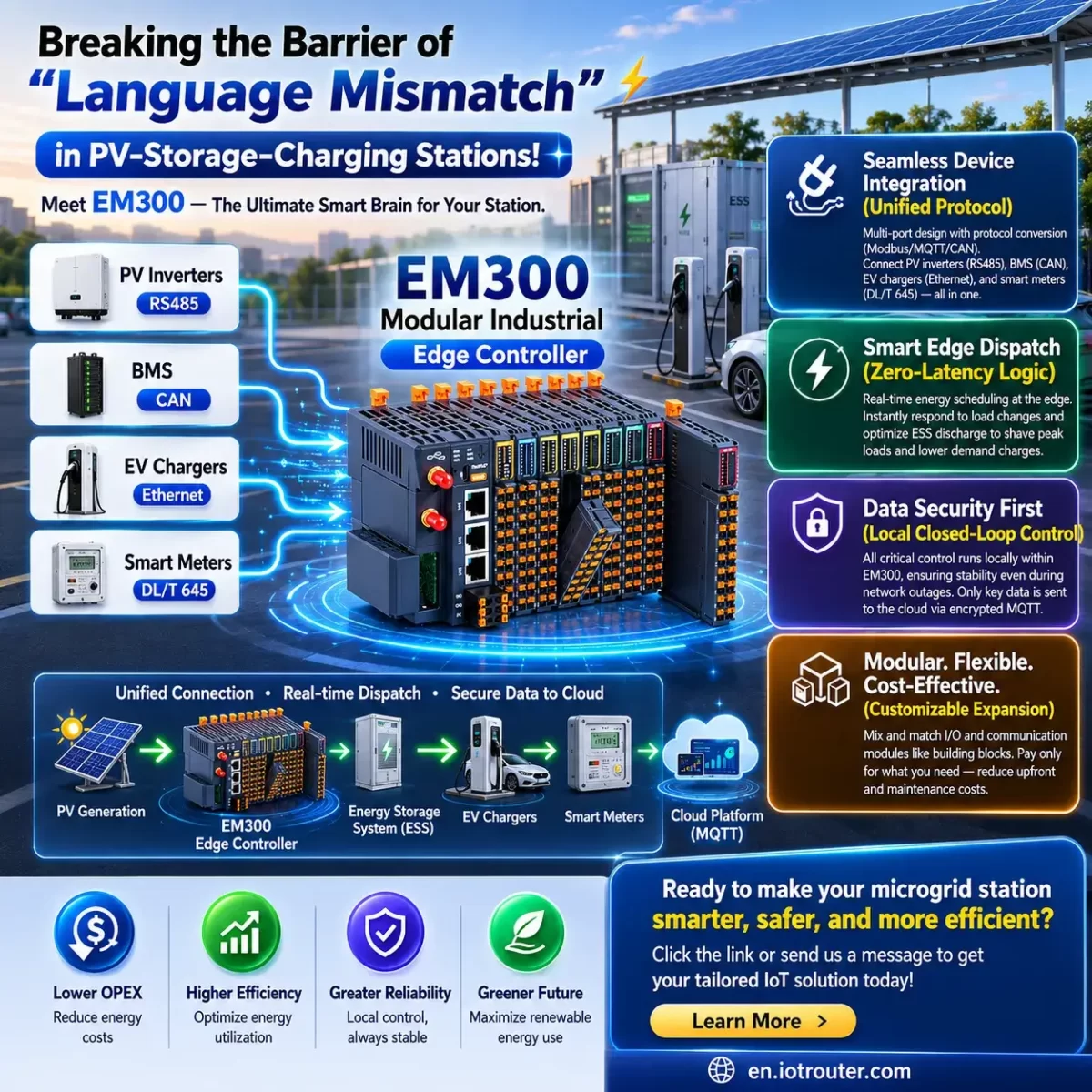
EM300 unifies photovoltaic, storage, EV charger, and distribution systems into a single data and control fabric. Based on solar output, grid electricity pricing, and charging demand, the industrial edge controller for renewable energy dispatches storage charge and discharge commands to smooth load fluctuations and reduce electricity costs.
A station with 200 kW solar, 500 kWh storage, and 4 DC fast chargers can use EM300’s edge logic to charge the battery during peak solar hours, discharge during evening charging demand, and avoid peak grid pricing — cutting electricity costs by 15-25% compared to uncoordinated operation.
Distributed Energy Microgrids and Grid Integration
The industrial edge controller integrates distributed solar, storage, EV chargers, and loads into a local microgrid. It supports bidirectional grid interaction, responding to frequency modulation, voltage regulation, and demand response commands. Island-mode and grid-connected mode switching is handled at the edge — typically in under 200 milliseconds — ensuring supply reliability for critical loads.
The industrial edge controller also meets utility requirements for data acquisition, monitoring, and assessment at renewable energy stations, facilitating efficient grid interconnection and compliance reporting.
What This Means for Your Stations
Cost Reduction and Efficiency Gains
Replacing four devices (protocol converter + gateway + small PLC + 4G router) with one industrial edge controller cuts hardware spend by 30-50%. Unattended operations reduce field inspection labor. Faster fault response — minutes instead of hours — minimizes unplanned downtime and generation losses. Optimized dispatch strategies reduce curtailment rates and improve storage utilization.
Safety and Reliability
The industrial edge controller provides real-time monitoring of device status and safety parameters, with automatic alerting and sub-50ms local intervention that reduces risks of thermal runaway, equipment burnout, and grid impact. Intelligent network recovery, breakpoint resumption, UPS backup, and hardware watchdog ensure safe operation during communication or power interruptions.
Built for the New Power System
Full data continuity from field devices through the edge to the cloud supports energy management, intelligent dispatching, fault prediction, and digital twin applications. Source-grid-load-storage coordination adapts to grid frequency modulation, demand response, and virtual power plant scenarios — making the EM300 Modular Industrial Edge Controller the industrial edge controller for renewable energy that grows with your stations as grid requirements evolve.
For related deployments, see how the EM300 works as an industrial IoT gateway for cloud integration, or explore EM300 in building automation for BMS integration use cases.
Technical Specifications Summary
| Category | EM300 Specification |
|---|---|
| Processor | RK3506J, 3× Cortex-A7 @ 1.2GHz |
| Memory | 512 MB RAM, 4 GB storage (128 GB Micro SD expandable) |
| Protocols | 100+ industrial protocols (PLC: 15+ brands, CNC: 12+ brands, IoT: Modbus/OPC UA/IEC 104/MQTT/BACnet/DLT 645/CJ188/HJ212) |
| RS485 | 4 channels (2400–921600 bps, isolated) |
| Digital I/O | 2× DI (NPN/PNP, 12V/24V), 2× DO (relay, 2A @ 30VDC) |
| Expandable I/O | Modular blades: DI/DO/AI/AO (hot-swappable, push-in wiring) |
| Ethernet | 1× WAN + 2× LAN (10/100 Mbps) |
| Wi-Fi | Wi-Fi 6, dual-band 2.4GHz + 5GHz, AP + STA |
| Cellular | 4G Cat.1 (CN/EU/LA band options) |
| Operating Temperature | -40°C to 85°C |
| Power Supply | 9–36V DC (optional UPS, 10s backup) |
| Cooling | Fanless passive |
| Certification | CE, EMC (ESD ±8kV / Surge ±1kV / EFT ±1kV) |
| Edge Computing | Node-RED visual programming, JS custom protocol parsing |
| Remote Management | IOTClient, VPN, P2P tunneling, SD-WAN, firewall |
| Dimensions | 53 × 100 × 80 mm, DIN rail mount |
EM300 Modular Industrial Edge Controller — protocol conversion, edge logic, and local control in one DIN-rail device. View full specificat