Think of the EM300 not just as a controller, but as the ‘fix’ for a broken data pipeline. It’s a single DIN-rail industrial edge controller that takes the headache out of connecting your factory floor to your cloud platform.
Most industrial projects fail because the data never reaches the cloud. You deployed the cloud platform. You set up the analytics dashboard. You trained the team. And then nothing came through. The data from the factory floor — PLCs, sensors, I/O signals — never arrived.
A production line runs Siemens, Mitsubishi, and Omron equipment simultaneously. Each speaks a different protocol. Legacy machines have only serial ports. Network conditions on-site are unpredictable. I/O point counts change mid-project, requiring rewiring and reprogramming.
When data collection is incomplete, transmission is unstable, or timestamps are misaligned, the entire application stack fails. Analytics produce misleading results. Dashboards show incorrect states. Decisions are made on bad information.
The cloud is not the problem. The problem is getting data from the factory floor to the cloud.
Why Your Data Stops at the Edge
A typical data acquisition system for PLCs requires four separate hardware components: a gateway to poll PLC data, a router for connectivity, a protocol converter, and I/O modules for on-site signals.
Each component is sourced, installed, configured, and maintained separately. Cabinets fill up. Cables become tangled. When data stops flowing, troubleshooting means checking each device one by one — gateway logs, router status, protocol diagnostics, I/O indicators.
But the bigger problem is data quality. Multiple devices run on multiple independent clocks. By the time data reaches the cloud, the sequence is often out of order. For production traceability and equipment monitoring — where real-time data monitoring is critical — out-of-order data is worse than no data at all.
More devices mean more failure points. More complexity means more things to go wrong.
What an Industrial Edge Controller Changes
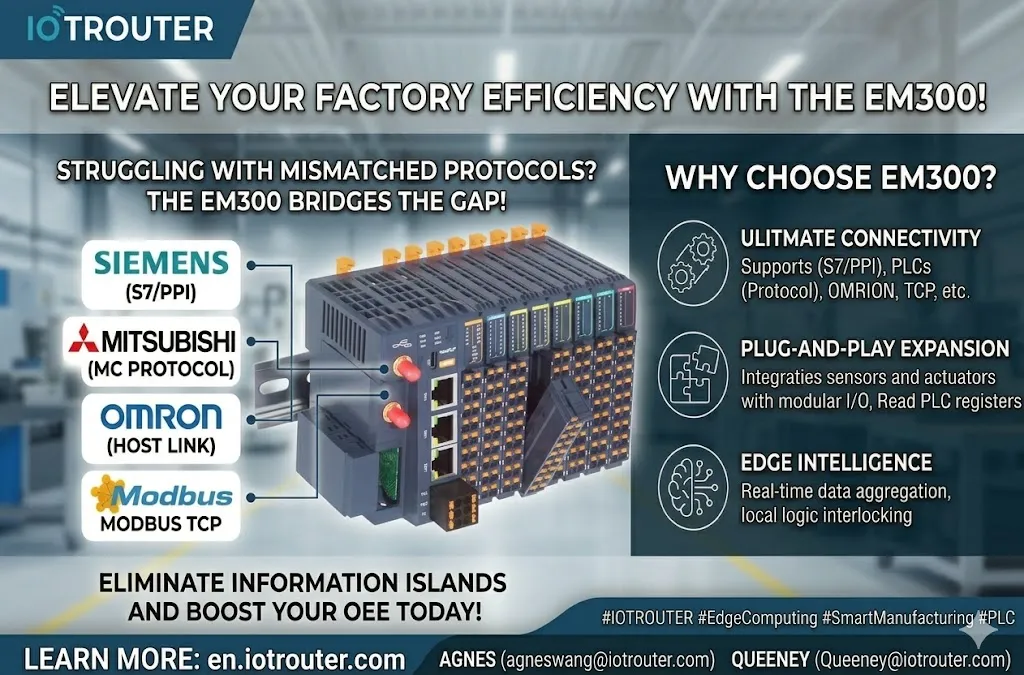
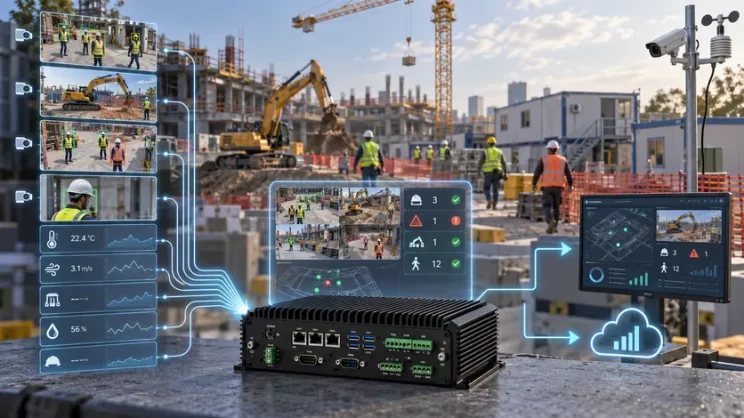
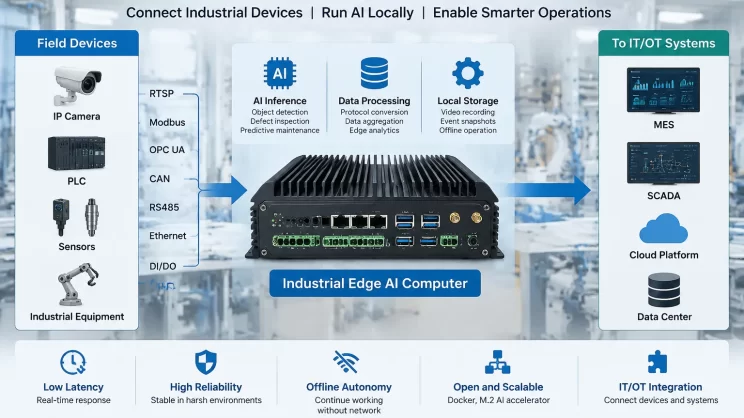
An industrial edge controller like the EM300 consolidates data acquisition, protocol conversion, network connectivity, and I/O expansion into a single DIN-rail-mounted device. It functions as both an IIoT gateway and an edge computing platform, handling data ingestion, processing, and transmission in one unified pipeline.
Six functional engines run concurrently: edge computing, visual programming (Node-RED), protocol conversion, industrial protocol stacks, industrial routing, and scalable I/O. Powered by an RK3506J triple-core ARM Cortex-A7 processor with 512MB RAM and 4GB eMMC storage.
Hardware costs decrease. The troubleshooting scope narrows to one device. Logs are centralized. Problem diagnosis becomes straightforward.
Simplify the architecture. Reduce the variables.
Speaking Every Protocol on the Factory Floor
Device diversity is the main reason data fails to move. OT to IT integration depends on the ability to translate between the many languages spoken on the factory floor.
The EM300 industrial edge controller’s protocol stack covers a broad range of industrial equipment:
- PLC protocols: Siemens, MELSEC, Omron, LS Electric, Allen-Bradley, Delta, and more
- CNC protocols: SIEMENS, MELSEC, Mazak, Heidenhain, Haas, KND, LNC, and more
- Industrial protocols: Modbus RTU/TCP, OPC UA, BACnet, IEC104, CJ188, DLT645, HJ212
- Network protocols: MQTT, HTTP, TCP, UDP, WEBSOCKET
Four independent RS485 ports, 3 Ethernet ports (1 WAN + 2 LAN), Wi-Fi 6, and a 4G module slot. Two built-in digital inputs and two digital outputs are included by default, with AI/AO available as optional expansions.
IEC104 support is a differentiator. In power utilities, energy storage, and microgrids, IEC104 is the standard between dispatch centers and substations. The EM300 connects directly to SCADA systems — no additional converter required.
Modular I/O: Build for Today, Expand Tomorrow
I/O estimation is a common source of project friction. Underestimate, and you need additional cabinets and rewiring. Overestimate and capital sits idle.
The EM300 industrial edge controller uses a blade-style modular I/O architecture. Users select DI/DO, AI/AO, and other signal types as needed, with support for up to 16 expansion modules. Modules are hot-swappable — added or replaced without powering down the system.
Installation uses push-in, tool-free terminals. In a cramped cabinet on a factory floor, this is a practical necessity. The ultra-slim blade-style modules greatly improve space utilization and deployment efficiency.
Remote Management: Fix Problems Without Traveling
Once edge computing hardware is deployed, the real costs begin. Process adjustments, fault diagnosis, firmware upgrades — each requires a site visit.
The EM300 addresses this through the IOTClient remote management platform. Remote configuration, debugging, diagnostics, and program updates are all supported.
Through intranet penetration and P2P direct connection technologies, remote device access feels as seamless as local operation. The EM300’s subnet proxy and network serial port functions enable devices to interconnect across physical and geographical boundaries. SD-WAN, VPN, and firewall capabilities are built in.
Reliability in Unattended Environments
Network disconnections are a fact of industrial life.
Automatic reconnection and intelligent data retransmission are supported at the hardware level. During network outages, data is cached locally. When connectivity is restored, it retransmits automatically — transparent to the upper-layer application.
Operating temperature: -40°C to +85°C with hardware watchdog protection. The device carries CE certification and meets ESD Level 3 (air ±8KV) and Level 2 (contact ±4KV) standards.
Application: Hydroelectric Station Multi-System Data Fusion
A hydroelectric station runs multiple monitoring systems — dam safety, unit condition, hydrological telemetry, gate control. Different vendors, different protocols, different data formats.
The EM300 industrial edge controller connects to all of them through its 4 RS485 ports. All data shares a single system clock — timestamps align across sources. When thresholds exceed limits, Node-RED triggers control logic directly.
PV + Storage + Charging Station Unified Access
A PV-storage-charging station includes inverters, BESS, chargers, meters, and a grid interconnection point. Protocols vary: Modbus RTU/TCP, IEC104, DLT645.
The EM300’s 4 independent RS485 ports are physically grouped by device type, each running at its own baud rate. Register maps for major inverter manufacturers are pre-configured. Energy scheduling runs locally. During outages, data caches locally and retransmits when connectivity returns.
Visual Programming Without Writing Code
The EM300 includes a deeply customized Node-RED environment. Visual drag-and-drop programming enables rapid construction of the complete “collection — transmission — control” workflow. This lowers the development barrier for field engineers and reduces project delivery time.
FAQ
1. What is the difference between an industrial edge controller and a PLC?
A PLC (Programmable Logic Controller) is primarily designed for real-time control of machinery and processes using ladder logic or structured text. An industrial edge controller, by contrast, combines control capabilities with data acquisition, protocol conversion, network routing, and cloud connectivity in a single device. While a PLC focuses on “control,” an industrial edge controller focuses on “control + data integration + remote management.” The EM300, for example, can read data from multiple PLC brands, convert protocols, and push data to the cloud — all while executing local logic through Node-RED.
2. How does an industrial edge controller improve data quality?
Data quality issues in industrial settings often stem from multiple devices running on independent system clocks, causing timestamps to be out of sync. An industrial edge controller consolidates all data acquisition and processing into a single device with a unified system clock. This ensures that data from different sources — PLCs, sensors, I/O modules — is timestamped consistently. The result is accurate sequencing for production traceability, equipment condition monitoring, and other time-sensitive applications. The EM300 also supports automatic reconnection and data retransmission during network outages, preventing data loss.
3. Does the EM300 support remote firmware upgrades?
Yes. When used with the IOTClient remote management platform, the EM300 supports remote configuration, remote debugging, remote diagnosis, and remote program updates. This means firmware upgrades can be deployed across distributed sites without on-site visits, significantly reducing maintenance costs and downtime.
Conclusion: Get Your Data to the Cloud First
Industrial digitization depends on one prerequisite: data must be reliably acquired, stably transmitted, and cleanly delivered.
An industrial edge controller like the EM300 is designed around a single objective: to reduce the complexity of edge implementation and maintenance. Wider protocol coverage means fewer integration steps. Complete remote operations mean fewer site visits. Flexible I/O means easier production line adjustments.
Its job is to get your factory data to the cloud — cleanly, completely, and in real time.
Get the data right. Then talk about digitalization.

Agnes Wang is an IoT Solutions Specialist at IOTRouter, focusing on industrial IoT gateways, edge computing, and industrial automation solutions.
She specializes in industrial communication technologies, including Modbus, IEC 60870-5-104, MQTT, OPC UA, PLC integration, and remote monitoring applications. She contributes to technical articles and application guides covering industrial IoT solutions, protocol conversion, and edge computing.