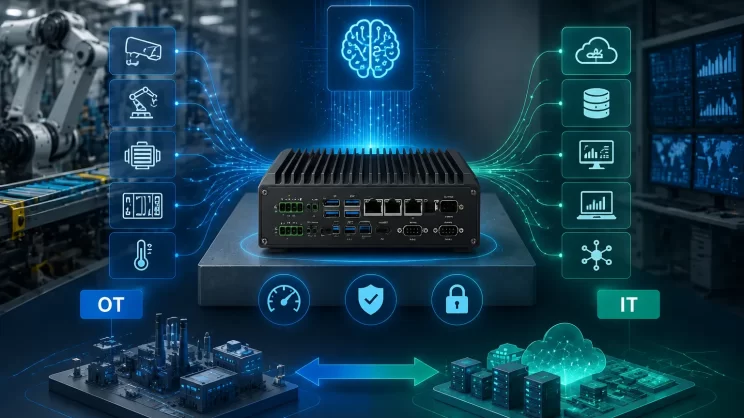
Speaking of the Internet of Things, are you both familiar and unfamiliar? Yes, from radio frequency technology that can be seen everywhere to smart wearables, smart appliances, and rapidly developing smart homes. Intelligent transportation, shared bicycles, drone transportation, smart medical care, etc. Behind these technological applications is the Internet of Things, but they are far from representing all of the Internet of Things.
The Internet of Things – this innovative Internet technology based on communication sensing technology and with unlimited potential for development- has set off the third wave of the development of the world’s information industry and will trigger huge changes in production and lifestyles. So how does communication sensing technology achieve such a powerful Internet of Things?
L'origine de l'internet des objets
Avant de comprendre l'internet des objets, nous devons d'abord établir une compréhension préliminaire des concepts et des technologies de l'internet des objets. La raison pour laquelle l'internet des objets est né est une cafetière. Oui, vous avez bien entendu. Il s'agissait d'une cafetière ordinaire située en bas du Truy Computer Laboratory de l'université de Cambridge en 1991. La cafetière ne pouvait pas informer intelligemment les scientifiques à l'étage. Pour savoir si le café est bien infusé, les scientifiques intelligents ont écrit un ensemble de programmes, installé une caméra à côté de la cafetière et utilisé la technologie de capture d'image de la caméra du terminal pour la transmettre à l'ordinateur du laboratoire à une vitesse de 3 images/seconde, de sorte que les scientifiques puissent vérifier si le café est bien infusé à tout moment. De manière inattendue, cette "invention de paresseux" est devenue le premier prototype de l'internet des objets.
In 1993, as the first X-Windows system case. The “Truy Coffee Pot Server” incident was also spread online. As far as network digital cameras are concerned, to be precise, their market development, technical applications, and various future network expansions all originated from the world’s most prestigious “Truy coffee pot”, so when was the concept of the Internet of Things proposed?
Proposition du concept de l'internet des objets
Eight years after the “coffee pot” incident, that is, in 1999, Kevin Ashton first proposed the concept of the Internet of Things at the Auto-ID Center of the Massachusetts Institute of Technology in the United States. The Internet of Things at this time only refers to relying on RFID technology and equipment. The agreed communication protocol is combined with the Internet to realize intelligent identification and management of item information, and realize the interconnection, exchange, and sharing of item information to form a network.
Historique du développement de l'internet des objets
À l'aube du XXIe siècle, l'internet des objets a commencé à se développer rapidement, et son processus de développement est passé par cinq étapes.
(1) In 2005, the International Telecommunication Union ITU released the “ITU Internet Report 2005: Internet of Things” at the World Summit on the Information Society (WSIS) in Tunisia, which applied the concept of “Internet of Things”. At this time, the definition and scope of the Internet of Things have changed, and it is no longer just IoT based on RFID technology.
(2) En novembre 2008, IBM a proposé le concept de "Smart Planet".
(3) En août 2009, "Perceiving China" a donné un coup d'accélérateur à la recherche et au développement d'applications dans le domaine de l'internet des objets dans mon pays. La ville de Wuxi a pris l'initiative de créer le centre de recherche "Perceiving China". L'Académie chinoise des sciences et l'université Jiangnan de Wuxi ont également créé une académie nationale, la première usine physique de l'IdO.
(4) En avril 2013, le gouvernement allemand a officiellement proposé la stratégie "Industrie 4.0" lors de la foire industrielle de Hanovre, visant à améliorer le niveau d'intelligence de l'industrie manufacturière. Sa base technique est constituée par les systèmes d'entités réseau et l'internet des objets.
(5) Le 8 mai 2015, le document "Made in China 2025" a été signé et publié. En tant que premier programme décennal de la China Power Strategy, la mise en œuvre approfondie de "Made in China 2025" a encore accéléré le développement des données massives (big data), des données massives (big data) et de l'Internet des objets. Applications dans la fabrication industrielle.
Si l'on examine le processus de développement de l'internet des objets au cours des 20 dernières années et son avenir, on peut le diviser grosso modo en trois périodes.
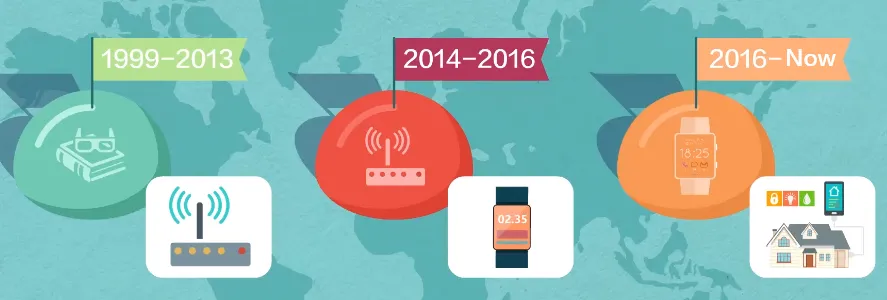
The first period is from the introduction of the concept of the Internet of Things to 2013. During this period, the Internet of Things remained in the conceptual stage, and the equipment involved was limited to “things” in the field of wireless radio frequency. The equipment involved is also limited to “things” in the field of wireless radio frequency. “thing”.
La deuxième période s'étend de 2014 à 2016. Cette période est marquée par l'acquisition de Nest par Google. L'internet des objets est passé des appareils à radiofréquences sans fil aux appareils intelligents à porter sur soi et aux appareils domestiques intelligents.
La troisième période a débuté en 2016 et se termine aujourd'hui. Au cours de cette période, les dispositifs portables et domestiques intelligents sont arrivés à maturité et sont entrés dans la vie quotidienne. Dans le même temps, la maturité de la technologie de l'IdO augmente rapidement, fournissant une base pour le développement de l'écosystème de l'IdO. Établir une bonne base pour la construction.
The freezing of the NB-IoT protocol marks a breakthrough for the Internet of Things at the wide-area connection protocol level. If analyzed from the perspective of our cloud-pipe-end system logic system, the trend of the cloud-pipe-end closed-loop completion of the Internet of Things has become more and more obvious. It is becoming more and more obvious, and we can even determine that 2016 is the first year of the Internet of Things ecosystem.
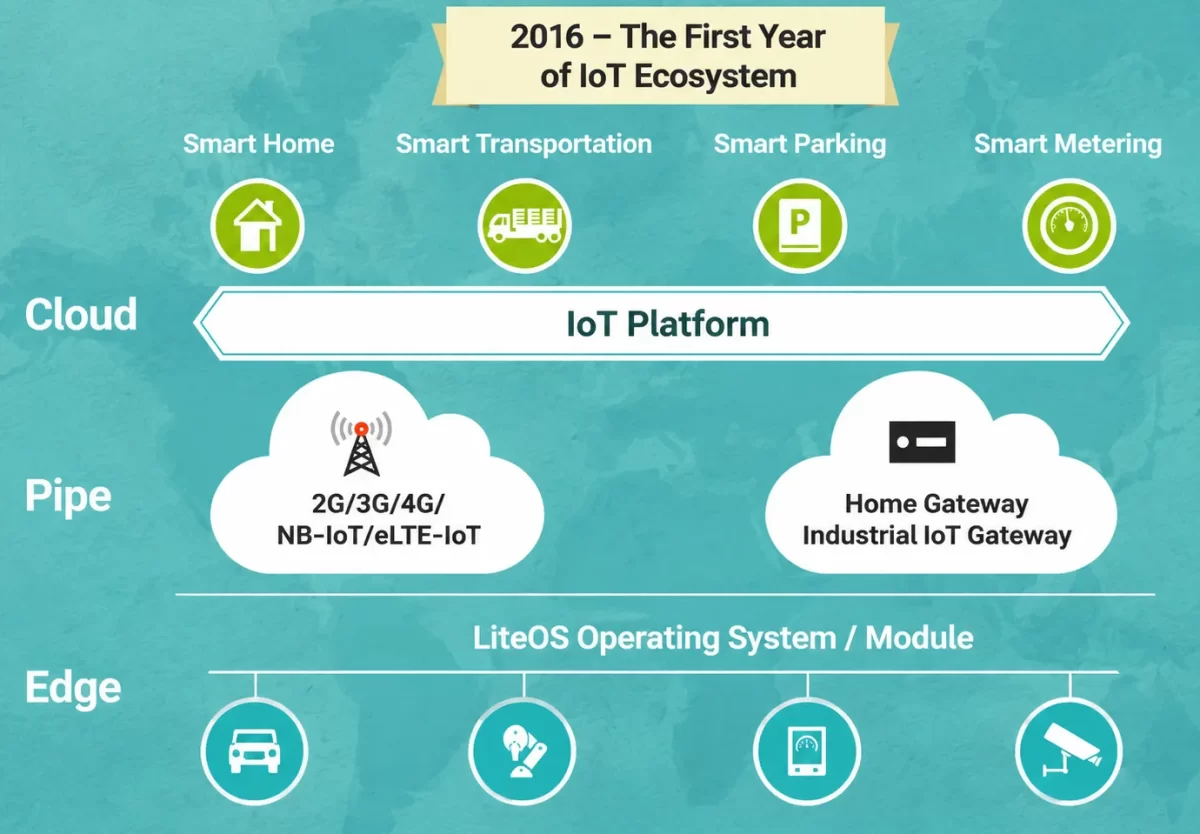
Couche IoT
From the perspective of the cloud-pipe-end logical system, the levels of the Internet of Things can be simply divided into four levels: perception layer, network layer, platform layer, and application layer. (For example, our company – Chengdu Zongheng Intelligent Control is at the network layer, and the company’s business is the research and development and production of Internet of Things data transmission equipment). Let’s use a picture to describe these four layers.
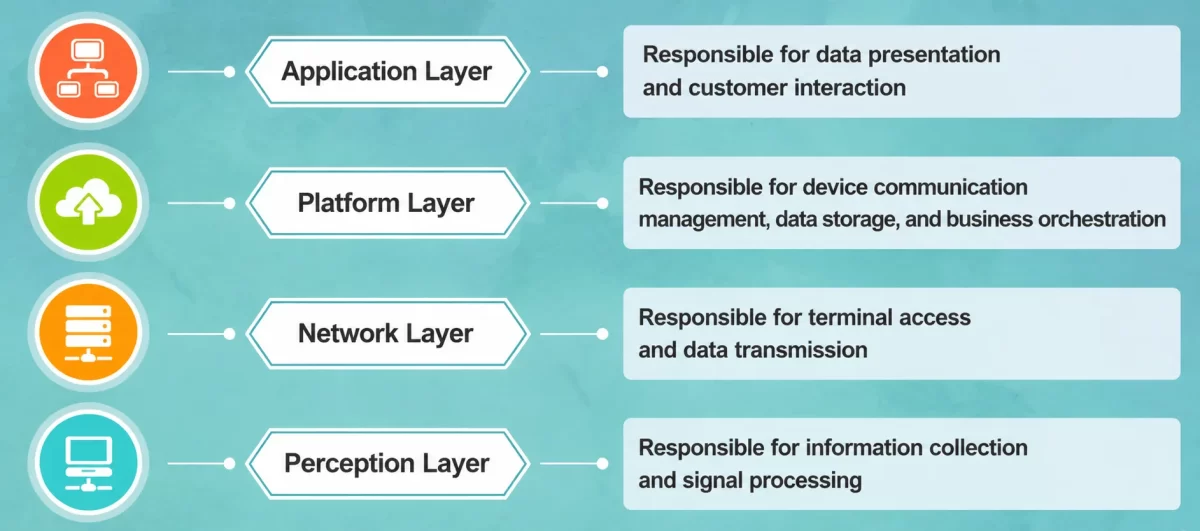
If further divided by vertical fields, the IoT industry applications can be simply divided into several major fields, such as industrial IoT, Internet of Vehicles, smart home IoT, etc. The communication used in IoT application scenarios in different vertical fields is not the same. Usually, the Internet of Things will adopt corresponding communication technologies based on business needs.
Here we list the business applications of wide-area wireless communication technology, such as Internet of Vehicles and video surveillance. Businesses such as Internet of Vehicles and video surveillance have high communication transmission rate requirements, usually above 100Mbps, and will use 4G, 5G, or LTE-V communication methods. These communication methods are characterized by low delay, fast speed, high power consumption, and high cost.
For services such as smart wearable devices, elevator networking, electronic advertising, and wireless ATMs that we have access to daily, communication methods such as eMTC and GPRS are usually used. The characteristics of these communication methods are that the transmission rate is around 1Mbps, with low latency and low cost. Power consumption is also lower.
Pour des services tels que la télérelève, les parkings intelligents et l'agriculture intelligente, NB-IoT sera utilisé pour la communication afin de répondre aux caractéristiques de faible coût, de faible consommation d'énergie, de faible coût et de large couverture.

Cet article nous a permis de comprendre l'histoire du développement et la division hiérarchique de l'internet des objets. Dans le prochain article, nous parlerons de la technologie de communication sans fil et comprendrons l'internet des objets d'un point de vue technique.