The Turning Point for Industrial AI: From Analytics to Action
At Hannover Messe 2026, the conversation around industrial AI shifted. More systems on the show floor were demonstrating AI-driven perception, decision-making, and adaptive control instead of traditional automation alone. As Siemens and other industrial leaders have been emphasizing, the real value of AI doesn’t lie in cloud-side analytics. It lies in the real-time decision-making capability that takes shape on the production floor.
Industrial AI is going through a directional shift: from back-office data analysis to real-time production-line decisions, from “observer” to “active participant.” The driving force behind this shift is Edge AI—moving AI inference from cloud data centers to the production floor, where it can perform real-time analysis and decision-making under lower latency and higher reliability.
Market data backs this up. According to QYResearch, the global AI edge controller market was valued at approximately USD 377 million in 2025 and is projected to reach USD 1.843 billion by 2032, with a CAGR of 25.8%. The broader edge computing and industrial AI markets continue to grow steadily, and the center of gravity for industrial computing is shifting from the cloud to the production floor.
But here’s the gap. Gartner projects that by 2026, 60% of AI projects will be abandoned due to a lack of “AI-ready data.” Rob McGreevy, Chief Product Officer at AVEVA, put it bluntly: the key challenge for industrial enterprises isn’t the algorithms—it’s the infrastructure. Operational data, engineering data, workflows, and compliance frameworks are rarely integrated systematically, making it difficult to scale AI deployment. In other words, AI doesn’t lack algorithms. What it lacks is the data pathway connecting those algorithms to the production floor.
IT/OT Integration: The Last Mile for Industrial AI
The biggest obstacle to industrial AI adoption is, at its core, the long-standing divide between IT (Information Technology) and OT (Operational Technology).
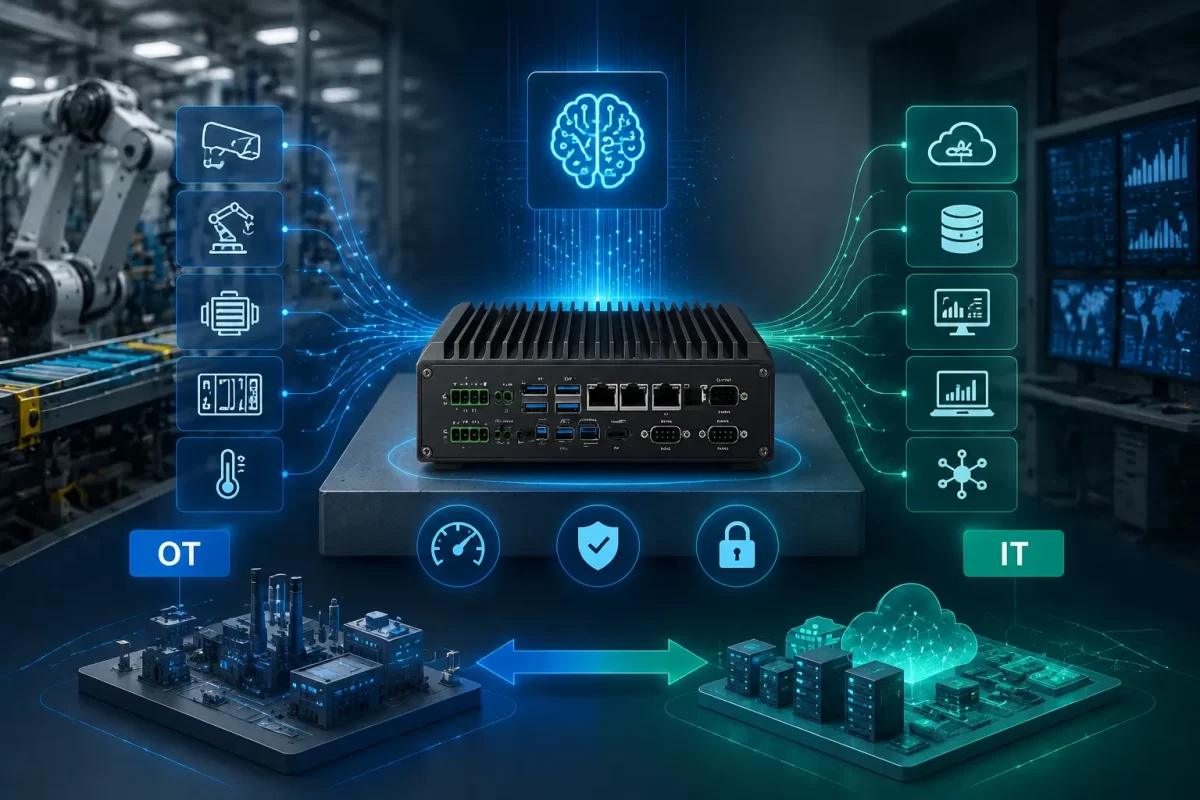
OT includes the physical control systems on the production line—PLCs, sensors, actuators, and robots—that ensure deterministic operation. OT data is scattered across a wide range of heterogeneous device ecosystems. IT, on the other hand, runs MES, ERP, cloud platforms, and AI model systems, processing massive datasets and driving high-level decisions. The problem is that these two worlds operate on fundamentally different priorities: OT demands determinism and reliability, while IT demands flexibility and scalability. As a result, the AI models and data analytics on the IT side struggle to directly reach the production floor and deliver real-time value.
Industrial edge computing plays a critical bridging role in IT/OT integration—connecting OT devices with IT applications so that field data can be captured, processed locally, and turned into intelligent decisions. Through local compute, secure data exchange, and cloud collaboration, it creates a complete pathway from field devices to smart decision-making.
Why Edge AI Matters: From Cloud AI to On-Site Intelligence
Traditional AI applications typically rely on cloud computing. The workflow is straightforward: device collects data → uploads to cloud → AI model analyzes → returns results. This model works fine for scenarios with large data volumes and low real-time requirements. But in industrial environments, AI faces a different set of challenges.
Edge AI addresses this by deploying AI inference at the edge—moving compute and inference capabilities closer to the equipment and data source, turning AI from a “cloud-side analytics tool” into “on-site real-time intelligence.”
It solves three key challenges in industrial scenarios:
1. Lower Latency
Machine vision, quality inspection, and motion control applications typically require millisecond-level response times. With Edge AI, data is analyzed near the equipment without a cloud round-trip, significantly reducing response time and enabling AI to participate directly in on-site decisions. By the time a cloud-processed result returns, the product may have already moved to the next process step.
2. Reliable Operation
Industrial network environments aren’t always stable. WiFi signals may be disrupted by metal structures, 4G/5G coverage may be insufficient, and network switches occasionally go down. Edge AI allows critical AI applications to continue running locally—even when cloud connectivity is temporarily lost—maintaining core production processes without interruption.
3. Sécurité des données
Manufacturing enterprises hold core asset data, including process parameters, equipment status, and quality inspection results. With local AI processing, raw data doesn’t need to be uploaded to the cloud in its entirety. Enterprises can keep sensitive data on-site and transmit only the necessary analysis results to upper-layer systems, significantly reducing security and compliance risks.
For Industrial AI Applications, Edge AI isn’t simply a “better option”—it’s the viable path forward. It’s a foundational architecture that lets AI truly adapt to the real-time, reliability, and security demands of industrial environments.
Industrial Edge Computing: The On-Site Compute Layer for Industrial AI Applications
As AI moves from the cloud to the industrial floor, enterprises need more than just AI models. They need an edge computing platform that can connect to equipment, process data, and run AI applications.
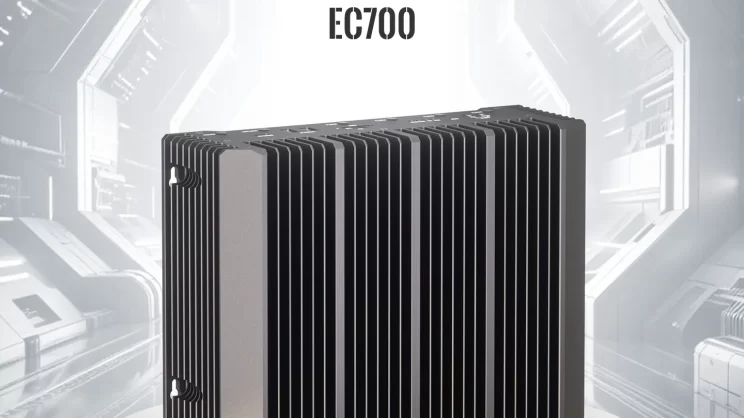
EC700 demonstrates how these capabilities can be integrated into a single industrial edge AI platform. It’s not replacing PLCs—it’s establishing a new intelligent compute layer at the IT/OT intersection.
Where PLCs handle real-time control, this platform addresses the new compute demands of the industrial AI era: enabling industrial device data to be captured, processed, and fed into AI inference on-site, providing the edge compute foundation for Industrial AI Applications. In the past, achieving this required a combination of industrial gateways, industrial PCs, and server or cloud computing resources. Today, these capabilities can converge into a single edge intelligence node.
1. The Value of an Open-Source ARM Platform
A key differentiator is the software layer. Unlike traditional closed industrial devices that lock users into fixed-function firmware, an open-source ARM Linux platform gives developers the freedom to deploy their own AI models, industrial applications, and container services based on project requirements. For industrial scenarios where requirements evolve, protocols upgrade, and models iterate, this openness matters—the platform can adapt over time rather than being replaced when needs change.
2. What Scalable AI Computing Actually Means
At the hardware level, the platform is built on the RK3588J industrial-grade ARM processor, with a built-in NPU that handles basic visual inspection, classification, and segmentation tasks. Beyond what a traditional industrial PC offers in data acquisition and application hosting, it adds local AI inference—enabling visual analytics, large model applications, and intelligent decisions to run directly at the device edge.
Through dual M.2 PCIe interfaces for AI accelerator modules, compute power scales from 6 TOPS to 320 TOPS. This scalable architecture lets enterprises upgrade computing capacity step by step as AI application complexity grows—without redeploying an entire hardware system. Many production lines adopt AI in phases: start with a visual defect detection pilot, then scale up to more complex models once results are validated. A single device and software environment that handles both stages is what production teams actually need.
3. Running Large Models on the Production Line
The platform supports deployment of large language models (LLMs) and vision-language models (VLMs) in the 1.5B–35B parameter range, including Gemma, Llama, and Qwen, through Docker containerized deployment. AI models, industrial applications, and service components can run independently and iterate quickly. Practical use cases include AI equipment assistants, industrial knowledge Q&A, maintenance support, and vision + language multimodal analysis—bringing intelligent assistance based on equipment data and enterprise knowledge bases to the factory floor, beyond traditional automation logic.
For example, when equipment triggers an alarm on the production line, engineers can use an on-site AI assistant to quickly get fault analysis references and handling recommendations based on equipment data and knowledge bases—instead of waiting for data to be uploaded to the cloud and results sent back. That’s Edge AI inference in action on the factory floor.
4. Protocol Connectivity and Data Pipeline
On the software ecosystem side, the platform supports Node-RED 4.0 for visual flow orchestration, NeuronEX for industrial protocol access and data acquisition, and FUXA for web-based SCADA monitoring and visualization. By supporting multiple industrial protocols and device connections, it can interface with different types of field equipment for unified data collection, then connect to MES or cloud platforms via MQTT, HTTP, and other industrial IoT interfaces. The full pipeline is closed-loop: field devices → data acquisition → edge processing → AI analysis → visualization → cloud systems.
5. Built for Industrial Environments
On the hardware side, the EC700 features fanless passive cooling with an aluminum alloy housing and large heat dissipation fins, operating across -20°C to 70°C, with photoelectric isolation and surge protection on the I/O side. These aren’t glamorous specs, but they’re exactly what production-line equipment needs: plug it in and keep it running.
What’s Next
The next phase of industrial AI isn’t about pushing more data to the cloud. It’s about bringing intelligence closer to where data is generated. Devices are evolving from “data sources” to “intelligent nodes”—capable of real-time perception, analysis, and decision-making through Edge AI.
Industrial edge AI computing platforms like EC700 are becoming essential infrastructure for IT/OT integration—connecting industrial equipment, running AI models, and driving on-site smart decisions for Smart Manufacturing. The future of manufacturing isn’t about generating more data from equipment. It’s about making sure that data is understood, processed, and turned into real-time action—in the right place, at the right time.