Introducción
Industrial equipment is often installed in locations where no wired network exists. Pump stations, remote cabinets, environmental monitoring sites, and production facilities often contain PLCs, meters, or sensors that communicate through RS232 or RS485 interfaces. However, these field devices still need a reliable way to exchange data with remote servers. Running fiber or Ethernet to every site is costly and sometimes impossible.
A 4G data transmission terminal, commonly referred to as a 4G DTU (Data Transfer Unit), provides these field devices with a wireless communication path to servers, SCADA systems, or cloud platforms. It transmits device data over LTE networks. In many industrial IoT projects, the DTU serves as the basic communication layer between field devices and remote systems.
What Is a 4G Data Transmission Terminal?
A 4G DTU is an industrial communication device that enables data transmission between serial devices and remote servers, SCADA systems, or cloud platforms over LTE networks. It is not a router, not a PLC, and not an edge computer. Its core role is to provide a reliable serial-to-IP data path.
Compared with edge computing devices, a traditional DTU focuses primarily on reliable data transmission rather than local processing or application execution. Some models offer limited I/O or protocol handling capabilities, but their core function remains communication.
How Does a 4G DTU Work?
A 4G DTU establishes a bidirectional data path between serial devices and remote systems. The basic chain is:
Industrial Device → RS485/RS232 → 4G DTU → 4G LTE Network → Server/Cloud Platform
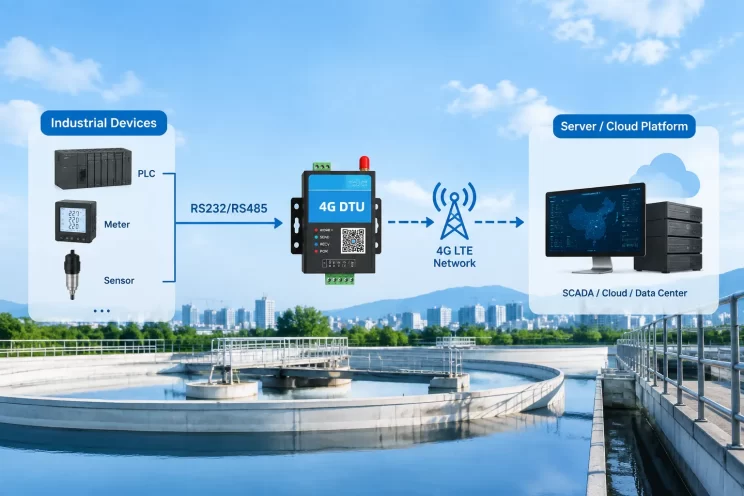
The communication process typically involves four steps:
-
The serial device sends data. The device sends data to the DTU through an RS232 or RS485 interface.
-
The DTU prepares the data. Depending on the configured communication mode, the serial data undergoes protocol conversion or data encapsulation before being transmitted over the IP network.
-
The DTU sends data over the cellular network. The data is transmitted over the 4G LTE network to the configured remote server or platform endpoint.
-
The server processes the data. The platform parses, stores, and displays the data. In applications that require bidirectional communication, remote commands can also travel back along the same path to the serial device.
Key Functions of a 4G DTU
Most 4G DTUs share the following capabilities, depending on the model and application:
Transparent Transmission. The DTU forwards the original data stream without parsing application-layer protocol content. Existing serial protocols do not need to be modified.
Serial Interface Support. Models provide RS485 or RS232 interfaces and are commonly used with Modbus RTU and other serial communication protocols.
Network Protocol Support. DTUs typically communicate with servers over TCP or UDP, and some models also support HTTP or MQTT.
Remote Configuration. Parameters such as server address, port number, baud rate, and heartbeat interval can be updated remotely without visiting the site. Some models also support remote firmware updates.
Link Reliability and Data Recovery. Heartbeat packets, registration packets, and auto-reconnect help maintain stable communication. Some models support local data caching to reduce data loss during network outages.
Where Are 4G DTUs Used?
The combination of low cost, simple deployment, and reliable wireless transmission makes 4G DTUs suitable for a wide range of industrial scenarios:
Industrial Equipment Monitoring. DTUs connect serial-based industrial devices, such as controllers, meters, and monitoring instruments, to remote servers or SCADA systems, enabling remote status monitoring and data access.
Energy Monitoring. In power distribution, renewable energy, and building energy management, DTUs are used to transmit data from smart meters, inverters, and power quality analyzers. Manufacturing plants can use DTUs to transmit data from distributed meters and monitoring devices to remote platforms, supporting energy analysis and management through remote data collection.
Water Monitoring. Water treatment plants, pump stations, and hydrological monitoring stations use DTUs to transmit data from level gauges, flow meters, and water quality sensors. Wireless capability is particularly valuable at unattended remote sites.
Environmental Monitoring. Air quality stations, emission monitoring systems, and noise sensors rely on DTUs to upload data to environmental monitoring platforms in real time. The wide coverage of 4G networks ensures connectivity even in remote monitoring locations.
Remote IoT Systems. From EV charging infrastructure to agricultural greenhouse control, from cold chain logistics to smart city infrastructure, DTUs provide the basic wireless connectivity layer that enables remote IoT applications.
4G DTU vs Industrial Gateway
In industrial IoT architectures, the 4G DTU is often compared with the industrial gateway. Both devices connect industrial equipment to networks, but they serve different roles.
| Dimensión | 4G DTU | Industrial Gateway |
|---|---|---|
| Main role | Data transmission | Data integration and processing |
| Compatibilidad con protocolos | Serial-to-IP communication | Multi-protocol integration |
| Local logic | Limited | Supports local processing |
| Processing capability | Lightweight | Higher computing capability |
| Typical applications | Remote monitoring and data transmission | Multi-device integration and edge applications |
The key difference is that a DTU acts as a communication channel, while a gateway is designed for broader system integration, including protocol conversion, local processing, and device management. Industrial gateways are typically selected when applications require additional capabilities such as protocol conversion, local data processing, or application-level integration. When the primary requirement is reliable serial data transmission over a network without complex data processing or application logic, a DTU is often the more suitable choice.
For applications that require more advanced data processing and programmable functions, see 4G DTU vs Programmable DTU/RTU: How to Choose the Right Industrial Communication Device.
Conclusión
The 4G Data Transmission Terminal is a foundational device in industrial wireless connectivity. It enables serial devices to communicate with remote systems over 4G networks. Whether used for equipment monitoring, energy management, water monitoring, or environmental sensing, 4G Data Transmission Terminals provide a practical communication solution for remote industrial applications. As industrial IoT continues to expand, 4G Data Transmission Terminals remain an important connectivity solution for distributed industrial applications.