Índice
ToggleThis article focuses on the working principles of the MQTT protocol and MQTT Protocol for Industrial IoT, and explains how MQTT gateways connect PLC devices to cloud platforms.
1. What is the MQTT Protocol?

MQTT (Message Queuing Telemetry Transport) is a lightweight publish-subscribe messaging protocol designed specifically for IoT communications.
In the traditional device-to-server communication model, each device maintains its own connection. However, this creates a problem: as the number of devices increases, server resource consumption grows accordingly.
MQTT replaces the traditional model with a publish-subscribe architecture. In the MQTT communication architecture, industrial devices act as data sources and publish data to an MQTT broker through MQTT publishers. The broker then forwards the messages to cloud platforms, SCADA, or other application systems based on subscription relationships. For more about how the MQTT broker handles message distribution, client management, and security, refer to related resources.
Devices no longer communicate directly with servers; instead, they publish messages to a broker. The broker routes these messages to any system that has subscribed to them.
This model makes data senders and receivers independent of each other. Devices only need to publish data, and cloud platforms or SCADA systems can subscribe to and use that data without needing a direct connection.
Main features of the MQTT protocol:
-
Minimal header: only 2 bytes, suitable for low-bandwidth and cellular network links
-
Configurable Quality of Service (QoS 0/1/2): from fire-and-forget to guaranteed once‑only delivery
-
Low overhead: devices can transmit efficiently even in constrained networks
For more in-depth features such as retained messages and session management, see our basic guide to the El protocolo MQTT para el IoT industrial.
2. The Importance of the MQTT Protocol for Industrial IoT
Unlike consumer IoT, industrial systems have stricter communication requirements. Industrial systems often connect thousands of field devices, so they need to ensure reliability and security while maintaining device compatibility. The MQTT protocol meets these needs well through several design features.
Lightweight communication
Industrial sites are often connected via cellular networks, especially in remote locations such as wind farms or water treatment plants. MQTT’s small packet size makes it suitable for bandwidth‑limited cellular networks. Compared with traditional HTTP‑based communication, it can significantly reduce bandwidth consumption—especially in scenarios with frequent telemetry updates.
Publish-subscribe model
In the traditional request-response model, clients need to actively request data, and the server returns a response. There is a direct communication relationship between devices and servers. As the number of devices grows, a large number of connections and requests increase the server load.
MQTT uses a publish-subscribe model. Devices act as data publishers, sending data to an MQTT broker; cloud platforms or SCADA systems obtain data by subscribing to the corresponding topics. Publishers and subscribers do not need to establish a direct connection with each other, which improves system scalability and flexibility.
Selectable message reliability levels for industrial scenarios
Different industrial applications have different requirements for data reliability. MQTT provides three QoS levels—0, 1, and 2—allowing engineers to choose the appropriate transmission method based on real‑time performance, network conditions, and data importance.
Convenient cloud integration
Major public cloud platforms and most private cloud deployments support MQTT communication. Industrial gateways or MQTT devices can connect to cloud platforms through standard interfaces, reducing the development work for protocol conversion on the cloud side.
The performance of MQTT under different network conditions and application loads further demonstrates its advantages in industrial IoT; for details, refer to Entender MQTT.
3. MQTT Architecture in Industrial IoT: Connecting Field Devices to Cloud Platforms
In industrial environments, large numbers of PLCs, sensors, and meters have been deployed for many years. Field protocols such as Modbus and BACnet are typically used for data acquisition and control, rather than native MQTT support.
A typical industrial MQTT architecture is as follows:
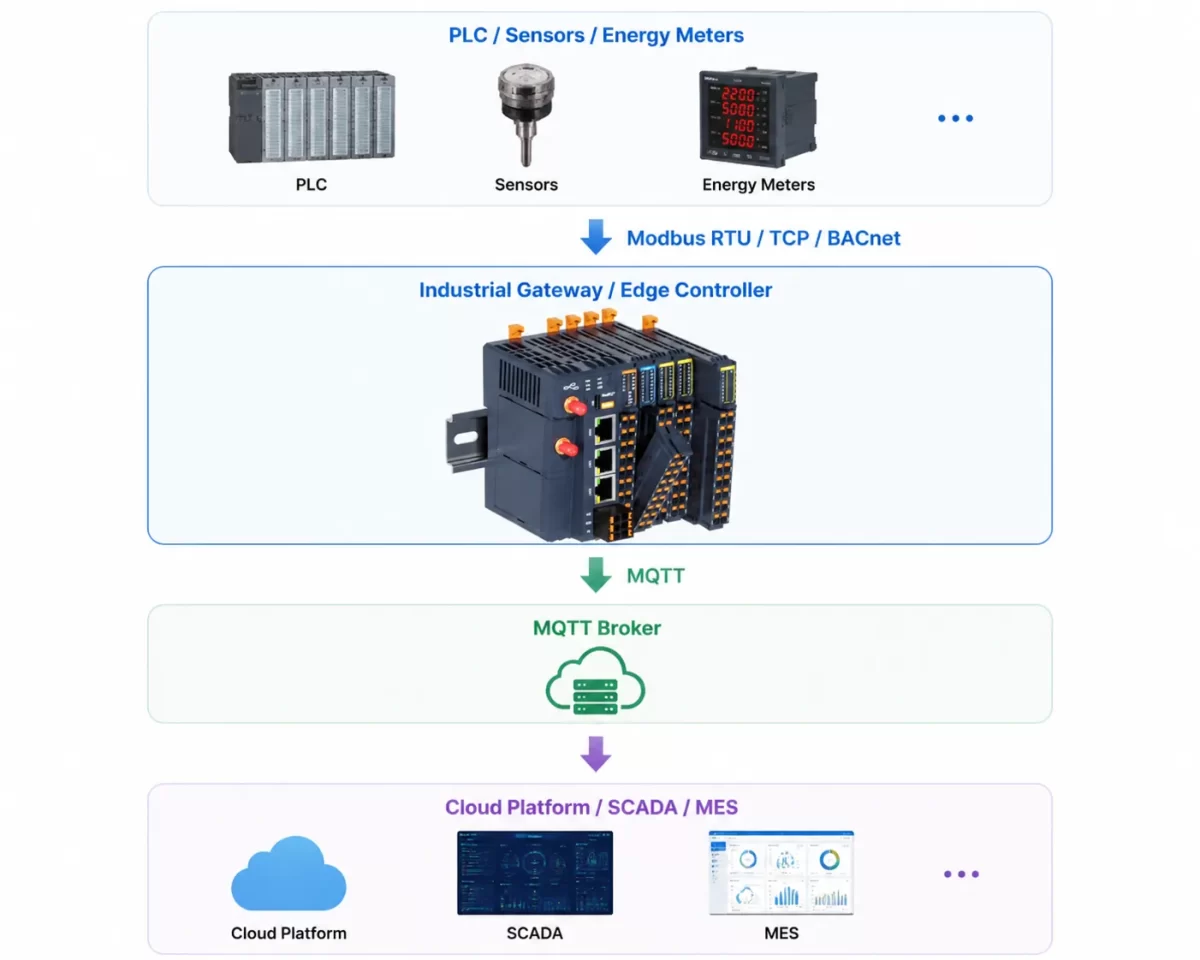
In this architecture, field protocols such as Modbus and BACnet still handle data acquisition and control on the device side, while MQTT is used to transmit the processed data to cloud platforms and upper‑layer applications. The industrial gateway sits between them, responsible for connecting field devices, performing protocol conversion, and converting field data into MQTT messages.
The industrial gateway mainly handles communication in two directions:
-
Southbound communication: connects to field devices via protocols such as Modbus RTU/TCP, BACnet, IEC 60870-5-104, etc.
-
Northbound communication: converts the collected data into MQTT messages and sends them to cloud platforms, SCADA, or other application systems.
This architecture allows traditional industrial systems to be connected to modern IoT platforms without modifying existing PLC programs or replacing field devices.
4. Application Scenarios of MQTT protocol for Industrial IoT
Let us look at scenarios where MQTT‑based industrial IoT architectures are actually deployed.
Fábricas inteligentes
PLC monitoring. In a factory, industrial gateways are deployed on production lines to collect device status, production cycle counts, and fault codes from PLCs, sensors, and actuators, and convert the data into MQTT messages published to a central broker. MES systems and cloud‑based OEE dashboards obtain real‑time data by subscribing to topics, enabling production monitoring and efficiency analysis.
Energy monitoring
Power meters connect to industrial gateways via Modbus RTU or DL/T645. The gateways collect real‑time energy consumption data and convert it into MQTT messages sent to the broker. The energy management platform subscribes to the data to monitor electricity usage, perform load analysis, and manage peak demand across multiple buildings or sites.
Water treatment and utilities
In distributed water systems, pumping stations and remote monitoring points are often located in remote areas. Industrial gateways collect flow, pressure, and water quality data through Modbus and sensor interfaces, and upload it via MQTT over cellular networks to the monitoring platform.
Remote equipment monitoring
OEM manufacturers use MQTT to monitor equipment already deployed at customer sites—compressors, generators, HVAC systems, etc. They publish operational data to the manufacturer’s cloud platform for predictive maintenance and remote diagnostics.
5. Comparison of MQTT and HTTP in Industrial IoT
MQTT vs HTTP: MQTT and HTTP have fundamentally different positioning in IoT communications:
| Característica | MQTT | HTTP |
|---|---|---|
| Communication model | Publish/Subscribe | Request/Response |
| Método de conexión | Persistent connection (TCP) | Stateless (each request independent) |
| Bandwidth efficiency | Optimized for low‑bandwidth telemetry | Generally higher overhead for frequent small messages |
| Data direction | Bidirectional push | Client‑initiated only |
| Real‑time updates | Native (push) | Requires polling |
For industrial telemetry scenarios with many devices and frequent data, MQTT is usually more suitable. HTTP is more applicable for REST API integration and batch upload scenarios.
6. How to Choose an MQTT Gateway
Choosing the right MQTT gateway comes down to five considerations.
Compatibilidad con protocolos
First, confirm the communication protocols used by the field devices, such as Modbus RTU, Modbus TCP, BACnet, IEC 60870-5-104, DNP3, DL/T645, or OPC UA. When selecting an MQTT gateway, ensure it supports the protocols required by the field devices; otherwise, additional protocol conversion equipment may be needed, increasing system complexity and maintenance costs.
Connectivity
Industrial sites usually have varying network conditions, so the gateway must support multiple connection methods depending on the application environment, such as Ethernet, Wi‑Fi, and 4G/LTE cellular networks. For remote areas or applications requiring high communication continuity, dual SIM and network failover capabilities can improve system reliability.
Edge computing capability
Whether the industrial gateway supports local data processing is also an important factor when selecting an MQTT gateway. Gateways with edge computing capabilities can filter, aggregate, and process data locally before uploading, sending only valuable data to the cloud. Through Node‑RED or Python‑based development environments, users can create custom data processing flows based on application needs, enabling local control and edge application deployment.
Security features
For industrial deployments, data security is non‑negotiable. When selecting an MQTT gateway, focus on TLS encryption for MQTT traffic, client authentication (username/password or certificate‑based), and secure network access.
Industrial‑grade reliability
Factory environments mean vibration, extreme temperatures, electromagnetic noise, and power fluctuations. Check for:
-
Operating temperature range (industrial grade typically -40°C to +70°C)
-
EMC protection and opto‑isolation for serial ports
-
DIN‑rail mounting suitable for distribution cabinets
-
Wide input voltage range (typically 9–36 V DC)
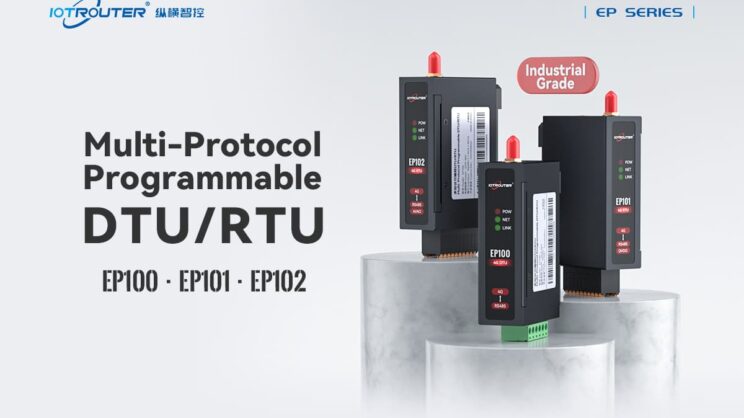
Devices such as the EM300 and similar industrial‑grade products are designed around these requirements, integrating multi‑protocol support with rugged hardware suitable for factory deployment.
Conclusión
MQTT solves the problem of efficient industrial data transmission, but the real challenge in industrial IoT is connecting existing PLCs, instruments, and control equipment to modern cloud platforms. Industrial MQTT gateways bridge this gap by converting data from Modbus, BACnet, IEC 60870-5-104, and other field protocols into MQTT messages, enabling traditional industrial equipment to communicate with cloud platforms, SCADA systems, and IoT applications.
The value of the MQTT protocol for Industrial IoT is not replacing existing equipment, but creating a reliable data connection between field devices and modern applications. Through the combination of MQTT protocols and industrial gateways, companies can unlock data from existing PLCs, sensors, and instruments to achieve remote monitoring, data analysis, and smarter industrial operations.

- iot-es
 11 de septiembre de 2026
 - iot-es