ARM’s business model
●ARM è responsabile solo della progettazione di circuiti integrati e della vendita della propria proprietà intellettuale (copyright).
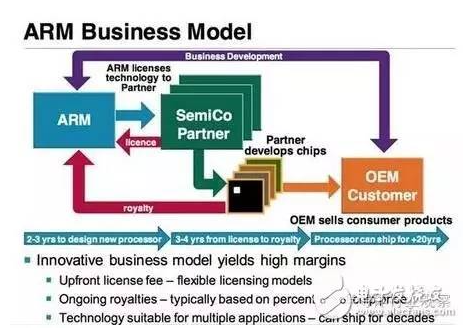
ARM non produce chip in proprio, ma concede in licenza la proprietà intellettuale dei progetti ad altri produttori di semiconduttori per la produzione di chip.
A rigore, ARM non è un produttore di semiconduttori.
Unlike Intel, ARM is also a fabless semiconductor company. This is the same as NVIDIA and AMD after selling the wafer factory. However, ARM does not produce any processors itself. It mainly provides IP licenses to semiconductor partners ( Qualcomm, Apple, AMD, and Samsung, etc.); the latter use ARM’s architecture, design, and development tools to launch their own processors, and then supply them to OEM customers (this is the case for various mobile phone and tablet manufacturers). This is a simple. For example, there may be a second authorization during the period.
I ricavi di ARM derivano da questo ciclo. I partner che acquistano la licenza IP di ARM devono pagare una tassa di licenza tecnologica (tassa di licenza), e inoltre estrarranno una certa quantità di royalties (royalties continuative, che possono anche essere definite come commissioni e spese di franchising) basate sul prezzo del processore del produttore. ecc.
In parole povere, il modello commerciale di ARM è "tu paghi, io autorizzo". La progettazione e lo sviluppo dei processori sono "insegnamento e riunione inclusi", e verrà fornita una serie di strumenti per aiutare i clienti a semplificare lo sviluppo.
ARM’s business model is very unique, at least now, it is very different from the PC market. In the PC market, Intel dominates the development of the platform, and its products generally occupy the largest BOM material cost. In the smartphone and tablet market, the main processor typically accounts for a single-digit percentage of the total device BOM cost—significantly lower than Intel’s dominant position in the PC market, where Intel processors often represent the largest single BOM component. Intel’s theory is that ultra-portable mobile devices will eventually change as chip complexity increases, but so far (and perhaps for some time in the future), the market still requires different business models.
Come funziona ARM?
As mentioned earlier, ARM’s business model is mainly to provide IP licensing. ARM also said that it can provide a variety of flexible licensing types. Specifically, there are three licensing methods: POP, processor, and architecture licensing.
Processor licensing refers to authorizing a partner manufacturer to use ARM-designed CPU or GPU processors. The other party cannot change the original design, but can use it accurately according to its own needs. For example, Samsung’s Exynos 5 Octa uses four Cortex-A7 and four Cortex-A15 processors, which is processor authorization. ARM will provide a series of guidelines to ensure that users use their designs, but in the end, the frequency and power consumption of the product still depend on the manufacturer’s own team.
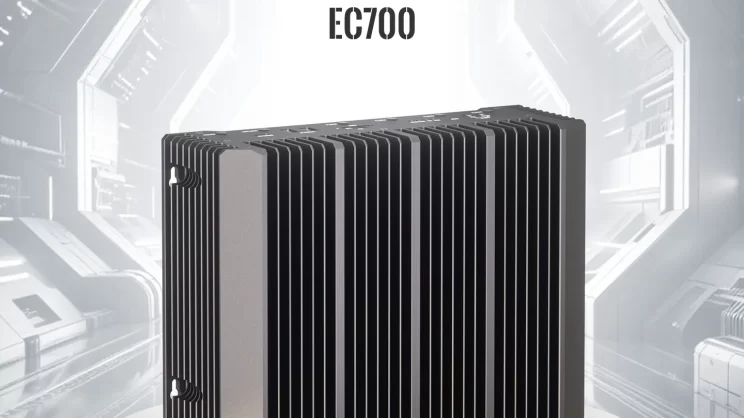
While chip designers build custom silicon using these licenses, system integrators leverage such robust architectures to build ready-to-deploy hardware. For instance, projects requiring high-end data acquisition and local intelligence often rely on open-source ARM-based AI Edge Computing Industrial PCs to run complex workloads directly at the edge.
POP (processor optimization pack, processor optimization package) authorization is an advanced method of processor authorization. If the partner’s team cannot control the ARM processor, then ARM can also sell the optimized processor to you, so that users can process with guaranteed functions that have been planned and produced using technology. In the Cortex-A8 era, Samsung and Apple teams were able to develop better processors than other companies, but not all companies have such capabilities, so POP licensing is more suitable for these companies that are willing but powerless.
L'architettura Cortex-A12 rilasciata da ARM è un metodo di licenza POP sotto il processo a 28 nm di GF e TSMC.
The last authorization method is architecture authorization. ARM will authorize the other party to use its own architecture (ARMv7 or ARMv8), and then the other party can design the processor according to its own needs. This is the authorization method used by Qualcomm Krait processors. Apple now uses the same approach for the “Swift” architecture. These processors are ISA compatible with ARM’s own planned Cortex-A15 processor, but there are Qualcomm’s and Apple’s own implementation methods.
In questo tipo di autorizzazione, riceverete alcune indicazioni e una serie di test per verificare la compatibilità con l'ISA ARM. ARM fornirà una certa assistenza, ma non potrà aiutarvi a progettare e sviluppare il vostro processore.
Come fa ARM a guadagnare?
Intel, AMD, and NVIDIA all make a living by selling processors. ARM does not sell any processors. It mainly relies on technology licensing fees and royalties. Manufacturers have to pay these fees. Both of them are different in processor architectures. The share is also different.
Technology licensing fees are charged based on the complexity of the chip architecture, and the old ARM11 is much cheaper than the latest Cortex-A57. Technology licensing fees are generally between US$1 million and US$10 million, although the actual situation may be higher or lower than these two figures.
The royalty commission is based on the share. The typical share is 1-2% for legacy architectures, but for the newer ARMv9 architecture, the rate is approximately 2-4.5%, about double that of ARMv8. For more advanced offerings like CSS (Compute Subsystems), the rate can reach 8-10%.
Quota di royalty per le diverse PI
La quota di royalty delle diverse licenze IP di ARM è riportata qui sopra. La maggior parte di esse si aggira intorno a 1-2TP3T. La quota di 0,5% delle licenze POP non è calcolata in base al prezzo del chip. Viene raccolta dalla fabbrica di wafer. Il calcolo è di 0,5% per wafer.
In generale, sono necessari 6 mesi per la firma del contratto da parte di entrambe le parti e il periodo che intercorre tra l'ottenimento dell'autorizzazione tecnica e la prima spedizione in grado di generare ricavi è di 3-4 anni. A seconda delle diverse condizioni di mercato, i produttori possono continuare a spedire per circa 20 anni.
ARM collaborates with more than 1,000 partners worldwide. The company has approximately 320 licensees, with the majority actively paying royalties. ARM continues to add 30-40 new authorized manufacturers annually.
In FY2026, royalties accounted for approximately 53% of total revenue ($2.61 billion), while licensing and other revenue accounted for approximately 47% ($2.31 billion).
ARM’s operating conditions are good. In fiscal year 2026 (ended March 31, 2026), ARM achieved record-breaking results with total revenue of $4.92 billion, up 23% year-over-year—the company’s third consecutive fiscal year with revenue growth exceeding 20%.
Royalty revenue reached $2.61 billion, and licensing revenue reached $2.31 billion. In the fourth quarter of FY2026 alone, revenue hit $1.49 billion, up 20% year-over-year.
However, because of ARM’s unique business model, its non-GAAP gross profit margin is approximately 97-98%, and its non-GAAP operating margin is around 53%. This ultra-high margin profile is a direct result of ARM’s asset-light IP licensing model.
Tipi di autorizzazione e selezione
Sebbene siano stati menzionati in precedenza i tre tipi principali di licenze fornite da ARM, le licenze fornite da ARM sono una serie di licenze complesse.
Academic licenses are free, but you cannot sell processors of any size, but it is still good for learning architecture in universities or research institutes. DesignStart is also a low-cost licensing option, but of course, you can’t sell the designed chips to make a profit.
For those situations where only a single application is required, ARM provides a Single Use license. A general Cortex-A grade CPU license typically costs between $1 million and $10 million, depending on the complexity of the architecture.
Multi-Use makes sense for large companies. Although you need to pay more license fees, you can use the CPU license in any product within a certain period (such as 3 years), unless the license expires; otherwise, you can use it on any product at will.
Subscription license is one of the most interesting of several licensing methods. Customer companies can spend a sum of money to purchase a complete set of licenses from ARM. This kind of license is suitable for engineering managers who do not need to worry about the budget to develop a new chip development plan. Of course, the price is more money, and the technology license fee is at the $10 million level.
The top one is architecture authorization, which has been introduced before. Currently, 15 companies, including Marvell, Qualcomm, and Apple, have architecture authorization.
Another thing to mention is the three early-stage cooperative development partners selected by ARM. Since ARM itself does not sell any chip products, it needs to ensure that each generation of products has partners that release processors based on ARM’s latest and best architecture.
Therefore, they will choose three manufacturers to cooperate closely with. The purpose of selecting these manufacturers is that as they expand the market, we tend to focus on high-end smartphone/tablet SoC processors, but ARM has also found its advantages in industrial applications, digital homes, smart TVs, and other markets.
The three selected partners can obtain earlier processor architecture information than other authorized manufacturers. They help with testing and debugging and even provide direct feedback to ARM. The advantage they gain is that they have a better market advantage than other companies.
New Licensing Models: ATA and AFA
In recent years, ARM has introduced two additional licensing models to better serve the evolving market:
Arm Total Access (ATA) is a subscription-like model where customers get access to a large portion of ARM’s technology portfolio for a multi-year period. This model is particularly popular among large technology companies—as of Q4 FY2026, ARM has 56 ATA contracts, with annual fees increasing 7% and renewed every three years. Over 50% of ARM’s top 30 customers are now on ATA.
Arm Flexible Access (AFA) is a “pay-as-you-go” model that offers access, design rights, and support, with manufacturing fees due only at tape-out. This model is ideal for smaller companies and startups. As of Q4 FY2026, ARM has 329 AFA customers.
ARM’s New Chapter in 2026: From IP Licensing to Silicon
Su March 24, 2026, ARM announced a historic shift in its business model: the launch of its first self-designed chip, il ARM AGI CPU. This marks the first time in ARM’s 35+ year history that the company has produced its own silicon product.
The ARM AGI CPU is:
-
Built on TSMC’s 3nm process
-
Equipped with 136 Arm Neoverse V3 cores
-
Running at up to 3.7GHz con 300W TDP
-
Co-developed with Meta as the primary partner and first customer
-
Designed for AI datacenter workloads, with per-rack performance over 2x that of x86 platforms
Customer demand for AGI CPU has already exceeded $2 billion for FY2027-FY2028—more than double what was announced at the launch event. ARM’s CEO expects the AGI CPU business to reach over $2 billion in scale within two years and to become operationally profitable next year.
This marks a fundamental evolution of ARM’s business model: from pure IP licensing → to CSS (Compute Subsystems) → to self-produced silicon. ARM now offers customers three ways to access its computing platform: IP, Compute Subsystems, and silicon—all while maintaining a unified architecture and software ecosystem.
(2026 Updated)