Let’s talk about wireless communication technology in this article. When it comes to wireless communication in the Internet of Things, I believe most people are familiar with it, such as 2G, 3G, 4G, WIFI, Bluetooth, and other common technologies in life. Wireless communication technology is widely used in smart homes, smart transportation, and other industries. Let’s learn about wireless network communication technology. We first introduce two types of wireless communication methods: long-distance cellular mobile communication and short-distance wireless communication.
Long-range – cellular mobile communications
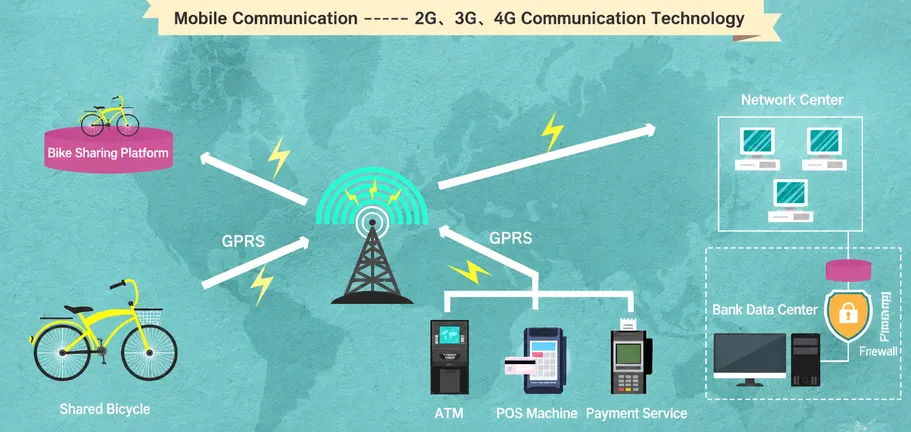
The first type of wireless communication technology is cellular mobile communication, which usually refers to what we often call 2G, 3G, and 4G communication technologies. At present, most Internet of Things terminal equipment access uses the GPRS communication method, which is often called 2G. One of the technologies, such as the network access of many shared bicycles and the network access of POS machines, is through GPRS. (Long-distance is more than just 2G, 3G, and 4G, and we will talk about others below)
Short-range wireless communication technology
The second category is short-distance wireless communication methods, such as Bluetooth, WIFI, ZigBee, Z-Wave, etc. First, let’s talk about Bluetooth.
(1) Bluetooth
Bluetooth is a high-capacity short-range wireless digital communication technology standard. Created by telecommunications giant Ericsson as an alternative to RS232 data lines, Bluetooth can achieve short-distance communication between fixed devices, mobile devices, and building personal area networks. Data interaction mainly uses radio waves in the ISM band of 2.4-2.48GHz, with a maximum data transmission rate of 1Mbps and a maximum transmission distance of 10 cm to 10 meters (the transmission distance can reach 100 meters by increasing the transmit power)
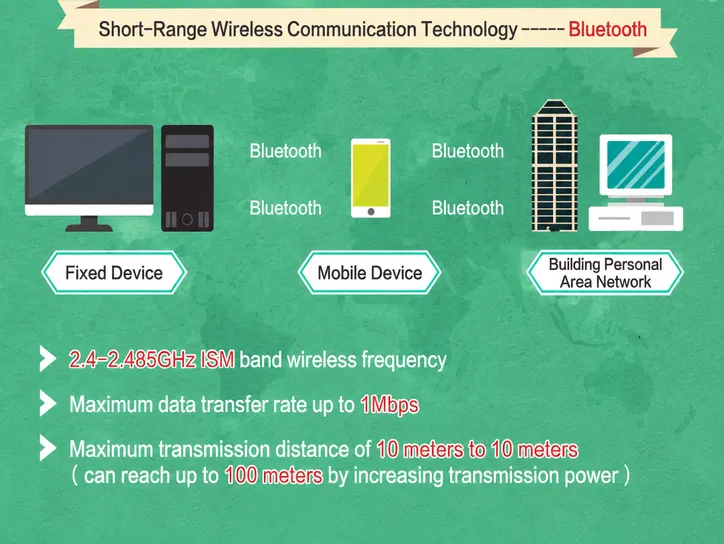
Common applications of Bluetooth include, in addition to mobile phones, Bluetooth headsets, speakers, smart wearables, and home appliances, all of which communicate through Bluetooth networking. Bluetooth communication is characterized by fast speed, low power consumption, and high security. But there are also disadvantages; that is, the Bluetooth network has few nodes and is not suitable for multi-point control.
(2) Wi-Fi
The second thing to introduce is Wi-Fi. Wi-Fi is familiar to everyone. It is a technology that allows electronic devices to connect to a wireless local area network (WLAN). It usually uses the 2.4 GHz UHF or 5 GHz SHF ISM radio frequency band. Connecting to a wireless LAN usually It is password protected, but it can also be open. When open, any device within the WLAN range can be connected. Wi-Fi plays an important role in our lives. Personal PCs, mobile phones, and many terminals can pass through Wi-Fi access Wi-Fi. Wi-Fi has wide coverage and a fast data transmission rate, but Wi-Fi transmission security is not good, stability is poor, and power consumption is slightly high.
(3) ZigBee
So what is ZigBee technology? Among short-distance wireless communication technologies, ZigBee is also a technology that is widely used in the Internet of Things. ZigBee is a low-power local area network protocol based on the IEEE802.15.4 standard. ZigBee is different from cellular mobile communications in that ZigBee is widely used in industry and the smart home field; ZigBee has the characteristics of being simpler, easier to use, reliable operation, and low price.
Mobile communications are mainly built for voice communications. The value of each base station is generally more than one million yuan, while the ZigBee “base station” is less than 1,000 yuan. Each network node can not only be used as a monitoring object, but also the network node it is connected to. The sensors directly collect and monitor data, and can also automatically transfer data transmitted from identified network nodes.
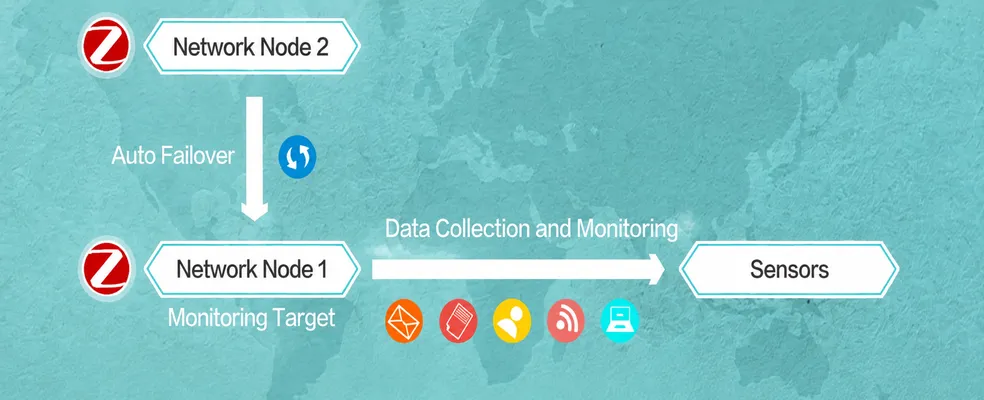
In many IoT applications, ZigBee is used for communication. In some terminals of functional home appliances, including some IoT solutions converged through gateways, ZigBee is used in downlink communication. ZigBee technology is a short-distance, low-speed, power-consuming wireless communication technology characterized by short distance, low complexity, self-organization, low power consumption, and low data rate.
Although ZigBee can reach hundreds of meters in point-to-point open scenes, in some application scenarios, such as smart parking scenarios, when a large object like a car blocks the signal, the signal attenuation will be very severe, and the compatibility of different ZigBee chips is poor. ZigBee network is more flexible and difficult to maintain.
(4) Z-Wave
Z-Wave is an emerging radio frequency-based, low-cost, low-power, high-reliability short-distance wireless communication technology. Z-Wave is a wireless networking specification led by the Danish company Zensys. The Z-Wave Alliance: The members are all manufacturers that already have current products in the smart home field. The alliance already has more than 160 internationally renowned companies, covering basically all countries and regions around the world.
Z-Wave technology is designed for residential, lighting, and commercial control, and status reading applications such as meter reading, lighting and appliance control, access control, burglary and fire detection, etc. The effective coverage range of Z-Wave signals is 30 m indoors and can exceed 100M outdoor, making it suitable for narrowband applications.
The advantage of Z-Wave communication is that the Z-Wave network structure is simple, with low power consumption, low cost, and high reliability. The disadvantage is that the speed is low and the standard is not open. The chip can only be obtained from Sigma Designs, the only source.
Otros
Long-distance transmission and NB-IOT. If you want to know about the NB-IOT network, please click >> NB-IoT to learn more!