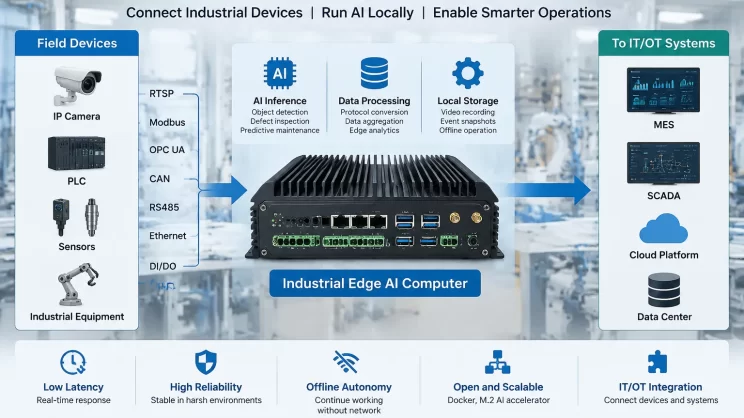
As edge AI extends from vision to the local deployment of LLMs and VLMs, M.2 AI accelerators are becoming a practical way to add additional inference performance to an edge AI computer without replacing the entire platform. But selecting the right accelerator is not simply a matter of comparing TOPS, memory, PCIe data flow, and thermal design. Other factors, such as software compatibility and the actual workload, can also influence real-world performance. So what do you really look at when you pick an M.2 AI accelerator for edge AI?
1. Start With the Workload, Not the TOPS Number

Before comparing accelerator cards, define what the system actually needs to do.
A single-camera object detection project and a local LLM deployment may both fall under the broad category of edge AI, but the hardware requirements are completely different.
For a vision application, the real questions are usually practical ones. How many video streams are there? What resolution and frame rate are required? Where will video decoding and preprocessing take place? What is the acceptable end-to-end latency?
An LLM or VLM raises a different set of questions. Model architecture, parameter count, quantization, context length, concurrency, and expected token generation speed all affect the hardware requirements.
Parameter count is useful, but only as a rough reference.
A 7B model is not a hardware specification. Two models with similar parameter counts may behave differently because their architectures, memory-access patterns, and runtimes are different. Dense models and Mixture-of-Experts models are an obvious example: total parameter count alone does not describe how much computation is active for every token.
Quantization changes the picture again. Reducing model precision can substantially lower memory and compute requirements, but the exact result depends on how weights, activations, and runtime data are handled.
So instead of starting with “How many TOPS should we buy?”
A better sequence is: Workload → Model → Performance target → Memory and compute requirements → Hardware. That sounds simple, but it avoids a surprising number of bad hardware decisions.
2. For Local LLM Deployment, Memory Can Matter as Much as Compute
TOPS has traditionally been one of the headline specifications for AI accelerators, especially in computer vision.
With LLMs and VLMs, memory becomes much harder to ignore.
The accelerator has to hold model weights, but that is only part of the memory requirement. Runtime overhead, intermediate tensors and KV cache also consume memory. Longer context windows and additional concurrent users increase the requirement further.
This is why two M.2 AI accelerators with impressive compute specifications can still be suited to very different workloads.
A card with relatively little local memory may work well for vision inference or smaller models. A card with much more accelerator memory can support a different class of generative or multimodal workload, provided that the software stack supports the model.
If the complete working set does not fit in accelerator-local memory, that does not automatically mean the model cannot run. Some systems can use host-memory offloading, split the model across devices, or use other memory-management techniques.
There is a trade-off, though.
Moving data between host memory and accelerator memory adds overhead. Multi-device execution also makes the software architecture more complex. In both cases, the model may technically run while delivering much less attractive latency or throughput.
For local LLM deployment, model compatibility is only the starting point. The accelerator still needs to meet the application’s requirements for generation speed, context length, and concurrency. In practice, that depends on compute capability, accelerator memory, memory bandwidth, quantization, and runtime memory usage.
3. PCIe Bandwidth Matters, but There Is No Universal x4 Rule
O M.2 specification is another area where specifications are easy to oversimplify.
An M.2 slot does not automatically tell you which bus is available, how many PCIe lanes are connected or which PCIe generation is implemented. Keying and physical compatibility also do not guarantee that the electrical interface matches the accelerator.
So yes, checking the host datasheet matters.
But the common advice that a high-performance AI accelerator must always use PCIe x4 is too simplistic.
What matters is the data flow between the host processor and the accelerator.
Suppose an accelerator has its own local memory. The model is loaded onto the accelerator, most inference stays there, and the host mainly sends input data and receives results. In that architecture, the amount of traffic crossing PCIe may be relatively limited.
Now consider an edge AI computer processing several high-resolution camera streams. Video is decoded and preprocessed on the host, and frames are continuously transferred to the accelerator. PCIe bandwidth becomes much more important.
The same applies when part of a model runs on the CPU and another part runs on the accelerator. Frequent transfers of intermediate tensors can quickly change the bandwidth requirement.
Multi-accelerator systems add another layer of complexity because model partitioning and inter-device data movement may affect performance as well.
PCIe should therefore be evaluated against the actual system data flow rather than the TOPS number alone. What matters is where the data originates, where preprocessing is performed, where inference runs, and how much traffic moves between the host and accelerator during operation. Those factors usually tell you more about whether PCIe will become a bottleneck than the lane count by itself.
4. Sustained Performance Depends on Power and Thermal Design
An AI accelerator does not operate by itself.
Inside an industrial edge computer, it shares the thermal environment with the CPU, memory, storage, communication modules and other electronics.
That matters because industrial installations rarely have the cooling conditions of a laboratory bench or data center server.
Edge AI computers may be installed inside control cabinets, equipment enclosures, production machinery, roadside cabinets or other spaces with limited airflow. In these environments, a short benchmark does not necessarily represent sustained performance.
As temperature rises, a processor or accelerator may reduce its operating frequency to remain within thermal limits. The theoretical TOPS rating has not changed, but actual inference throughput can fall.
The effect becomes more important as accelerator power increases or when more than one compute module is installed.
For that reason, power and thermal design should be evaluated at the system level.
Do not look only at the accelerator’s nominal power rating. Consider the CPU, AI module, storage, cellular modem and other components that may be active at the same time. The module’s own operating-temperature specification and cooling requirements also need to be checked separately from the base computer’s temperature rating.
A dual-accelerator configuration may have twice the theoretical AI compute of a single-card configuration, but that does not automatically mean the complete system will sustain twice the inference performance at every ambient temperature.
For a real industrial AI project, sustained testing under the expected workload and environment is more useful than a short peak-performance benchmark.
5. The Software Stack Often Determines Integration Time
This is one of the easiest parts of AI accelerator selection to underestimate.
The hardware can be installed in minutes. Getting the target model running properly may take much longer.
Dedicated NPUs and AI accelerators normally use their own model converters, compilers, quantization tools, runtime libraries, drivers and SDKs.
A PyTorch model or ONNX file is therefore not necessarily something that can simply be copied onto an accelerator and executed.
Model conversion may be required. Unsupported operators may need workarounds. Quantization can affect model accuracy. New architectures may not yet have the same level of support as mature CNN models.
The operating system also matters. A technically capable accelerator is not very useful if its runtime or driver does not support the Linux distribution and CPU architecture used by the target edge AI computer.
Then there is maintenance.
Industrial systems often remain in service for years, while AI frameworks and model architectures change quickly. An accelerator with a healthy SDK, active runtime development, and documented deployment examples is usually a safer long-term choice than hardware with an impressive specification but a stagnant software ecosystem.
That is why we recommend testing the actual model before the hardware configuration is finalized.
For vision workloads, measure the real end-to-end pipeline rather than only NPU inference time. Camera input, decoding, preprocessing, inference and post-processing all contribute to latency.
For LLMs, useful measurements include time to first token, generation speed, memory consumption and performance at the intended context length.
A real model test can reveal more in one afternoon than several pages of accelerator specifications.
6. An Edge AI Computer Still Has to Fit Into the IT/OT System
For an IIoT engineer or system integrator, getting the model up and running isn’t the end of the project.
The edge AI computer still needs to connect to the rest of the site.
These can be PLCs, cameras, sensors, instruments, SCADA systems, MES platforms, local databases and enterprise applications.
Software needs an upgrade too. Models may need replacement. The system health needs to be monitored. Engineers must understand what will happen if the WAN connection drops or an AI service stops responding.
Cybersecurity and lifecycle management are also part of the architecture for enterprise, government and critical-infrastructure projects. The NIST AI Risk Management Framework provides a useful reference for managing AI-related risks across the system lifecycle.
The AI node needs to be embedded in the current IT/OT security model and not be outside it.
That includes network segmentation, controlled software updates, access management and recovery planning.
Another important barrier in industrial systems is that AI inference should not be the only decision layer for safety-critical control.
An unsafe situation may be detected by a vision model. LLM can comprehend an alarm or maintenance record. Those results can serve as useful inputs, but applications involving safety of equipment or personnel should still rely on the deterministic control logic, interlocks and safety mechanisms that are required.
This is a practical difference between deploying AI on a development board and deploying AI into a production OT environment.
A Practical Example: Scalable AI Compute
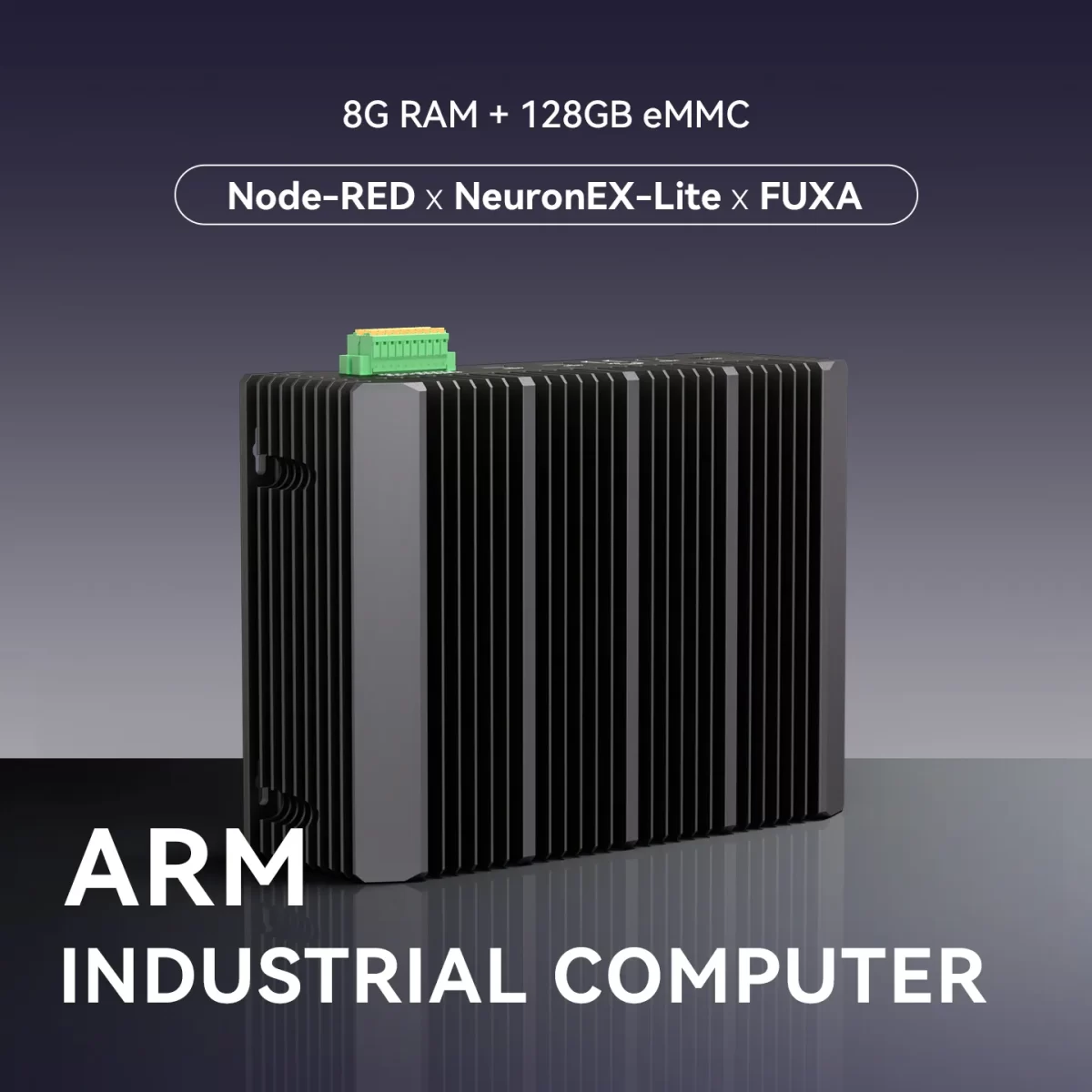
EC700 is one example of this scalable approach. Built on the RK3588J platform, it combines an integrated 6 TOPS NPU with two M.2 PCIe interfaces for additional AI acceleration, allowing compute resources to be expanded as workload requirements change.
For machine-vision applications, see our guide to building expandable industrial vision systems with RK3588J and M.2 AI accelerators.
Local AI or Cloud AI?
There is no universal answer.
Cloud AI is often the simpler choice when usage is low, teams need rapid access to the newest large models, or maintaining local inference infrastructure would create unnecessary overhead.
Local and on-premises AI become more attractive when workloads are continuous, latency matters, network connectivity cannot be guaranteed, sensitive data needs to remain within the local environment, or recurring API costs become significant.
Even then, local inference is not free.
Hardware, power, deployment, model adaptation, monitoring, and maintenance all have a cost.
For many industrial and enterprise projects, a hybrid architecture makes more sense than choosing one side exclusively.
Local models can handle real-time, privacy-sensitive, or offline workloads. Cloud services can still be used for larger models, centralized processing, or workloads that change frequently.
The better architecture is the one that matches the operational requirements.
M.2 AI Accelerator Selection Checklist
Before committing to an M.2 AI accelerator, check the complete system rather than one number on the datasheet.
| Area | What to Verify |
|---|---|
| Workload | Model architecture, input type, quantization, target latency or throughput, context and concurrency |
| Memória | Accelerator-local memory, memory bandwidth and actual runtime memory requirement |
| Host Interface | M.2 compatibility, PCIe generation, lane configuration and host-to-accelerator data flow |
| Power & Thermal | Sustained module power, cooling requirements, ambient temperature and complete-system thermal design |
| Software | Model conversion, operators, runtime, drivers, OS compatibility and SDK maintenance |
| Integration | Industrial interfaces, IT/OT connectivity, software updates, cybersecurity and lifecycle requirements |
| Validation | Test the real model and measure FPS, latency, TTFT, tokens/s, memory use and sustained stability |
The Bottom Line
TOPS can be helpful, but it should never be the sole criterion when choosing an M.2 AI accelerator.
For real edge AI projects, it is better to ask whether the accelerator can handle the workload, be compatible with the software stack and maintain the necessary performance in the deployment environment.
The best choice is not the highest number on the datasheet. It is the one that still makes sense when the prototype becomes a production system.

Agnes Wang é especialista em soluções de IoT na IOTRouter, dedicando-se principalmente a gateways de IoT industrial, computação de ponta e soluções de automação industrial.
É especialista em tecnologias de comunicação industrial, incluindo Modbus, IEC 60870-5-104, MQTT, OPC UA, integração de PLC e aplicações de monitorização remota. Colabora na elaboração de artigos técnicos e guias de aplicação sobre soluções de IoT industrial, conversão de protocolos e computação na periferia.