An Industrial Edge AI Computer is an edge computing platform designed for deployment in industrial environments. It performs AI inference, data processing, protocol conversion, and real-time decision-making locally. Compared with cloud-dependent solutions, it reduces reliance on network connectivity and improves response speed for industrial applications.
This guide is intended for engineers, system integrators, and technical teams evaluating industrial edge AI deployment options. From an engineering practice perspective, it covers the system architecture, hardware resource evaluation, AI workload analysis, stress testing, and on-site acceptance methods for industrial edge AI computers, helping reduce risks such as insufficient compute, performance fluctuation, and long-term runtime instability.
1. Overall Engineering Architecture of an Industrial Edge AI Computer
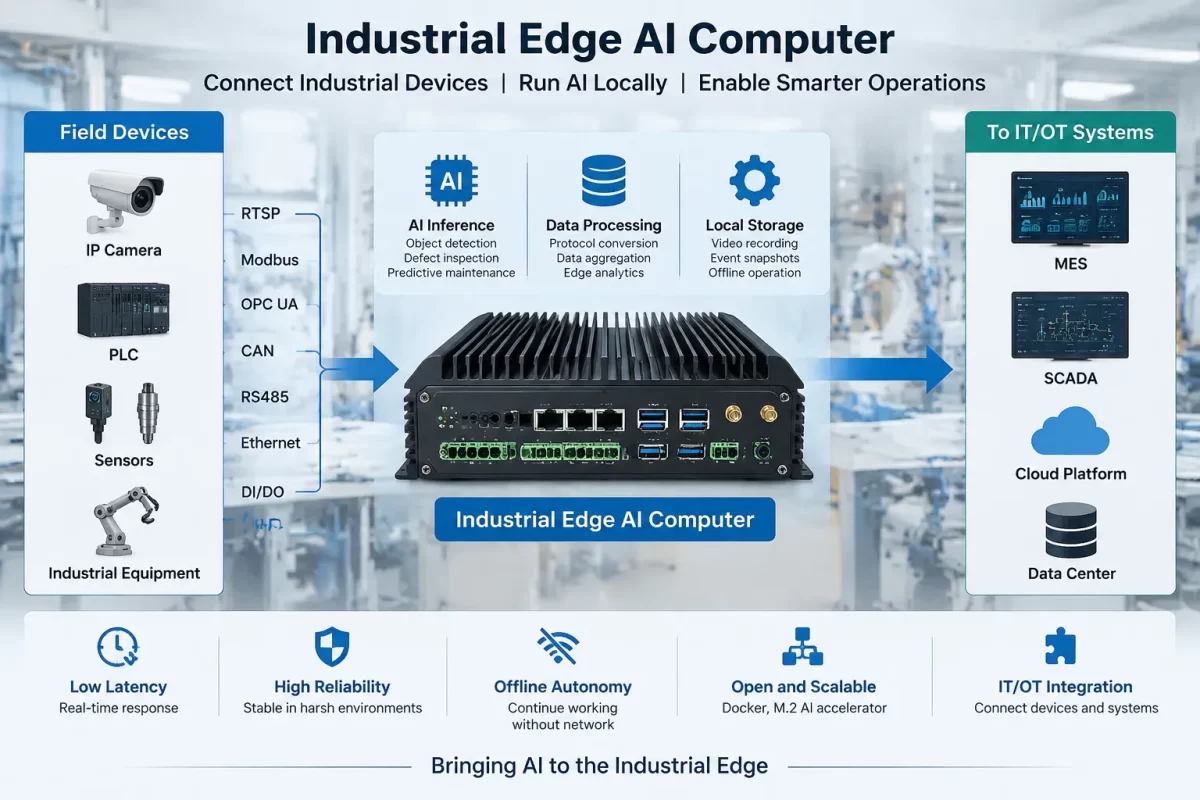
The core positioning of an industrial edge AI computer is: industrial device connectivity + edge computing + AI inference + local application deployment + IT/OT convergence.
Unlike cloud-based approaches, an industrial edge AI computer places compute capability on the site side, performing data processing, AI inference, and business logic locally. This reduces network transmission pressure and improves system reliability in low-latency, low-bandwidth, and unstable network environments.
Typical architecture: Industrial Device / Sensor / Camera → Industrial Edge AI Computer → Data Processing + AI Inference + Local Application → MES / SCADA / Cloud Platform.
1.1 Hardware Layered Architecture
1. Connectivity Layer
Industrial data sources: PLCs, CNC equipment, robots, industrial sensors, vision devices, and other field devices.
Data access: Connect to field devices through industrial communication methods such as RS485, CAN FD, and Ethernet to obtain equipment status, production data, sensor information, and business data.
Rede: Use Ethernet, Wi-Fi, 4G/5G, and other network methods to enable device connectivity, remote access, and industrial system data exchange.
2. Compute Layer (Core)
CPU: Handles operating system operation, industrial data processing, network communication, protocol parsing, and application service management.
NPU: Typically handles the main AI inference tasks, but the actual system bottleneck is not necessarily limited to AI compute. It may also be affected by CPU scheduling, video decoding, memory bandwidth, and data transfer efficiency.
Memory (RAM): Used for Linux system operation, AI model loading, data caching, and multi-application deployment.
Storage (eMMC/SSD): Used for system files, AI models, databases, applications, and industrial data storage to meet long-term runtime requirements.
3. Output Layer
Upstream: Push alarms, snapshots, and structured data to cloud platforms via MQTT/HTTP/HTTPS.
Local output: Alarm IO output, local web pages, and local databases.
1.2 Software Layered Architecture (Common in Engineering Deployments)
Business Application Layer: Runs industrial applications, AI algorithms, local data analysis, and user-defined programs.
├─AI Inference Layer: Deploys vision models, machine learning models, or other edge AI applications based on hardware capabilities and application requirements. Depending on the deployment framework and hardware platform, inference engines such as ONNX Runtime can be used to optimize model execution across different environments.
├─ Middleware Layer: Provides the application runtime environment based on project needs, such as Docker containers, databases, MQTT communication services, or industrial data services.
├─ System Layer: The Linux operating system manages system resources, network communication, and device operation.
└─ Hardware Driver Layer: NPU drivers, network ports, and IO peripheral drivers.
For scenarios that require local LLM/VLM operation, memory capacity and AI acceleration capability need to be evaluated further. Do not assume that all edge AI computers are suitable for this type of workload.
Two Deployment Modes
-
Firmware-Integrated Mode: The system environment and applications are pre-configured, making it suitable for standardized application scenarios.
-
Docker Containerized Deployment: AI models, databases, business programs, and industrial services run in separate containers. This makes independent application upgrades and secondary development easier, and it is suitable for long-term industrial deployment.
1.3 Typical Data Flow
Typical industrial application workflow:
PLC / Sensor / Camera / Industrial Device
              ↓
Data Acquisition
              ↓
Protocol Conversion + Local Processing
              ↓
AI Inference + Business Logic
              ↓
Local Application
              ↓
MES / SCADA / Cloud Platform
For example, in smart manufacturing, an AI computer for smart manufacturing can receive PLC runtime data, equipment status information, and vision data, complete data processing and AI analysis locally, and then synchronize the results to MES, SCADA, or an industrial cloud platform.
Key engineering pitfall: the performance of an industrial edge AI computer cannot be judged by TOPS alone. In actual deployments, CPU compute capability, memory capacity, software ecosystem, AI expansion capability, and long-term runtime stability all affect the final application performance.
2. Industrial Edge AI Computer Workload Evaluation Method (Pre-Selection to Avoid Insufficient Performance)
The goal of workload evaluation for an industrial edge AI computer is to determine whether the device can meet the compute requirements of the actual project.
Unlike traditional servers, edge computing devices usually need to run device communication, data processing, AI inference, and local applications simultaneously under limited power and industrial environmental conditions. Therefore, during selection, it is not enough to look only at AI compute parameters. CPU performance, AI model size, memory resources, storage requirements, and software runtime environment must also be considered.
Core evaluation factors include: industrial data volume, AI task complexity, number of concurrent applications, memory usage, and expansion compute requirements.
2.1 Business Workload Input Parameters (Confirm Before Solution Design)
During the project evaluation phase, the first step is to clarify the data types, AI task types, and runtime environment the device needs to handle.
Different application scenarios have significantly different compute resource requirements. For example, industrial data acquisition, vision analytics, local AI model operation, and multi-service deployment have different requirements for CPU, AI compute, and memory resources.
At the same time, it is necessary to confirm whether the device needs to run multiple application services, such as Docker, databases, communication services, and user-defined programs, to provide a basis for subsequent hardware selection.
2.2 Practical Workload Estimation Method (Quick Engineering Estimate)
The actual workload of an industrial edge AI computer is not determined by AI compute alone. It is jointly affected by CPU processing capability, AI inference tasks, memory resources, and data processing volume.
First, the CPU business load needs to be evaluated. In addition to running AI models, an edge computing device also needs to handle the Linux system, industrial protocol parsing, network communication, Docker services, and business program operation. If a project runs PLC data acquisition, MQTT communication, a database, and AI applications at the same time, CPU resource consumption will increase significantly. Therefore, during selection, it is not enough to focus only on NPU performance. Actual runtime testing is needed to confirm CPU utilization and system response.
AI inference load mainly depends on model complexity, input data scale, inference frequency, and the number of concurrent tasks. For example, in vision applications, resolution, FPS, and the number of video streams directly affect compute resource consumption. A lightweight vision model and a local LLM may have completely different compute and memory requirements even when running on the same AI hardware.
Engineering evaluation usually needs to consider AI task complexity, input data scale, inference frequency, and concurrency together. However, this relationship can only be used for preliminary estimation. Actual performance still needs to be confirmed through benchmark testing with the target model.
At the same time, memory and storage are also key factors in edge AI deployment. The device needs to load AI models, run Docker services, maintain databases, and cache industrial data at the same time. Therefore, RAM capacity and storage performance directly affect system stability.
For applications such as local LLM/VLM, model size is usually the main limiting factor. It is not possible to judge whether a device meets the requirements based only on TOPS.
Nota: Theoretical compute does not equal real-world business capability. TOPS does not equal real-world industrial AI performance. When selecting AI acceleration hardware, factors such as memory bandwidth, PCIe interface, thermal design, and software support should also be considered. See our guide on [M.2 AI accelerator selection].
The nominal TOPS of a chip represents the ideal compute peak. Real industrial applications are also affected by model optimization, software frameworks, memory access efficiency, data transfer, and thermal conditions.
Therefore, industrial edge AI device selection should be based on actual business benchmark results, not simply on chip parameters.
2.3 Common Workload Risks
In industrial edge AI projects, the common problem is usually not insufficient AI compute, but insufficient system resource planning.
For example, focusing only on NPU performance while ignoring CPU load can cause response degradation when the device handles industrial communication and application services.
When multiple Docker services, databases, and AI models run at the same time, insufficient memory can also reduce system stability.
In addition, AI applications usually continue to increase in model scale as projects upgrade. Therefore, the device needs to reserve a certain amount of compute and expansion headroom to avoid replacing hardware during later upgrades.
2.4 Hardware Selection Reference
Lightweight industrial applications mainly focus on device connectivity, data processing, and simple AI tasks. These scenarios usually require a stable industrial computing platform and basic AI capability.
For industrial vision AI applications, local AI analytics, and multi-application parallel operation, an industrial AI computer for machine vision or similar workloads requires a higher-performance CPU, NPU, and more memory resources.
If the project also involves PLCs, sensors, or industrial device connectivity, RS485, CAN, Ethernet, and other industrial communication interfaces and protocol compatibility also need to be considered.
If the application involves local LLM/VLM, multi-model parallel inference, or complex AI computing, AI acceleration expansion capability needs to be considered further, for example, expanding to a higher-performance AI module through M.2 PCIe.
3. Engineering Stress Testing (Load Validation, Required Before Go-Live)
Being able to run an AI model in a lab environment does not mean the device is necessarily suitable for actual industrial deployment.
When an edge AI computer runs on site, it usually needs to handle changing compute tasks, network fluctuations, multiple concurrent applications, and long-term operation. Therefore, before formal deployment, the device’s compute capability and stability need to be tested under actual business scenarios.
The focus of validation is not to test the theoretical peak of the device, but to confirm whether the device can meet real-time performance, stability, and expansion requirements under the target application load.
3.1 Test Environment Preparation
The test environment should be as close as possible to actual application conditions.
During validation, it is recommended to use the actual software environment from the target scenario, including the same operating system, AI model, inference framework, and applications.
At the same time, device runtime status needs to be monitored, such as CPU, memory, AI compute resources, storage read/write, and task response time, to determine whether the device has resource bottlenecks.
3.2 Business Workload Testing
The performance of an edge AI device needs to be evaluated in combination with actual tasks.
For example, smart construction sites may focus on real-time response for vision analytics tasks; PV inspection may focus on image processing and model inference capability; industrial smart manufacturing may focus on device data access, local computing, and AI analysis at the same time; transparent kitchen monitoring and security AI analytics usually focus more on multi-channel video concurrency, alarm real-time performance, and long-term stable operation.
During testing, the complete workflow should be run according to the actual business process, rather than testing the AI model alone. The key is to observe whether AI inference remains stable, whether the system runs smoothly under multi-task operation, whether data processing introduces latency, and whether application services can remain running over time.
3.3 Long-Duration Runtime Testing
Edge AI devices are often deployed in unattended environments, so long-term runtime reliability needs attention.
During testing, observe whether the device shows the following under continuous operation:
-
Continuous memory growth;
-
Abnormal application exit;
-
Inference performance degradation;
-
Slower system response.
The purpose of long-duration runtime testing is to uncover issues that cannot be exposed during a short demo phase.
3.4 Abnormal Environment Testing
Actual site environments are not always ideal.
Before deployment, the device’s recovery capability under abnormal conditions needs to be validated, for example:
-
Whether communication recovers after a temporary network interruption;
-
Whether application services can restart after an abnormal exit;
-
Whether data caching and synchronization mechanisms work normally.
This type of testing helps determine whether the device is suitable for long-term deployment, not just for operation in a lab environment.
3.5 Test Result Evaluation
When selecting an edge AI device, the focus should be on whether the device meets actual business requirements, not simply on comparing CPU, NPU, or TOPS parameters.
An edge AI computing platform suitable for industrial deployment needs to provide sufficient compute headroom, a stable software runtime environment, good expansion capability, and long-term runtime reliability under the target workload.
3.6 Recommended Validation Metrics Reference
The following metrics can be used as a reference for stress testing and selection validation. Specific thresholds should be adjusted based on actual project load and platform capability.
| Métrico | Validation Focus |
|---|---|
| CPU | Whether it remains saturated for long periods during business operation |
| Memória | Whether there is continuous growth or a leak |
| AI Inference | Whether latency remains stable |
| Armazenamento | Whether continuous writes are abnormal |
| Rede | Whether recovery after disconnection works normally |
| Runtime | Stable operation for 72h or more |
4. On-Site Project Acceptance Method
After pre-deployment workload evaluation and stress testing are completed, on-site acceptance is mainly used to confirm whether the industrial edge AI computer has been deployed according to the design plan and to verify that the device, software, and business systems are properly connected.
Unlike the performance testing described earlier, on-site acceptance focuses on deployment consistency in the actual environment, including hardware configuration, software environment, data links, and application runtime status.
4.1 Hardware and Software Environment Confirmation
During on-site deployment, first confirm that the actual device configuration matches the design plan, including the compute platform, memory, storage, and AI acceleration configuration.
At the same time, record the software runtime environment, such as the Linux system version, AI inference framework, application version, and Docker container configuration.
This information is an important basis for subsequent device maintenance and troubleshooting. Especially during long-term operation of industrial projects, software version changes may affect model operation and application compatibility.
4.2 Data Ingestion and Business Process Confirmation
An industrial edge AI computer ultimately needs to serve a specific business process, so on-site validation should be built around the complete data flow.
For example, in industrial automation, an edge AI computer for industrial automation needs to confirm that data from PLCs, sensors, or other devices can enter the edge computing node normally and complete processing and upload according to the designed workflow.
In AI application scenarios, it is necessary to confirm that the model can load normally, that inference results meet business logic requirements, and that data exchange with upper-layer systems works properly.
If Docker or other containerized deployment methods are used, the dependencies and communication between application services also need to be confirmed.
4.3 System Runtime Status Confirmation
During on-site operation, confirm that the device can remain stable under the real network and industrial environment.
Focus on device runtime logs, application service status, and data transmission status to ensure that problems can be quickly identified when abnormalities occur.
For applications that require remote maintenance, remote access, software updates, and device management methods also need to be confirmed as configured, avoiding the need for on-site operations during later maintenance.
4.4 Delivery Documentation and Post-Deployment Maintenance
Industrial edge devices usually run for many years. Therefore, delivery is not just about completing device installation; it also requires complete maintenance information for later support.
During project delivery, device configuration, software version, application deployment method, and maintenance notes should be retained to facilitate later functional upgrades, model updates, or troubleshooting.
For edge AI projects, the hardware itself is only a runtime platform. Continuous software maintenance and application iteration also affect the device lifecycle.
4.5 Commonly Overlooked Issues in Real Deployments
In real projects, a common mistake is to validate only AI model accuracy in a lab environment while ignoring resource changes after long-term device operation. For example, the system may run normally during initial deployment, but as logs accumulate, databases grow, or models are upgraded, memory usage gradually increases and eventually affects application stability. These issues usually do not appear during a short demo, but they directly affect long-term performance after project delivery. This is also why industrial projects usually require stress testing and on-site validation, rather than judging device capability only from model runtime results in a development environment.
4.6 Acceptance Failure Criteria
The following conditions usually indicate that the solution needs further optimization:
-
Under the target load, AI inference performance continuously degrades;
-
Memory continuously grows, indicating a resource leak;
-
Key application services frequently exit;
-
Business processes fail to recover automatically after network recovery;
-
Crashes or abnormal reboots occur during long-term operation.
The acceptance goal of an industrial edge AI computer is to confirm that the device can operate reliably over the long term in a real industrial environment, not to verify peak performance under lab conditions.
5. Common Pitfalls Summary
-
Focusing only on TOPS parameters and ignoring actual business workload.
-
Testing only demo performance without validating long-term runtime capability.
-
Ignoring software ecosystem and deployment method.
-
Selecting hardware without reserving expansion headroom.
-
Ignoring industrial interfaces and protocol compatibility.
-
Ignoring future model upgrades and application expansion requirements.
6. Conclusion
For system integrators and project teams, an industrial edge AI computer is a compute node that must run for the long term within a project. Architecture determines integration difficulty, while field validation determines delivery quality. A datasheet is only the starting point. What really matters is stable operation under real conditions, ease of maintenance, and the ability to pass acceptance.
From system architecture design to field validation, the value of an industrial edge AI computer is not in peak compute, but in continuing to work reliably after project delivery. Industrial sites do not need a one-time demo. They need an edge AI solution that can run long-term, be maintained, and be delivered with confidence.

Agnes Wang é especialista em soluções de IoT na IOTRouter, dedicando-se principalmente a gateways de IoT industrial, computação de ponta e soluções de automação industrial.
É especialista em tecnologias de comunicação industrial, incluindo Modbus, IEC 60870-5-104, MQTT, OPC UA, integração de PLC e aplicações de monitorização remota. Colabora na elaboração de artigos técnicos e guias de aplicação sobre soluções de IoT industrial, conversão de protocolos e computação na periferia.