


Descrição
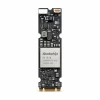
IOTRouter Technology developed the RK182X Edge AI Accelerator Card(RK1820, RK1828) for on-device large language models and multimodal inference.
The RK182X uses a 3D-stacked DRAM processing-in-memory architecture. Compared with a conventional design that uses separate SDRAM and SoC chips, it provides more than 10,000 DRAM I/O connections and up to 1 TB/s of peak bandwidth, while operating at a lower interface frequency and consuming less power.
The RK182X natively supports mainstream 1.5B–35B LLMs and VLMs, including the Qwen 2.5/3 series, ChatGLM, DeepSeek-R1-Distill, Llama2, InternVL, Qwen-VL, and FastVLM. Beyond language and multimodal models, it also supports vision models such as SigLIP, DINOv2, and YOLOv5-ResNet, along with ASR and TTS workloads such as Whisper and SenseVoice.
On the software side, the RK182X includes the complete RKNN 3.0 toolchain, supports mainstream frameworks including PyTorch, TensorFlow, ONNX, and GUFF, and provides an OpenAI-compatible API. Together, these capabilities make it a top choice for deploying large models at the edge in industrial quality inspection, smart security, energy storage operation and maintenance, and smart home applications.
Highlights At A Glance

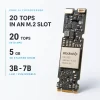
20 TOPS INT8
Delivers 20 TOPS of INT8 performance for edge AI and local inference

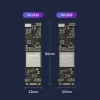
M.2 2280 Design
Compact M.2 2280 format for embedded systems and compatible AI PCs

5GB 3D-Stacked DRAM
Integrates 5GB of onboard 3D-stacked DRAM for high-bandwidth processing

3B–8B Model Support
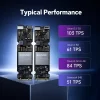
Supports 3B–8B LLMs and VLMs, with over 100 tokens/s stated for 3B models
Especificações do produto
Key specifications of the RK1820 and RK1828 M.2 compute modules
| Especificação | RK1820 M.2 Compute Module | RK1828 M.2 Compute Module |
|---|---|---|
| Product positioning | Dedicated edge M.2 accelerator card for 3B-parameter LLMs / VLMs | Dedicated edge M.2 accelerator card for 8B-parameter LLMs / VLMs |
| Core chip | RK1820 coprocessor | RK1828 coprocessor |
| Chip package | On-board main chip in an FCBGA746L package; 19 mm × 19 mm body; 0.65 mm ball pitch | |
| Product design | Dedicated NPU accelerator card with no standalone video codec output capability; requires a host / main control chip for pre- and post-processing and application workload scheduling | |
| CPU cores | 3 RISC-V cores, 2 of which integrate a 128-bit VPU; each core has 128 KB L2 cache | |
| NPU cores | 8-core NPU; supports mainstream quantized data types, including INT8 and W4A16 | |
| Compute performance | 20 TOPS | |
| On-board DRAM capacity | 2.5 GB | 5 GB |
| DRAM bandwidth | Hundreds-of-GB class; peak across the series can reach the 1 TB class | |
| On-board base storage | Standard SPI Flash; supports external SDMMC / FSPI / eMMC storage expansion | |
| Multimedia hardware acceleration | 4K JPEG image encoding and decoding; 4K 2D RGA acceleration engine | |
| Natively supported model size | 3B-parameter LLMs / VLMs | 8B-parameter LLMs / VLMs |
| Host communication interface | PCIe 2.0 1lane (dual mode, 2.5G / 5Gbps bandwidth); standard M.2 edge connector | |
| Entrada de energia | Powered through the M.2 interface; supports 3.3V main input + 12V auxiliary input | |
| On-board power management | Integrated BUCK step-down circuit and LDO linear voltage regulator | |
| On-board clock | 24MHz OSC active crystal oscillator | |
| Cooling control interface | Supports PWM fan speed control (Fan speed CTL) and fan speed detection (Fan speed DET) | |
| Debug interface | On-board UART Debug serial port | |
| Expansion I/O | Exposed through the M.2 edge connector: I2C×5, SPI×2, UART×3, GPIO, PWM, SMBUS | |
| Reset and control signals | Supports hardware RST reset, NPOR power-on reset, and CLKREQ clock request signal | |
| Peak whole-chip power supply requirement | 40W+ | |
| Average power in extreme scenarios | 20W+ | |
| Operating environment | -10°C ~ 55°C | |
| Supporting toolchain | Complete RKNN 3.0 toolchain; supports model conversion, simulation, debugging, and performance analysis | |
| Compatible AI frameworks | Supports mainstream frameworks including Huggingface, Pytorch, ONNX, and Tensorflow; compatible with the GGUF model format | |
| Development interfaces | Provides an OpenAI-compatible API, C/C++ API, Python API, and CLI debugging tools | |
| Hardware platforms | Can be used with x86 / RK3588 / RK3576 / RK3572 / RK3562 / RV1126B, etc. | |
| Operating system support | Supports Windows / Linux / Android / OpenHarmony; supports compute fusion and scheduling through the Rockit framework | |
Need help integrating the RK182X? Talk to our team about system compatibility, AI applications, and pricing.
Use Cases of the Edge AI Accelerator Card
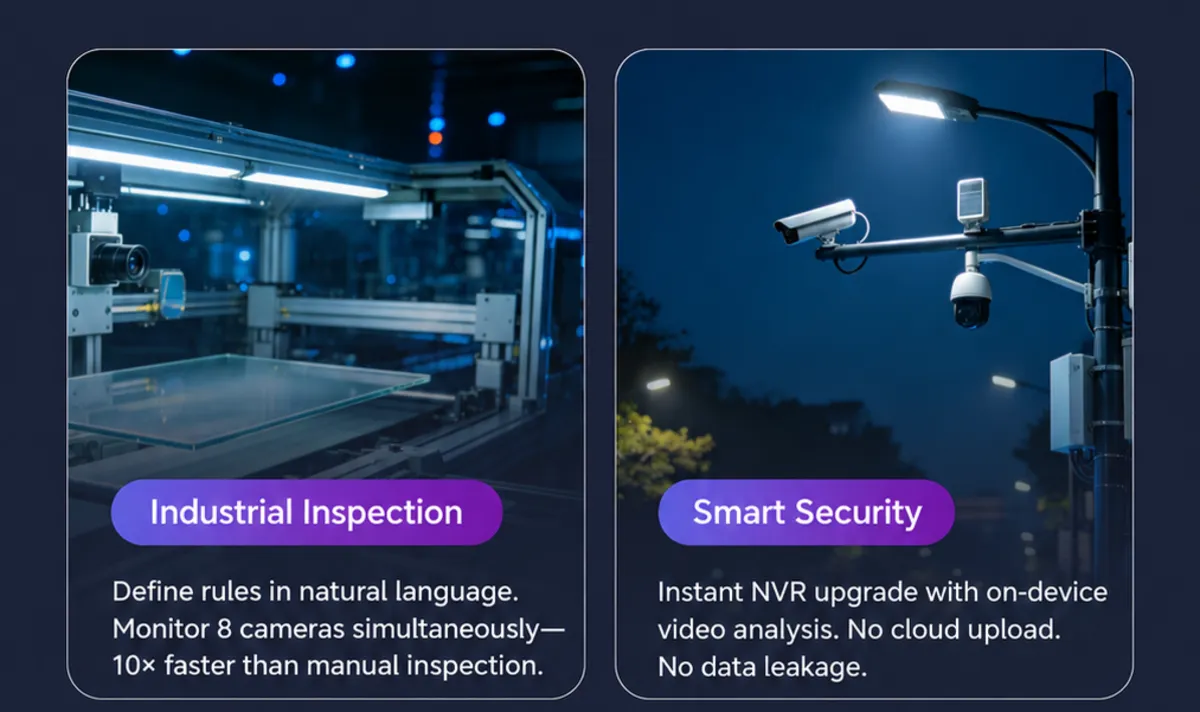
1. Industrial Quality Inspection
The RK182X allows production teams to set inspection rules in natural language and check feeds from up to eight cameras at the same time. In compatible systems, it can carry out inspection on site at up to 10 times the speed of manual checks.
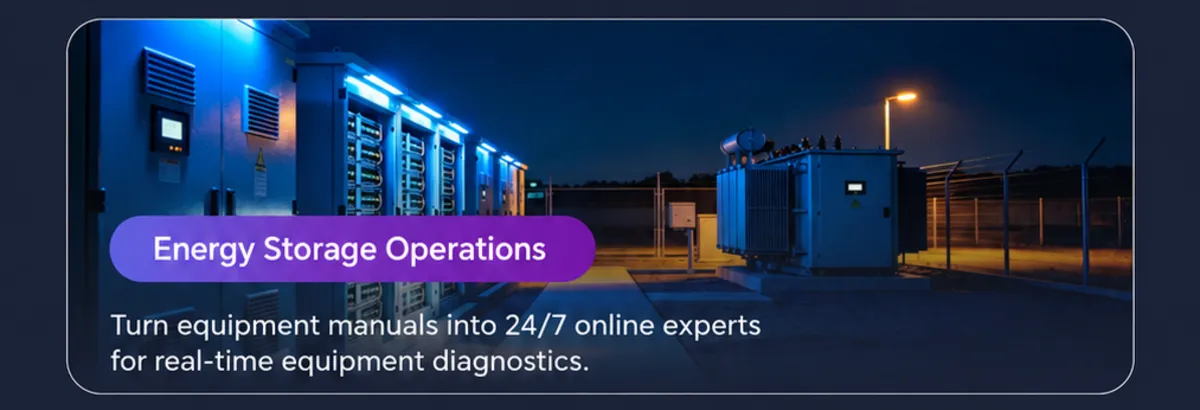
2. Smart Security
Installed in a compatible NVR or edge device, the RK182X can analyze video and detect events locally. Footage does not need to be uploaded to the cloud, which helps protect sensitive surveillance data and lowers the risk of exposure.
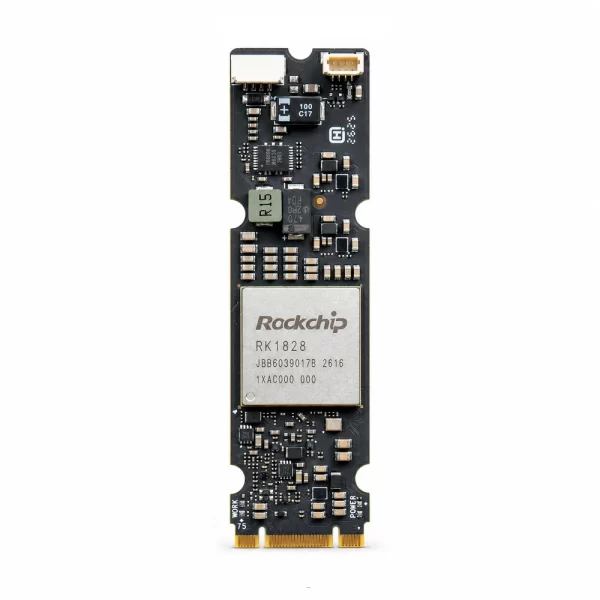
3. Energy Storage Operations and Maintenance
The RK182X gives maintenance teams round-the-clock access to an AI assistant built on equipment manuals and operating data. Staff can look up technical information and use current data to assess equipment conditions and spot potential problems.
4. Smart Home Systems
The RK182X can run locally in home hubs, smart panels, and service robots. It supports voice and visual interaction, making it easier to control devices, find information, and handle everyday tasks through one connected home system.