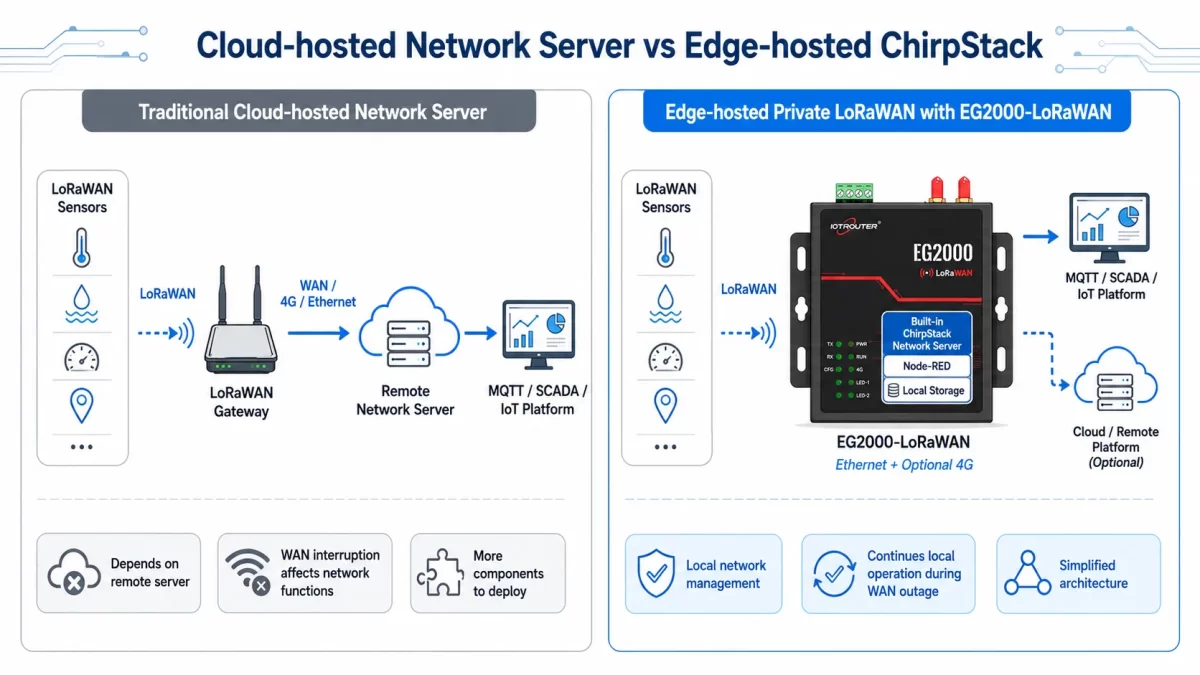
A LoRaWAN deployment often appears straightforward at the outset. A few sensors, a single gateway, and a cloud endpoint can form a working pilot. In practice, however, moving to an industrial-grade installation introduces considerable complexity. In a conventional LoRaWAN architecture, the gateway mainly handles radio communication and forwards LoRaWAN packets to a Network Server, which manages device activation, MAC-layer communication, downlinks, and application data routing. Running ChirpStack locally changes this architecture by allowing the gateway to become part of a private LoRaWAN network that can continue handling local network functions without depending entirely on a remote cloud server.
This leads to a recurring question among system integrators: does the Network Server have to reside in the cloud?
Not necessarily. For factories, farms, water utilities, and energy sites, running ChirpStack directly at the edge can simplify the overall architecture and reduce dependence on wide-area network connectivity. The EG2000-LoRaWAN industrial edge gateway embodies this model, integrating an SX1302 concentrator, a built-in ChirpStack Network Server, Node-RED, local storage, and Ethernet with optional 4G connectivity within a single unit.
Why Private LoRaWAN Is Gaining Traction
LoRaWAN is well suited for applications that require wide coverage and low data throughput – water level monitoring, pressure transmitters, environmental sensors, smart meters, and agricultural field devices. In such projects, the primary challenge is rarely wireless coverage alone. The more demanding tasks are network management, data preprocessing, and integration with existing control or reporting systems.
A conventional deployment places the gateway on site and hosts the Network Server remotely, often in a public cloud or a central data centre. This model works under stable conditions, but it introduces a critical dependency. If the 4G or WAN link becomes unstable, communication between the gateway and the remote server can be disrupted, affecting device join procedures, downlink responses, and even network-level housekeeping.
For industrial sites with limited or unreliable connectivity, keeping more of the LoRaWAN system locally improves operational resilience. A private network also gives system integrators greater control over device provisioning, data routing, and application integration, without exclusive reliance on third-party cloud services.
What Changes When ChirpStack Runs at the Edge
Integrating the ChirpStack Network Server directly into the EG2000-LoRaWAN gateway fundamentally shifts its role from a passive packet forwarder to an active local network controller. End devices can communicate through the gateway, while the built-in ChirpStack Network Server handles LoRaWAN network management and local uplink/downlink communication. Sensor data can then be processed at the edge before selected information is forwarded upstream.
For industrial deployments where local autonomy and a simplified architecture are priorities, this consolidation reduces the number of separate systems to be installed and maintained. The architecture becomes more cohesive: the wireless front-end, Network Server, edge processing layer, and backhaul interface reside in one enclosure. This cohesion is especially valuable in remote sites, where each additional server or external service adds configuration overhead and potential points of failure.
How Does Node-RED Work with ChirpStack?
Receiving LoRaWAN packets is only the beginning. Industrial users typically need to transform, route, or enrich that data before it becomes actionable. A raw temperature reading may require scaling and unit conversion; multiple sensor inputs may need aggregation; an abnormal pressure value may need to trigger a local alert; certain data streams may go to MQTT, while others feed a SCADA historian.
Node-RED, running locally on the EG2000-LoRaWAN, provides a visual, low-code environment for building these processing flows without writing a full custom application. Once the LoRaWAN data is available locally, engineers can use Node-RED to filter values, transform data formats, apply logic, and route selected information to external platforms. This capability makes the gateway an active edge application node, reducing the processing burden on central systems and simplifying integration with heterogeneous device types.
Can a Private LoRaWAN Network Work Without Internet?
One of the most practical concerns for remote industrial projects is system behaviour during WAN outages. Consider a water monitoring station, agricultural site, or energy facility where local sensors remain operational but the primary 4G backhaul is temporarily lost. If the Network Server is cloud-based, the interruption affects not only data uploads but also device join requests, downlink commands, and MAC layer coordination.
Running the Network Server locally reduces this dependency. The local LoRaWAN network and edge processing can continue operating even when the WAN connection is temporarily unavailable. Data that cannot be immediately forwarded can be cached locally and transmitted once connectivity is restored. This approach does not advocate for fully offline operation in all cases, but it enables the system to tolerate intermittent WAN links, helping improve operational resilience for remote installations.
When Should You Use LoRaWAN — and When Shouldn’t You?
LoRaWAN is optimised for long-range, low-power, low-data-rate communication. It is well suited for periodic sensor readings – soil moisture, tank levels, ambient conditions, utility metering, and pressure logging. It is not designed for millisecond-level control, high-speed motion, or deterministic PLC communication. Those functions should remain on industrial Ethernet or real-time fieldbuses.
A sound industrial IoT architecture does not force all device types onto a single network. Rather, it uses the most appropriate technology for each data class. LoRaWAN extends the sensing reach of the system, while wired networks continue to handle real-time control loops. Recognising this boundary is essential to avoid misapplying the technology in later project phases.
Can Existing RS485 and Modbus Devices Connect to LoRaWAN?
Many industrial sites already operate large populations of RS485 meters, Modbus RTU sensors, and other serial devices. Replacing them with native LoRaWAN alternatives is often cost-prohibitive and technically unnecessary. In such cases, an external RS485-to-LoRaWAN node provides a practical bridge. The existing meter or sensor remains in place, while its data is transmitted wirelessly to the EG2000-LoRaWAN gateway.
This approach is particularly valuable in retrofit projects, where running new cabling is expensive or physically difficult. It enables existing field instruments to become part of a broader wireless monitoring system without a complete site overhaul, preserving capital investment while extending digital capabilities.
Where This Architecture Fits Best
A private LoRaWAN architecture with edge processing is most suitable when sensors are widely distributed, wired installation is impractical, and the project requires local control over network operations and data management. In water management, this includes pressure, flow, level, or water-quality monitoring across remote stations. In agriculture, it connects soil, weather, temperature, humidity, and irrigation sensors spread across large fields. Energy projects use it for distributed sub-metering, environmental monitoring, and auxiliary data collection. Environmental monitoring benefits from low-power wireless nodes placed in locations where continuous mains power or wired communication is infeasible.
The common factor is not the industry vertical, but the combination of wide geographic distribution, low per-node bandwidth, and the need for manageable edge autonomy.
When Edge-Hosted ChirpStack Is Not Always the Best Choice
While running ChirpStack at the edge offers clear benefits for single-site or locally managed deployments, it is not a universal solution. For organisations managing multiple geographically distributed gateways across dozens of sites, a centralised or cloud-based Network Server may actually reduce operational overhead. Centralised management can simplify device provisioning, network configuration consistency, and cross-site visibility or data integration.
For a single factory, farm, water station, or remote facility where local WAN connectivity is unpredictable, however, an edge-hosted ChirpStack Network Server can provide greater local autonomy than an architecture that depends entirely on a remote Network Server. The right choice depends on the scale of the deployment and the operational tolerance for WAN interruptions.
From Gateway to Industrial Edge Node
The value of an industrial LoRaWAN gateway is no longer determined solely by RF sensitivity or communication range. The decisive criteria are the capabilities that activate once data arrives: Can the network be managed locally? Can sensor data be processed and structured before reaching the cloud? Can the system maintain integrity when the WAN connection becomes unstable? Can existing serial instruments be integrated without a full replacement?
These questions distinguish a laboratory testbed from a production-ready installation. The EG2000-LoRaWAN is engineered around this broader mandate, combining the SX1302 concentrator, embedded ChirpStack Network Server, Node-RED processing, local storage, industrial interfaces, and Ethernet with optional 4G backhaul. For many industrial projects, this integration means fewer components to deploy and a shorter path from wireless sensors to the systems that ultimately consume their data.
Planning Your Private LoRaWAN Deployment
When designing a private LoRaWAN network, the most practical first step is to define the operating frequency band, expected device count, approximate coverage area, sensor types, and target platform for data ingestion. Planning a LoRaWAN project? Send us these project details, and our engineers can help evaluate the gateway configuration that best fits your deployment.

Agnes Wang è una specialista in soluzioni IoT presso IOTRouter, dove si occupa principalmente di gateway IoT industriali, edge computing e soluzioni di automazione industriale.
È specializzata in tecnologie di comunicazione industriale, tra cui Modbus, IEC 60870-5-104, MQTT, OPC UA, integrazione di PLC e applicazioni di monitoraggio remoto. Collabora alla stesura di articoli tecnici e guide applicative riguardanti soluzioni IoT industriali, conversione di protocolli ed edge computing.