4G DTU vs programmable DTU/RTU is a common decision in industrial communication projects. Both connect field devices to remote servers over cellular networks, but they differ in data processing, protocol handling, local logic, and I/O control. This guide breaks down the key differences, practical applications, and selection criteria so you can choose the right device for your project.
Introduzione
Traditional 4G DTUs have long been the backbone of industrial remote communication, powering applications such as remote meter reading, environmental monitoring, water monitoring, and energy data collection. Their core mission is simple: connect serial devices to remote servers over cellular networks.
However, as industrial IoT evolves, some deployments demand more than just data transmission. They require local processing, protocol parsing, custom logic, and I/O control. This is where programmable DTU/RTU devices offer a more flexible solution.
1. What Is a Traditional 4G DTU?
1.1 Basic Architecture
A traditional 4G DTU acts as a communication bridge. A serial device connects to the DTU via RS232 or RS485, and the DTU sends that data over LTE to a remote server or cloud. In transparent transmission mode, the DTU forwards serial data while preserving the original communication process. Some models may offer additional protocol-related functions depending on their design.
Serial Device
      |
 RS232/RS485
      |
   4G DTU
      |
   LTE Network
      |
 Server / Cloud
1.2 Key Features of a Traditional 4G DTU
Transparent Transmission — Serial data is forwarded while maintaining the original serial communication process.
Serial Communication — RS485/RS232 interfaces supporting Modbus RTU and meter communication protocols.
Cellular Connectivity — 4G LTE with TCP/UDP support for remote communication.
Gestione remota — Parameter configuration, status monitoring, and firmware upgrade capabilities.
Example: ZHC4013 4G DTU
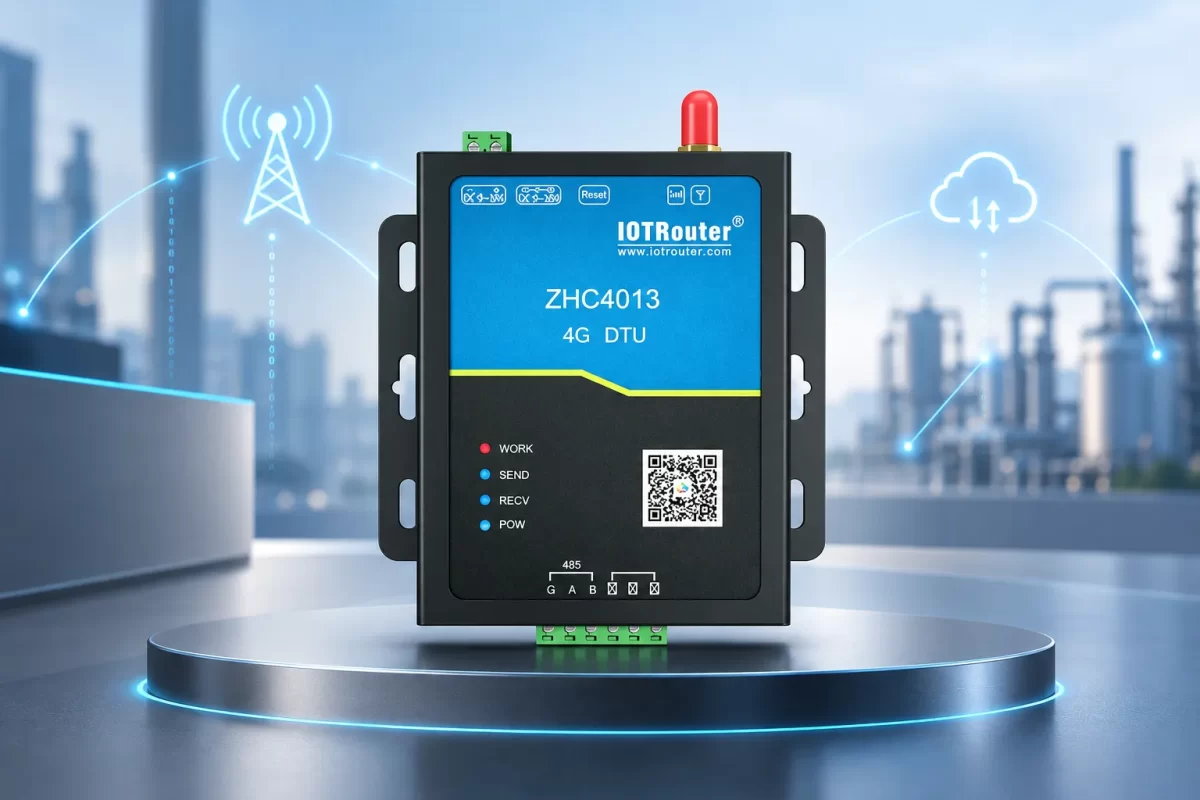
Il ZHC4013 is an industrial-grade 4G DTU featuring a single RS485 interface, transparent transmission, TCP/UDP communication, and remote configuration. It’s built for reliable operation in distributed industrial monitoring environments.
2. Limitations of Traditional 4G DTUs
This section isn’t about diminishing the value of traditional DTUs—it’s about defining their application boundaries.
A traditional DTU excels when data only needs to be transmitted. It becomes limited when projects require:
-
Conversione del protocollo — translating between Modbus RTU and MQTT, for example
-
Filtraggio dei dati — removing redundant data at the edge before uploading
-
Local decision making — triggering actions based on sensor thresholds
-
I/O control — directly driving relays, switches, or analog outputs
-
Customized logic — executing application-specific rules on-device
In a simple deployment, a meter connects to a DTU via RS485, and the DTU forwards the meter data to the cloud. In a more complex industrial site, multiple devices—sensors, meters, and field devices—connect to a programmable DTU/RTU, which aggregates and processes their data before sending it to the cloud or SCADA system.
Traditional DTUs primarily function as communication forwarders. While some models offer basic protocol-related functions, they generally provide less flexibility for local decision-making and complex protocol processing. When requirements shift from simple data transmission to local logic processing, a traditional DTU may no longer suffice.
The choice between a traditional DTU and a programmable DTU/RTU isn’t about which device is more advanced. It depends on where the data processing and decision-making should happen.
3. What Is a Programmable DTU/RTU?
A programmable DTU/RTU combines cellular communication, serial communication, protocol processing, and local control logic in a single device.
The distinction is fundamental:
-
Traditional DTU: Moves data.
-
DTU/RTU programmabile: Processes data, controls devices, and communicates remotely.
They can also execute user-defined logic through programming interfaces such as MicroPython, enabling customized data handling and control functions at the device side.
4. EP Series Programmable DTU/RTU Overview
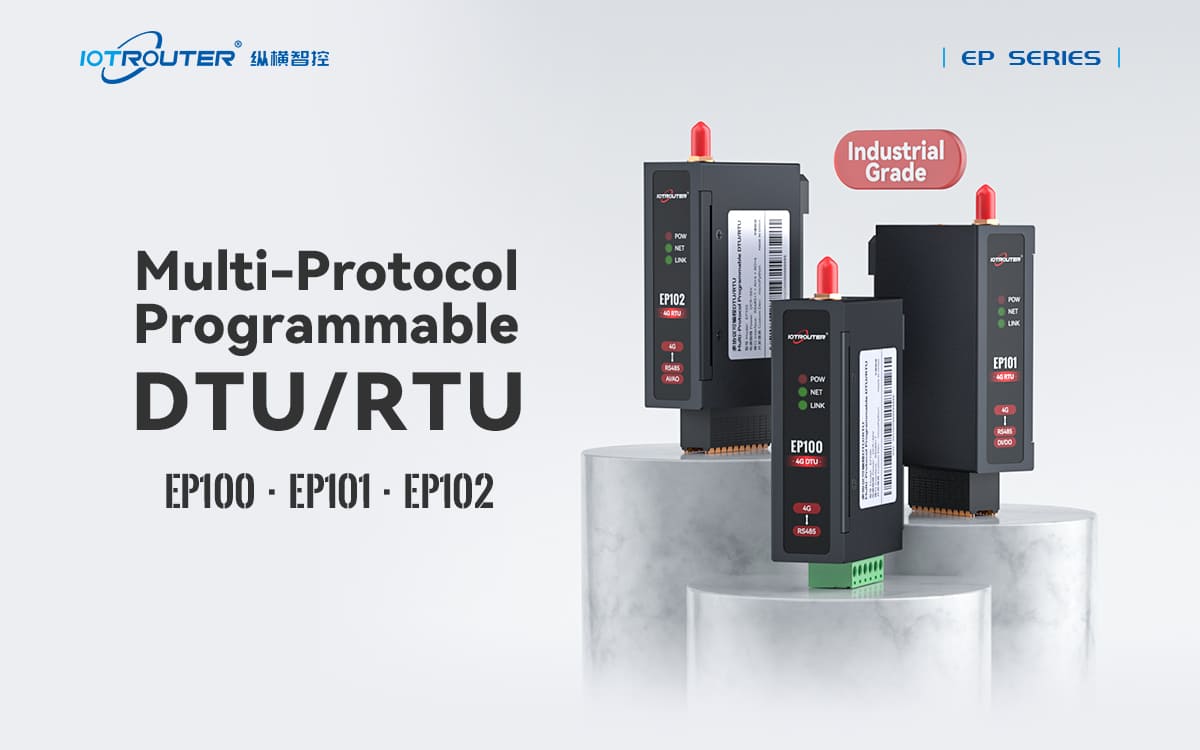
EP Series: When More Than Data Transmission Is Required
Il EP100 series DTU/RTU programmabile is an industrial-grade, multi-protocol programmable DTU/RTU designed for data acquisition, switch control, and analog signal monitoring. It targets scenarios such as industrial equipment monitoring, remote meter reading, smart water management, and smart agriculture.
4.1 Communication Capability
The EP series supports:
-
4G Cat.1 cellular connectivity
-
RS485 serial port
-
TCP/IP, MQTT, and HTTP networking
-
Bidirectional transparent transmission over 4G and serial ports
These capabilities enable remote monitoring with flexible network configuration, including one-to-one and many-to-one topologies.
4.2 Protocol Processing
Here’s where the upgrade becomes tangible.
A basic transparent DTU mainly focuses on communication forwarding, while programmable DTU/RTU devices add local protocol parsing and application logic. The EP series can parse industrial protocols and organize field data for communication with cloud platforms or upper systems.
The EP series features built-in industrial protocols including Modbus RTU/TCP and DLT645. It supports local parsing and conversion to standardized JSON format, compatible with MQTT and TCP/IP for efficient bidirectional communication between devices and the cloud. Serial transparent transmission, Modbus parsing, DLT645 parsing, and change reporting are all supported.
4.3 Local Logic and Custom Functions
The EP series provides edge-level data processing capabilities, supporting local logic processing, filtering, and proactive reporting. This means the device can execute rules and take actions without cloud round-trips.
For example, if a temperature reading exceeds a configured threshold, the EP RTU can execute local rules and trigger an alarm output without waiting for the cloud. The device also supports linear calculation and local logic execution as standard software features.
For customized applications, the EP series supports further development based on the Quectel SDK, with MicroPython support. This allows integrators to write custom scripts and device-side logic directly on the device.
4.4 Remote Device Management
The EP series supports remote configuration, remote monitoring, and firmware updates. It includes dual hardware/software watchdogs and multiple protections such as ESD and surge protection, ensuring reliable operation in the field.
Model Selection:
-
EP100: RS485 × 1 — for applications requiring programmable communication with RS485 devices
-
EP101: RS485 × 1 + Digital Input (DI) × 4 + Digital Output (DO) × 4 — for scenarios requiring switch control
-
EP102: RS485 × 1 + Analog Input (AI) × 4 + Analog Output (AO) × 4 — for analog monitoring and control scenarios
5. 4G DTU vs Programmable DTU/RTU Comparison
| Caratteristica | Traditional 4G DTU | DTU/RTU programmabile |
|---|---|---|
| Trasmissione trasparente | ✓ | ✓ |
| RS485 communication | ✓ | ✓ |
| 4G connectivity | ✓ | ✓ |
| Modbus protocol parsing | Depends on model | ✓ |
| Elaborazione dei dati | Limited | ✓ |
| Local logic | No/Limited | ✓ |
| Digital/analog I/O | Usually unavailable | ✓ |
| Custom application | Limited | ✓ |
6. How to Choose Between DTU and Programmable DTU/RTU
Choose a traditional 4G DTU when:
-
You only need remote communication
-
Your existing server handles all processing
-
Devices already have established protocols
-
Cost sensitivity is a priority
For example, in water meter remote reading, a meter connects to a ZHC4013, and the DTU uploads the data to the server.
Choose a programmable DTU/RTU when:
-
You need protocol conversion
-
You need local control
-
You need custom logic
-
You need multiple device integration
-
You need to reduce external controllers or communication modules
For example, in a smart pump station, sensors, meters, and field devices connect to an EP Series device, which sends processed data to the cloud or SCADA system.
7. Conclusion
4G DTU vs Programmable DTU/RTU: they serve different industrial communication requirements. They aren’t competitors—they’re complementary tools for different layers of the IoT stack.
-
Traditional DTU: Simple, reliable, and cost-effective connectivity for data transmission.
-
DTU/RTU programmabile: Greater flexibility for intelligent industrial applications requiring local processing, protocol conversion, and device control.
As industrial IoT continues to evolve, both device categories will coexist. The key is matching the device to the actual requirements of your project—not over-engineering simple deployments and not under-powering complex ones.