As large language models move from the cloud to the edge, users increasingly value inference speed, stability, and cost efficiency.
IOTRouter EC700 delivers scalable AI computing performance of up to 320 TOPS and supports AI models ranging from 0.5B to 35B parameters, including Qwen, DeepSeek, and GPT-OSS. It provides a flexible platform for running large language models locally, without per-request API charges.
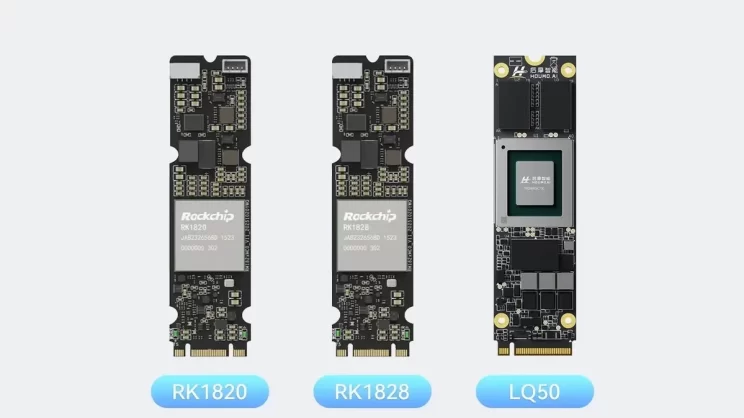
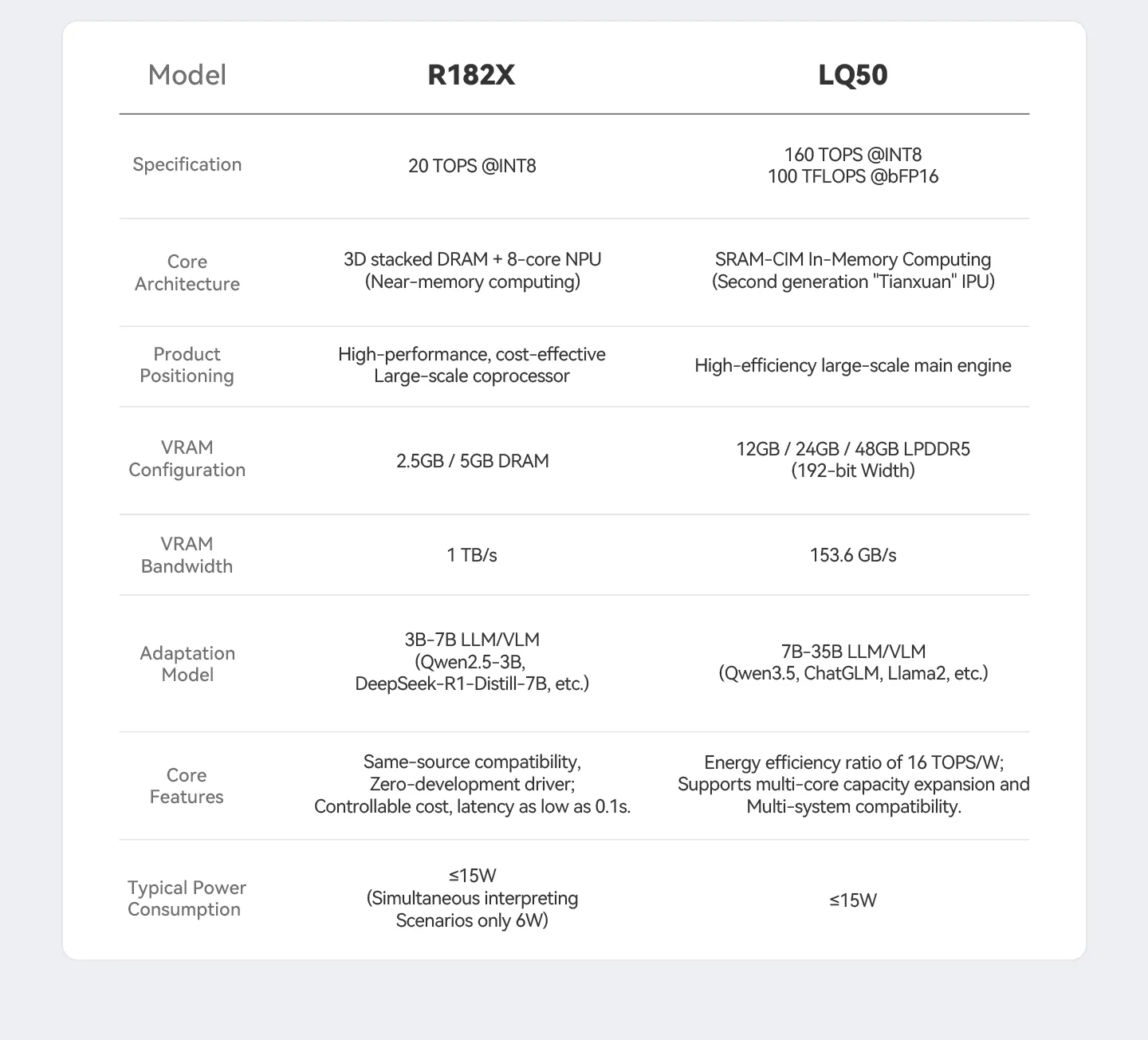
M.2 AI Accelerator Card Options
For the EC700 + RK182X benchmark configuration, testing focused on Time to First Token (TTFT) and Time Per Output Token (TPOT). Qwen2.5-7B achieved a TTFT of 158.06 ms and a decoding speed of 70.26 tokens/s, while the lightweight Qwen2.5-0.5B reached 215.86 tokens/s.
For the EC700 + LQ50 configuration, GPT-OSS 20B achieved a Prefill speed of up to 2,449.14 tokens/s with a dual-chip configuration, while Qwen3.5 35B-A3B reached 33.94 tokens/s with a single-chip configuration.
Vision-language models are also supported: Qwen3-VL-4B achieves 17.29 fps in vision processing and 26.91 tokens/s in LLM decoding.
These results demonstrate EC700’s ability to run both lightweight and larger-scale AI models locally, with flexible hardware configurations for different inference requirements.
Let’s explore its supported AI models and official performance benchmarks.
1. AI Model Support: Focused on Local LLM and VLM Inference
EC700 supports a range of AI models for local inference, covering large language models (LLMs) and vision-language models (VLMs).
Large Language Models (LLMs)
-
Qwen2.5: 0.5B / 1.5B / 3B / 7B
-
Qwen3: 0.6B / 1.7B / 4B / 8B / 14B / 30B-A3B / 32B
-
Qwen3.5: 2B / 4B / 9B / 35B-A3B
-
DeepSeek-R1-Qwen3: 8B
-
GPT-OSS: 20B
Vision-Language Models (VLMs)
-
Qwen2.5-VL: 3B / 7B
-
Qwen3-VL: 2B / 4B / 8B / 30B-A3B
-
InternVL: InternVL3-2B / InternVL3.5-4B
-
FastVLM: 1.5B
-
MiniCPM: MiniCPM-3o / MiniCPM-V-4
-
MiMo-VL: 7B-RL
These models cover a variety of local AI workloads, from text generation and reasoning to image understanding and multimodal interaction.
Model availability and performance depend on the selected AI accelerator card and software configuration. The benchmark results below show representative tested configurations.
Benchmark Data Source
The performance figures presented in this article are based on IOTRouter’s internal testing results, as documented in the official EC700 product specification. The benchmarks cover LLM and VLM inference performance on the RK182X and LQ50 AI accelerator configurations.
2. EC700 AI Performance Benchmarks- RK182X: Low-Latency LLM and VLM Inference
The RK182X AI Accelerator Card features a 3D-stacked DRAM architecture and an 8-core NPU, delivering 20 TOPS of INT8 computing power.
With 2.5 GB / 5 GB of DRAM and memory bandwidth of up to 1 TB/s, it is designed for efficient, low-latency inference of lightweight LLMs and VLMs.
LLM Performance Benchmarks
The following tests were conducted with 128 input tokens and 128 output tokens.
| Modell | TTFT (ms) | TPOT (ms) | Decode (tokens/s) |
|---|---|---|---|
| Qwen2.5-0.5B | 21.89 | 4.63 | 215.86 |
| Qwen2.5-1.5B | 47.47 | 6.78 | 147.56 |
| Qwen2.5-3B | 83.44 | 9.80 | 102.01 |
| Qwen2.5-7B | 158.06 | 14.23 | 70.26 |
| Qwen3-0.6B | 27.53 | 5.58 | 179.33 |
| Qwen3-1.7B | 52.16 | 7.20 | 138.88 |
| Qwen3-4B | 106.70 | 11.42 | 87.56 |
| Qwen3-8B | 177.87 | 16.36 | 61.11 |
The results show that RK182X can deliver responsive local inference across different model sizes. Qwen2.5-0.5B reaches 215.86 tokens/s, while Qwen2.5-7B maintains a decoding speed of 70.26 tokens/s.
VLM Performance Benchmarks
Selected results from official performance benchmarks.
| Modell | Vision Resolution | Vision (ms) | LLM TTFT (ms) | Decode (tokens/s) |
|---|---|---|---|---|
| FastVLM-1.5B-stage3 | 512×512 | 144.13 | 47.99 | 148.47 |
| MiniCPM-3o | 448×448 | 234.43 | 62.74 | 116.70 |
| InternVL3-2B | 448×448 | 190.80 | 47.93 | 148.26 |
| InternVL3.5-4B | 448×448 | 183.96 | 107.12 | 87.86 |
| Qwen2.5-VL-7B | 392×392 | 279.34 | 159.42 | 70.02 |
| Qwen3-VL-2B | 384×384 | 155.33 | 53.39 | 142.37 |
| Qwen3-VL-4B | 384×384 | 158.89 | 108.29 | 89.69 |
| MiniCPM-V-4 | 448×448 | 237.55 | 94.94 | 106.62 |
These benchmarks demonstrate RK182X’s capabilities in local image understanding and multimodal inference.
3. EC700 AI Performance Benchmarks-LQ50: Inference for Larger Language Models
For applications that require more computing power and larger models, EC700 supports the LQ50 M.2 AI Accelerator Card.
LQ50 delivers up to 160 TOPS INT8 computing power and 100 TFLOPS@bFP16 performance. It features 12 GB, 24 GB, or 48 GB of LPDDR5 memory (192-bit) and a memory bandwidth of 153.6 GB/s.
LQ50 supports 7B–35B LLM/VLM models, with multi-chip configurations providing additional computing capacity for more demanding inference workloads.
GPT-OSS 20B: Dual-Chip Performance
In the official GPT-OSS 20B benchmark, the test conditions were as follows:
-
Context length: 256K
-
Batch size: 1
-
Number of chips: 2
-
Output length: 0.05K tokens
Under these test conditions, the dual-chip configuration achieved:
At an input length of 0.5K tokens:
| Performance Metric | Result |
|---|---|
| Prefill | 2,449.14 tokens/s |
| Decode | 41.55 tokens/s |
At an input length of 0.25K tokens, decoding reached 42.40 tokens/s.
Qwen3.5 35B-A3B: Single-Chip Performance
The single-chip configuration also demonstrates the ability to run larger MoE models.
Test conditions:
-
Context length: 64K
-
Batch size: 1
-
Number of chips: 1
-
Input length: 0.25K tokens
-
Output length: 0.05K tokens
| Performance Metric | Result |
|---|---|
| Prefill | 833.39 tokens/s |
| Decode | 33.94 tokens/s |
This makes EC700 a flexible platform for deploying larger local language models in applications such as intelligent assistants, knowledge retrieval, and industrial data analysis.
Qwen3-VL-4B: Vision-Language Inference
The LQ50 AI Accelerator Card also supports multimodal inference workloads.
Test conditions:
-
Context length: 32K
-
Batch size: 1
-
Number of chips: 1
-
Input length: 0.25K tokens
-
Output length: 0.05K tokens
| Performance Metric | Result |
|---|---|
| Prefill | 2,964.03 tokens/s |
| Decode | 26.91 tokens/s |
| Vision | 17.29 fps |
By combining visual processing with language inference, EC700 can support local image understanding, visual question answering, and multimodal AI applications.
4. Flexible AI Computing for Real-World Edge Environments
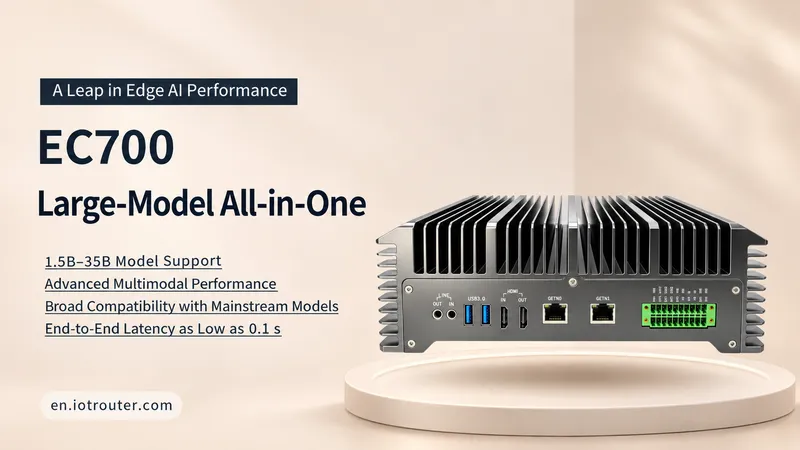
EC700 is not designed to compete with large-scale GPU clusters on peak computing power. Its focus is on practical AI inference in space- and resource-constrained environments, such as server rooms, production lines, and meeting rooms.
With a general-purpose host platform and dedicated AI acceleration, EC700 combines flexible computing expansion with practical inference performance, balancing computing efficiency, power consumption, and deployment requirements.
Conclusion: Flexible AI Computing at the Edge
With two standard M.2 PCIe expansion slots and support for the RK182X and LQ50 AI Accelerator Cards, EC700 provides flexible AI computing configurations for different model sizes and inference workloads.
By combining a general-purpose host with dedicated AI acceleration, EC700 brings scalable local AI inference to practical edge environments.
IOTRouter EC700 — Bring Local AI Inference to the Industrial Edge.

Agnes Wang ist Spezialistin für IoT-Lösungen bei IOTRouter und konzentriert sich auf industrielle IoT-Gateways, Edge-Computing und Lösungen für die industrielle Automatisierung.
Sie ist auf industrielle Kommunikationstechnologien spezialisiert, darunter Modbus, IEC 60870-5-104, MQTT, OPC UA, SPS-Integration und Fernüberwachungsanwendungen. Sie verfasst Fachartikel und Anwendungsleitfäden zu industriellen IoT-Lösungen, Protokollkonvertierung und Edge-Computing.