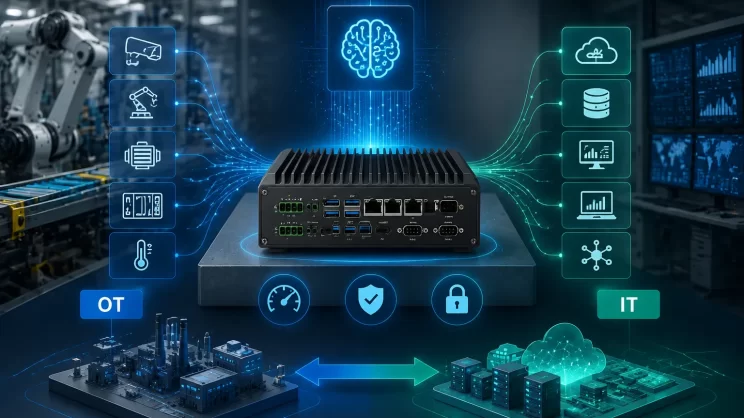
The edge AI industry is moving from pilot projects to large-scale deployment. M.2 AI accelerator cards are quickly becoming a popular hardware choice for edge AI applications.
The main reason is not simply increased computing performance. M.2 AI accelerator cards address three fundamental challenges in edge computing. These can be summarized in three key advantages.
However, choosing the right M.2 AI accelerator involves more than understanding its form factor and advantages. There are several technical factors to consider when evaluating an accelerator for a real-world edge AI application. See our guide to choosing an M.2 AI accelerator based on six factors beyond TOPS.
1. Standardized Interfaces Enable Easy Upgrades to Existing Hardware
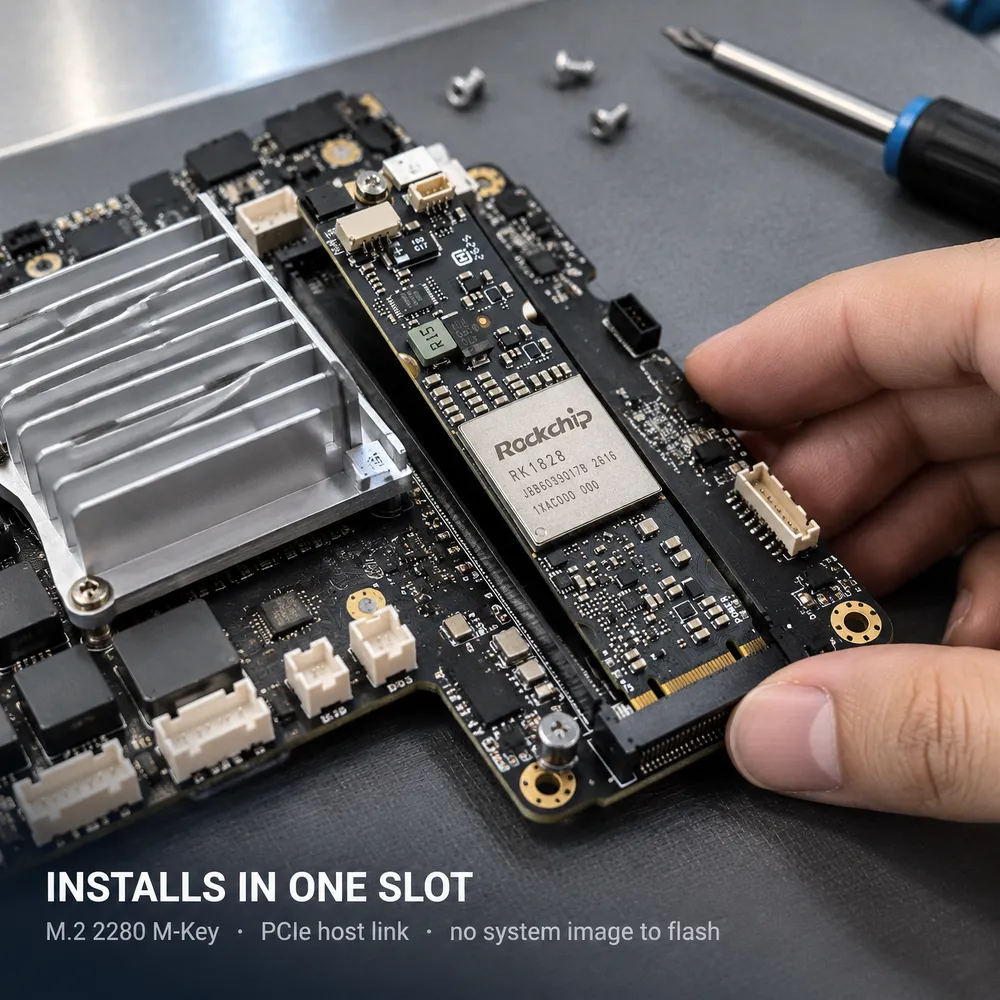
M.2 is a standardized hardware interface already widely used in both consumer and industrial devices. Common M.2 2280/M-Key configurations support PCIe Gen3/Gen4 and can be integrated into compatible embedded motherboards, industrial gateways, industrial PCs, and smart devices based on x86, ARM, and RISC-V architectures.
This means hardware manufacturers do not need to redesign their PCBs or restructure their entire systems. Even devices already deployed in the field can potentially gain AI computing capabilities simply by installing an M.2 accelerator card.
This significantly reduces hardware upgrade costs and development time while addressing the long-standing industry challenges of fragmented hardware platforms and expensive customization.
2. High Power Efficiency for Demanding Edge Environments
The main hardware constraints in edge computing are not peak computing performance alone, but also power consumption, heat dissipation, and physical space.
Many industrial gateways, surveillance devices, vehicle-mounted terminals, and mobile robots use fanless, sealed enclosures. They often rely on battery power or limited power supplies, with very restricted cooling capabilities.
Mainstream M.2 AI accelerator cards typically feature a TDP of just 2–10 W while delivering 20–40 INT8 TOPS of inference performance. Their computing performance per watt is significantly higher than that of traditional full-height PCIe accelerator cards. Their low thermal design requirements allow them to operate directly in industrial environments with a wide temperature range of -40°C to +85°C, making them suitable for power-constrained applications such as solar-powered systems and battery-operated devices.
This is a key barrier preventing high-power accelerator cards from gaining traction in edge deployments, and one of the defining advantages that makes M.2 accelerator cards difficult to replace.
3. Modular Computing Architecture Enables Flexible Upgrades and Reduces Costs
Edge AI models are evolving rapidly, from conventional computer vision to large language models (LLMs) and multimodal models. As model architectures change, computing requirements also increase and become more diverse.
M.2 AI accelerator cards separate the AI computing module from the host motherboard, creating a modular hardware architecture.
Flexible computing configurations
The same motherboard can support different M.2 accelerator cards according to application requirements, covering workloads ranging from lightweight object detection to 7B-scale large language model inference.
Lower upgrade costs
When AI models and computing requirements evolve, manufacturers can upgrade the accelerator card without replacing the entire system. This reduces hardware replacement costs and the risk of premature equipment obsolescence.
A mature and reliable supply chain
M.2 accelerator cards leverage the established M.2 form factor and manufacturing ecosystem used by consumer SSDs. This helps provide more accessible module sourcing and more stable supply compared with fully customized accelerator modules.
Schlussfolgerung
The growing adoption of M.2 AI accelerator cards reflects the natural progression of edge AI from customized pilot projects to large-scale deployment.
Their standardized interfaces, low power consumption, and modular architecture address three fundamental challenges in edge computing: fragmented hardware platforms, cost-sensitive deployments, and rapidly evolving computing requirements.
These advantages make M.2 AI accelerator cards an increasingly practical hardware choice for bringing AI capabilities to edge devices.