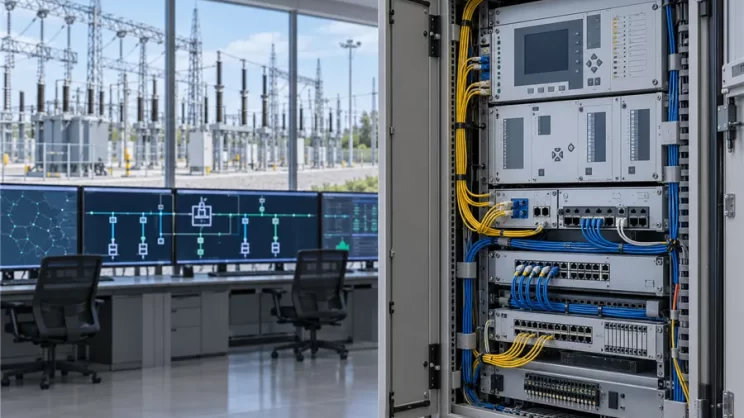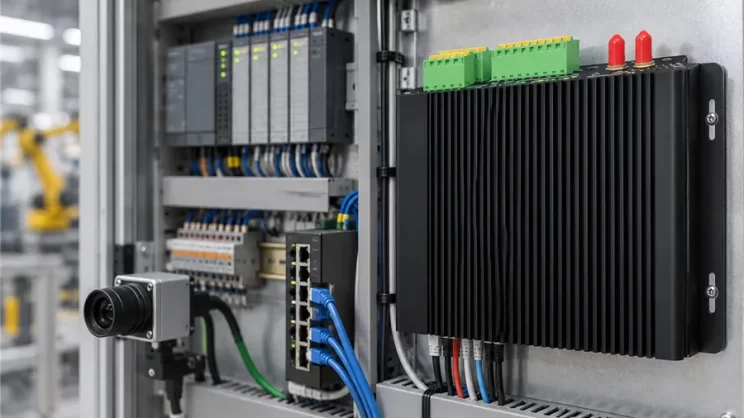
IOTRouter has introduced the EM100 Edge Computing Gateway for equipment connectivity, standard data acquisition, and small to medium-sized retrofit projects. It combines communication, expandable I/O, data processing, and control in one device, with configuration handled through a web browser.
A retrofit might begin with a pressure transmitter that needs monitoring or a meter whose readings are still checked on site. The next step could be remote setpoint adjustment or a connection to an existing SCADA system. These additions involve different signals and interfaces, while installation costs and configuration work still need to stay within the project budget.
EM100 Edge Computing-Gateway brings those tasks into a shared configuration workflow. Engineers select the I/O modules required at the site, connect the equipment to a supervisory system or business platform, and configure reporting and control around the application.

Modular I/O Expansion for Different Field Signals
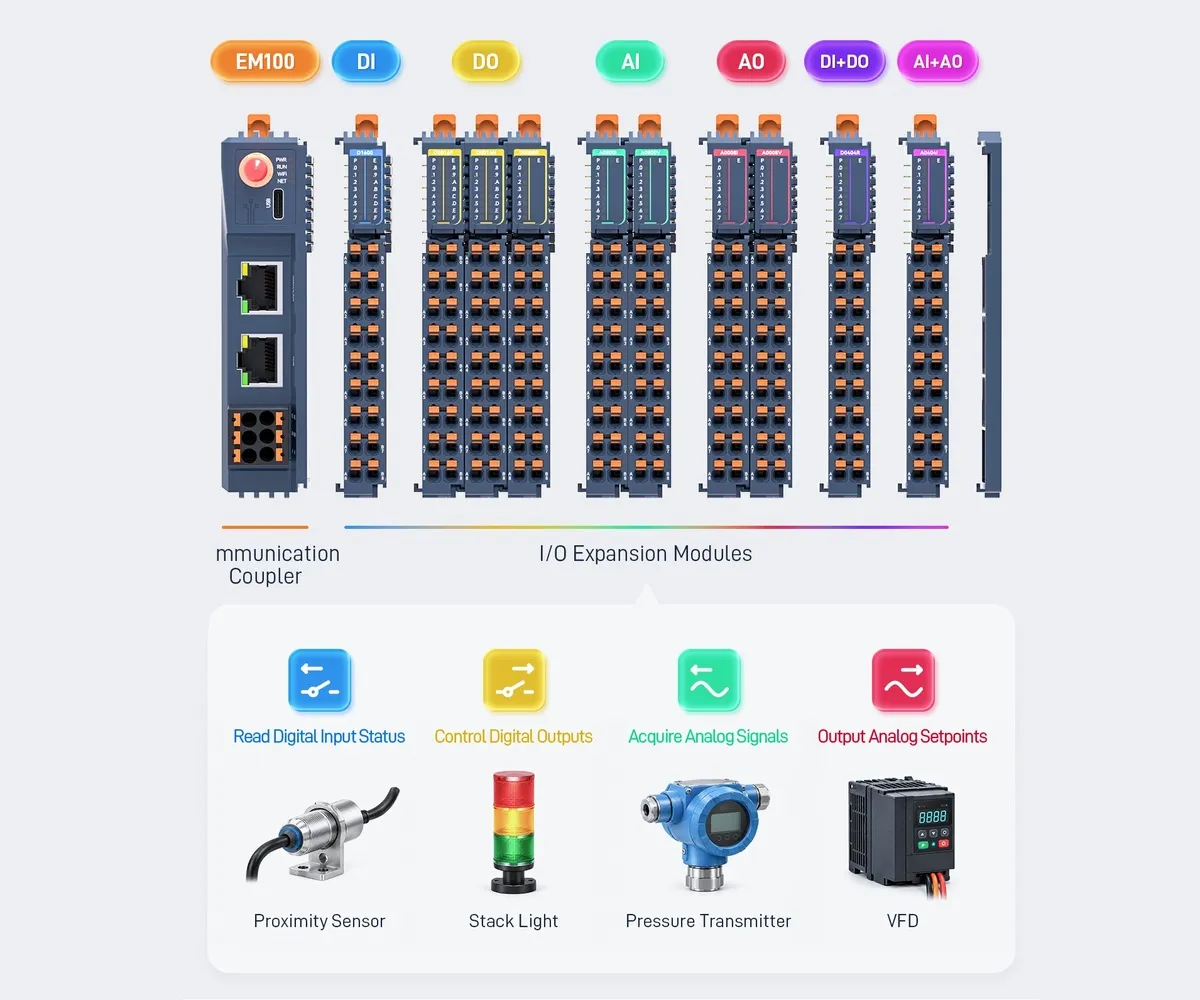
A switch state, a pressure measurement, and a variable-frequency drive setpoint each require a different interface. EM100 supports up to 16 expansion modules, with digital input, digital output, analog input, analog output, and relay options.
Digital inputs can read equipment running status, while analog inputs receive signals from transmitters. Output modules provide switching signals or analog setpoints where control is required.
Combined DI+DO and AI+AO modules are also available. Where an installation needs both inputs and outputs, these combinations can reduce the number of modules and the cabinet space they occupy.
Connect Serial and Ethernet Systems Through Modbus
New instruments do not always use the same communication interface as the existing monitoring system. EM100 supports bidirectional Modbus RTU/TCP conversion to connect the two.
For example, EM100 can poll RS485 temperature, pressure, or flow instruments and map their readings to registers that an Ethernet-based supervisory system can read. In the other direction, it can collect data from Modbus TCP devices and make it available to an existing Modbus RTU master.
Expansion I/O can use the same mapping approach. A PLC, HMI, or SCADA system can read digital states and analog measurements, then write to mapped DO, AO, or other writable values.
Instrument readings can also be processed before they reach the receiving system. EM100 supports scaling and expression calculations: a raw temperature value of 253, for instance, can be multiplied by 0.1 to produce 25.3°C.
Exchange Data and Commands Through MQTT or TCP
For connections to energy management, equipment monitoring, or maintenance platforms, EM100 sends data through MQTT or TCP. JSON fields can be configured to match the receiving platform’s message format.
Periodic, change-based, and scheduled reporting rules can run together. Engineers can set a regular reporting interval, send updates when a value meets a configured change threshold, or report at specified times. Local automation can also trigger a reporting task when its conditions are met.
Two independent upstream links allow data to serve separate business systems. One connection might send process measurements to an enterprise platform, while the other sends equipment status to a maintenance service. Each has its own connection settings and reporting tasks.
Communication also works toward the field. Platforms can send JSON commands to operate configured outputs or update writable setpoints. For data sharing between systems, EM100 can extract selected fields from received JSON messages and map them to registers for a PLC or HMI to read.
Run Routine Control Tasks Locally
EM100 can execute control rules locally as well as receive commands from supervisory systems and platforms.
Cabinet cooling is one example. Separate rules can start fan control above 30°C and stop it below 28°C. Using different start and stop thresholds helps avoid repeated switching as the temperature fluctuates around a single value. Rules can also combine multiple conditions and use a minimum execution interval.
Daily schedules, periodic actions, and pulse outputs cover other routine tasks. An action can run at a set time, repeat at a fixed interval, or apply an output for a specified duration before resetting it. These options suit scheduled acquisition and control, periodic checks, and brief signals such as a buzzer indication.
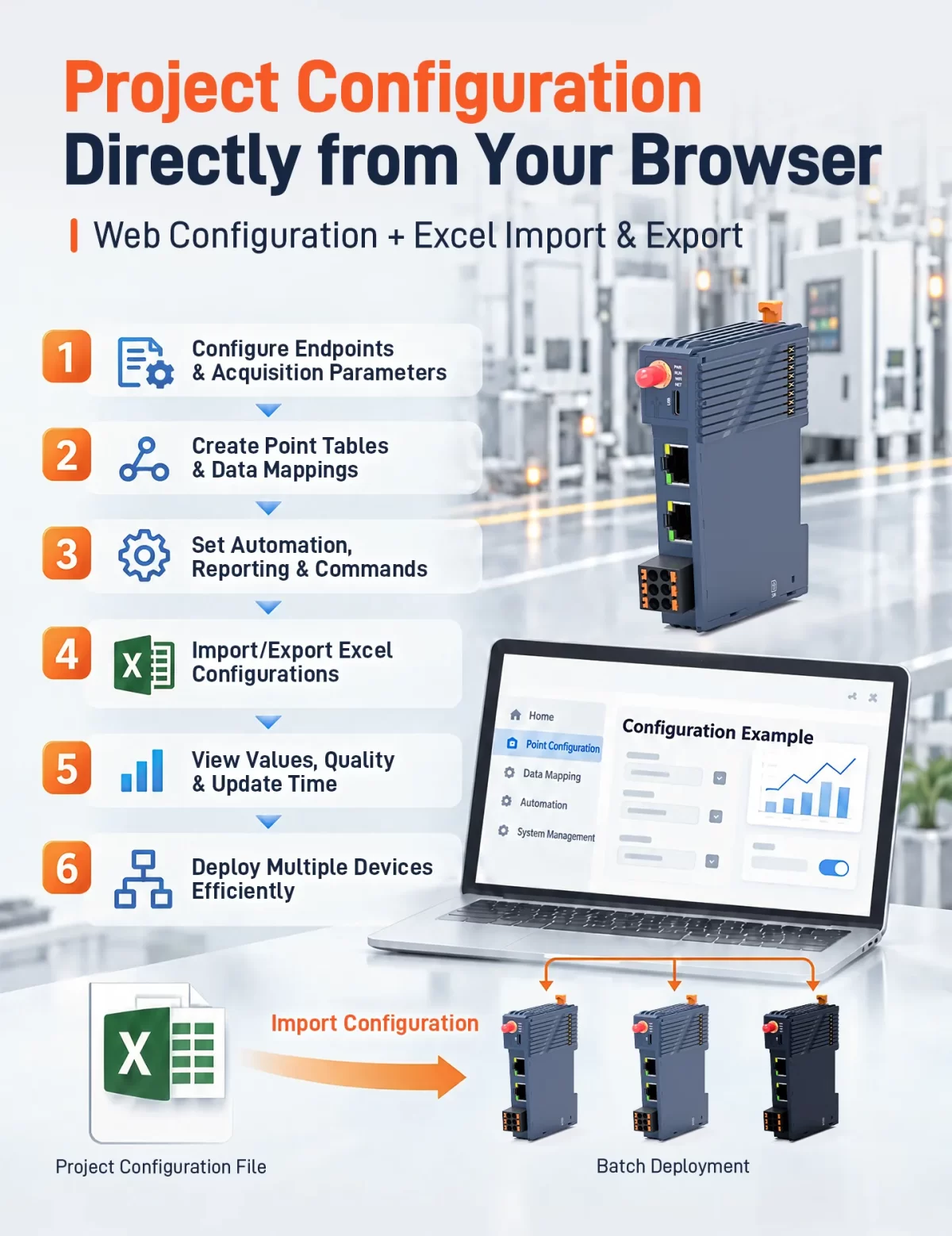
Configure Through a Browser and Reuse Settings in Excel
EM100 provides 4G, Wi-Fi, and Fast Ethernet connectivity, allowing engineers to choose a network connection that suits the installation.
The web interface covers device connections, acquisition parameters, point tables, address mappings, reporting, and control tasks. During commissioning, the overview page shows current values, data quality, and update times. Filters by category, device, or status help engineers check whether communication and readings are working as expected.
For similar installations, engineers can export the edge computing configuration to Excel, edit it in bulk, and reuse it at another site. Device addresses, connection parameters, and signal assignments can then be adjusted to match the equipment installed there, reducing repeated data entry.
Where EM100 Fits
The appropriate configuration depends on the equipment, signal types, and systems involved. Typical applications include:
| Anmeldung | How EM100 Is Used |
|---|---|
| Equipment retrofits and cabinet I/O expansion | Connect existing equipment signals and add inputs or outputs using slim modular I/O with tool-free assembly. |
| Energy data collection and equipment monitoring | Acquire meter readings, sensor measurements, and equipment status for MQTT reporting to a business platform. |
| Remote I/O and valve adjustment | Use Modbus writes or platform commands to operate DO/AO outputs and change writable setpoints. |
| Environmental monitoring and distributed acquisition and control | Collect measurements such as temperature and pressure, then execute local condition-based, scheduled, or periodic actions. |
| Data sharing between systems | Receive platform JSON data and map selected values to Modbus registers for PLC or HMI access. |
| Serial-to-Ethernet protocol conversion | Bridge RS485 devices and Ethernet systems through bidirectional Modbus RTU/TCP conversion. |
The EM100 Edge Computing Gateway is intended for projects with defined connectivity, acquisition, and control requirements that can be delivered through standard configuration. Integrators can select modules around the field signals, configure communication for the receiving systems, and set control actions around the equipment’s operating tasks.
For detailed specifications and configuration information, see the EM100 documentation and application guide. To discuss module selection or a planned installation, contact IOTRouter with the equipment list, signal types, and platform communication requirements.