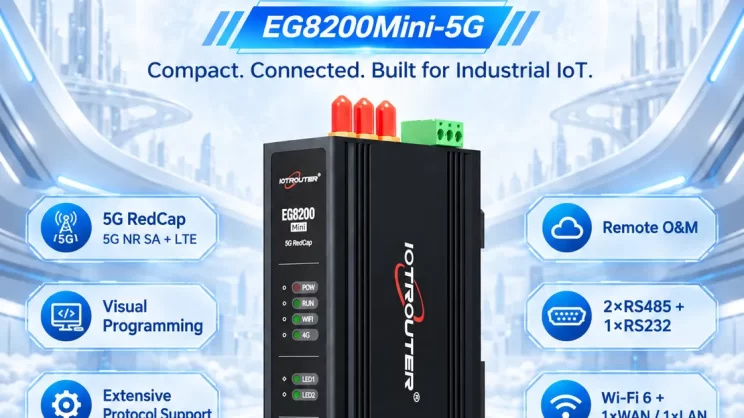
Neste tutorial, vamos centrar-nos na gateway de computação periférica da série EG com PLCs. Esperamos que este tutorial seja útil.
Related guide:
Como fazer a interface com os PLCs da série KV-7500 da Keyence através do protocolo KV TCP
Today, let’s talk about how to interface the EG edge gateway with Keyence KV-8000 series PLCs via the MC-3E protocol.
Compatible PLC: KV-8000 Series
1. Ligação do hardware
The MC-3E protocol utilizes Ethernet communication. Therefore, simply ensure the gateway’s LAN port and the Keyence PLC’s IP address are within the same subnet.
| EG8200Mini(LAN) | KV-8000 | |
| Endereço IP | 192.168.1.100 | 192.168.1.1 |
2. Parâmetros de comunicação do PLC
IP: 192.168.1.1
Porto: 5000
3. Definições da porta de entrada
3.1. Definições de ligação do PLC
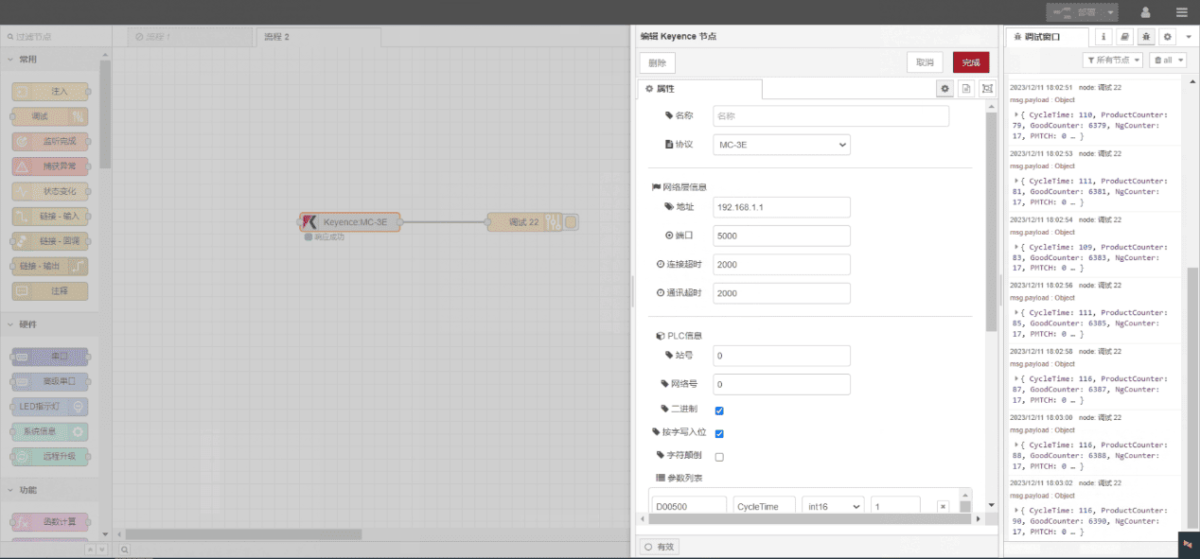
Drag a Keyence node from the left panel, double-click to open the settings page, and configure as follows based on the PLC’s communication parameters:
Protocolo: MC-3E
Network Port: Connected to the gateway’s LAN port
Endereço: 192.168.1.1
Porto: 5000
Tempo limite de ligação: 2000
Tempo limite de comunicação: 2000
ID da estação: 0
Network ID: 0
Binary: √
3.2. Configuração do ponto de dados
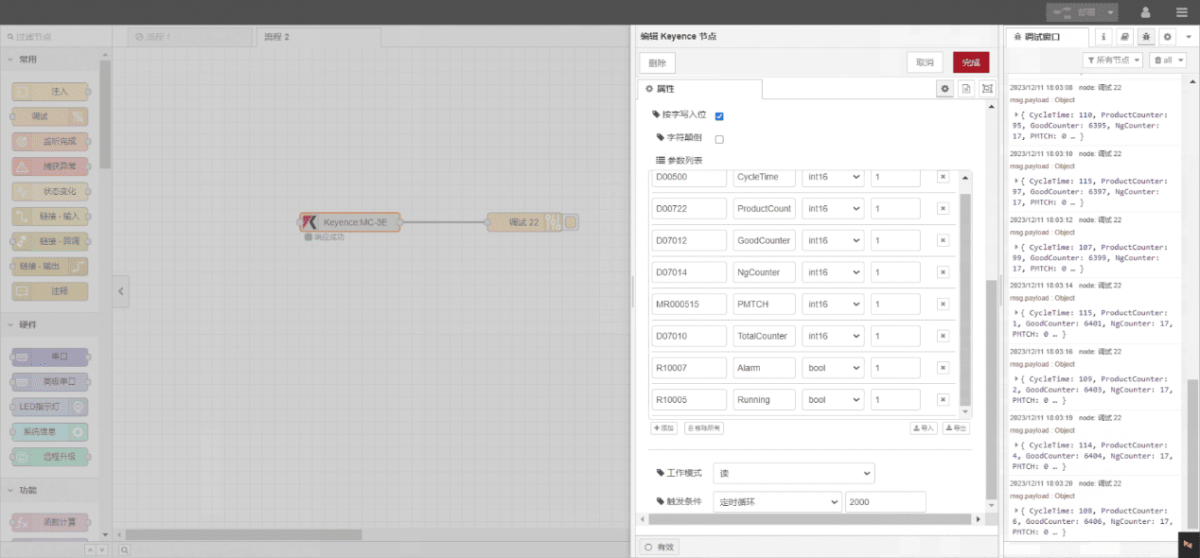
Enter the data points to be read into the parameter list of the Keyence node. Once configured, the node will automatically read data from the PLC at the specified frequency.
Data points are typically provided by PLC engineers. Upon receiving the point list, fill in the data points according to the gateway’s required format. For specific correspondence, refer to:
Esta é uma ficha de conteúdo sobre os Yueque. Clique na ligação para ver:(Pode utilizar o Google Chrome para traduzir) https://iotrouter.yuque.com/zn3vdn/eg8000/wgvrbfp0ivzdod3h
This example reads data from multiple addresses, such as DM00500 and DM00722. In the parameter list, enter each entry in the following order: Address/Name/Data Type/Data Length. The data is read cyclically every 2 seconds, as shown in the diagram:
3.3. Ensaios
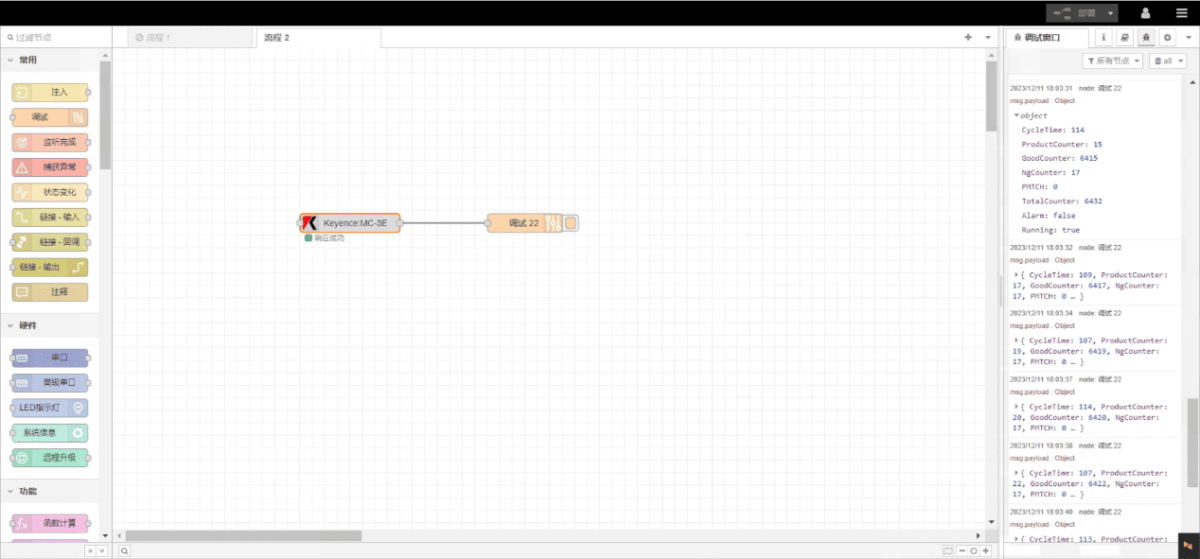
Click Deploy and observe that a data point is printed every 2 seconds. Verify that the returned data point name and corresponding value appear—communication is successful!
Guias relacionados em Integração de PLC industrial
← Voltar ao Centro de Integração PLC

Agnes Wang é especialista em soluções de IoT na IOTRouter, dedicando-se principalmente a gateways de IoT industrial, computação de ponta e soluções de automação industrial.
É especialista em tecnologias de comunicação industrial, incluindo Modbus, IEC 60870-5-104, MQTT, OPC UA, integração de PLC e aplicações de monitorização remota. Colabora na elaboração de artigos técnicos e guias de aplicação sobre soluções de IoT industrial, conversão de protocolos e computação na periferia.