Choosing the right communication protocol is critical for PLCs to connect reliably with SCADA, HMIs, and other devices. This guide breaks down 10 common protocols, their features, and typical industrial applications to help you make the right choice.
10 common PLC communication protocols
Nr.1 Ethernet/IP
Ethernet/IP is een open protocol voor toepassingslagen. Het is alleen bedoeld voor thuis- en zakelijke doeleinden. Het is niet bedoeld voor industriële toepassingen. Het is een geavanceerde versie van standaard Ethernet. Het protocol is ontwikkeld door Rockwell Automation.
Nr.2 Modbus
Modbus is a protocol based on master-slave technology for transferring information over serial lines or Ethernet. It is further categorized as Modbus RTU, Modbus ASCII, and Modbus TCPIP.
Nr.3 Profibus en Profinet
PROFIBUS is a classic serial fieldbus. PROFINET is a type of industrial Ethernet characterized by faster speeds, greater bandwidth, and larger messages. The PROFIBUS protocol is designed for high-speed communication with distributed I/O devices (remote I/O). The PROFIBUS system uses a bus master to poll RS485 serial buses with DP I/O devices that are distributed in a multipoint fashion. The PROFIBUS system uses a bus master to poll DP I/O devices distributed in multiple points on the RS485 serial bus.
Nr.4 EtherCAT
EtherCAT, oorspronkelijk ontwikkeld door Beckhoff Automation, is een real-time Industrial Ethernet-technologie die zich richt op korte cyclustijden (<= 100 us). Elk apparaat leest de gegevens in zijn frame en voegt de gegevens toe aan het frame terwijl het stroomafwaarts beweegt. De gegevensstroom kan zo klein zijn als een paar bits tot kilobytes aan informatie. Als de controller slechts van één apparaat informatie opvraagt, zal de gegevensstroom korter en sneller zijn in vergelijking met het verzamelen van informatie van alle apparaten.
Nr.5 Optomux
Optomux is a serial network protocol that works on RS-232/RS-485 and works on the ASCII standard. It was developed by Opto22. Similar protocols to these standards are Interbus and DirectNet.
Nr.6 DF-1
DF-1 is an asynchronous, byte-oriented protocol used to communicate with RS-232-based Rockwell devices.
Nr.7 Interbus
Interbus is een serieel netwerkprotocol dat werkt op RS-232/RS-485 en op de RTU-standaard. Ontwikkeld door Phoenix Contact.
Nr.8 HostLink
HostLink, this protocol is developed based on the ASCII protocol, which is typically used to communicate over RS232 of RS422.
Nr. 9 Gegevenssnelweg (DH+)
It is a protocol developed by Rockwell Automation that uses transformers to couple differential signals; this means that the transmitter and receiving station do not need to be at the same ground potential. Works with the concept of differential signaling. It uses two wires for data transmission, and the data is represented by the voltage difference between the two wires. Here, data is transmitted through differential voltage, and noise is easily removed in both wires. It uses half-duplex transmission for communication. This is a very old protocol used only for Rockwell PLCs. Today, it is obsolete and rarely used. It is suitable for token-passing protocols and uses relay lines with drops.
Nr.10 KAN
CAN protocol is an application layer protocol that uses peer-to-peer messages to communicate with various devices. It is a multi-master slave communication system and has an object dictionary that contains all the functions of a device. It is a practical communication method with standard communication objects for real-time data (PDO), configuration data (SDO), timestamps, synchronization messages, emergency messages, startup messages, NMT messages, and error control messages, as well as other data. In a hardware configuration, termination at the end device is required to establish communication over the entire link.
Quick Comparison of Common PLC Communication Protocols
The following table provides a quick overview of the most common PLC communication protocols, including their communication type, relative speed, and typical industrial applications. While actual performance depends on the implementation and network design, this comparison can help you quickly identify which protocol is best suited for a particular automation project.
| Protocol | Communication Type | Relative Speed | Typische toepassing |
|---|---|---|---|
| Ethernet/IP | Industrieel Ethernet | Hoog | Rockwell Automation Systems |
| Modbus RTU | Serie | Laag | PLC-to-Device Communication |
| Modbus TCP | Ethernet | Medium | SCADA and Industrial Networking |
| Profibus | Serial Fieldbus | Medium | Legacy Factory Automation |
| Profinet | Industrieel Ethernet | Hoog | Real-Time Factory Automation |
| EtherCAT | Real-Time Ethernet | Zeer hoog | Motion Control and Robotics |
| Optomux | Serial (ASCII) | Laag | Remote I/O Communication |
| DF1 | Serie | Laag | Allen-Bradley PLC Communication |
| Interbus | Fieldbus | Medium | Distributed Industrial Networks |
| HostLink | Serie | Laag | Omron PLC Communication |
| Data Highway Plus (DH+) | Proprietary Network | Medium | Legacy Rockwell Systems |
| KAN | Fieldbus | Medium | Automotive and Embedded Control |
As shown in the table above, Ethernet-based protocols such as EtherCAT, Profinet, and Ethernet/IP dominate modern industrial automation, while Modbus, Profibus, and other serial protocols continue to play an important role in legacy systems and cost-sensitive applications.
PLC Communication Protocol Integration Challenges
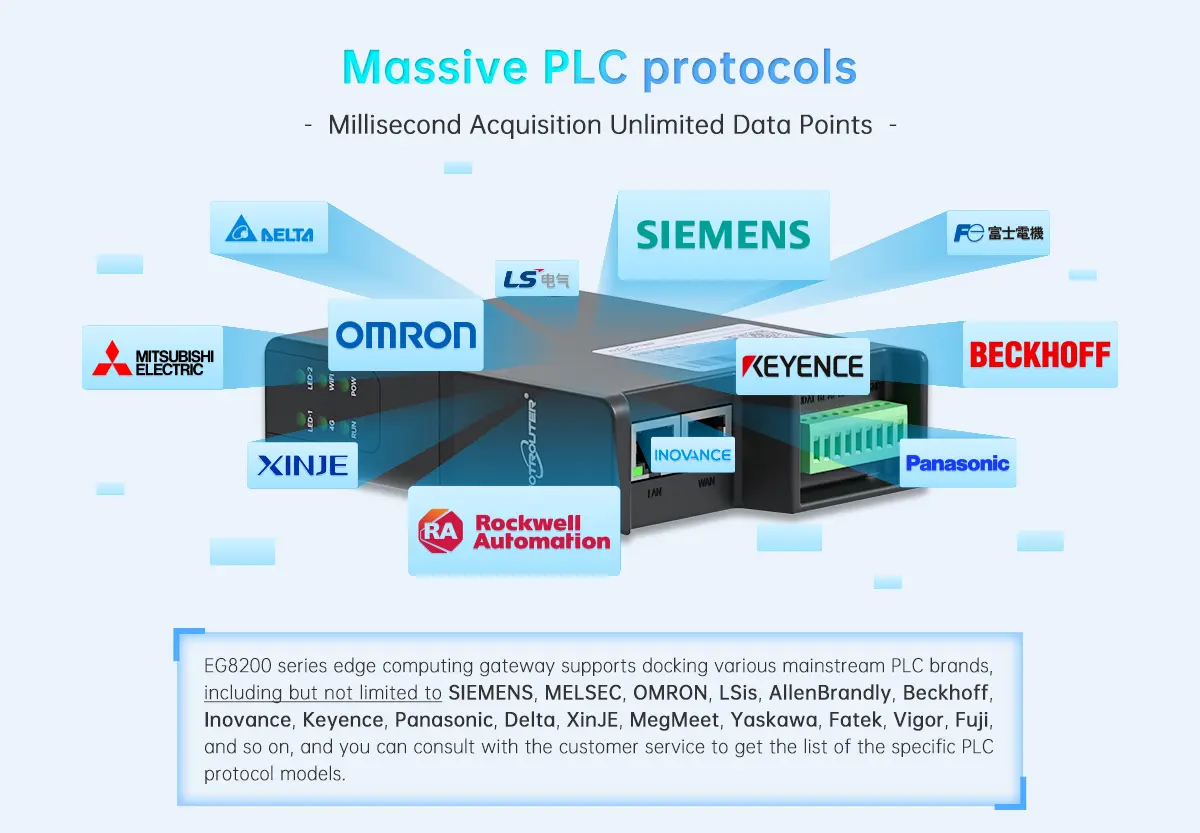
While understanding individual PLC communication protocols is important, many automation projects involve multiple protocols operating within the same system. Integrating devices from different manufacturers often requires protocol conversion, data collection, and centralized management. As a result, industrial gateways have become a practical solution for connecting PLCs, HMIs, SCADA systems, and cloud platforms across different communication standards.
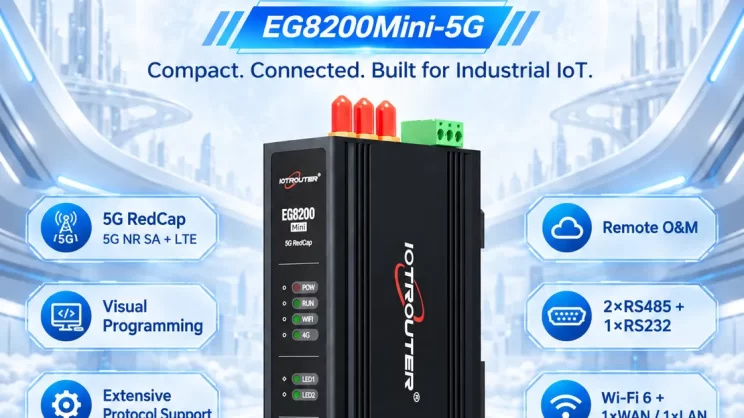
Bijvoorbeeld, IOTRouter EG Series Edge Gateways support docking various mainstream PLC brands, including but not limited to SIEMENS, MELSEC, OMRON, LSis, AllenBrandly, Beckhoff, Inovance, Keyence, Panasonic, Delta, XinJE, MegMeet, Yaskawa, Fatek, Vigor, Fuji, and so on.
Samenvatting
In practice, no single PLC communication protocol fits every scenario. Modbus and Profibus remain reliable for legacy systems, EtherCAT and Profinet excel in high-speed automation, and CAN is ideal for distributed or automotive networks. In real-world projects, the challenge is rarely choosing one protocol—it’s ensuring that devices, systems, and vendors can communicate effectively across multiple protocols. Taking the time to understand each protocol’s strengths and limitations and to plan for interoperability is key to building a stable, efficient, and future-proof automation system.

Agnes Wang is IoT-oplossingsspecialist bij IOTRouter en richt zich op industriële IoT-gateways, edge computing en oplossingen voor industriële automatisering.
Ze is gespecialiseerd in industriële communicatietechnologieën, waaronder Modbus, IEC 60870-5-104, MQTT, OPC UA, PLC-integratie en toepassingen voor monitoring op afstand. Ze levert bijdragen aan technische artikelen en toepassingsgidsen over industriële IoT-oplossingen, protocolconversie en edge computing.