IEC 60870-5-104, commonly known as IEC 104, and IEC 61850 are not simply older and newer alternatives. IEC 104 is commonly used for transmitting status information and measurements to dispatch centers, while IEC 61850 covers a more comprehensive set of information models and engineering methods for power system automation.
Five Questions to Ask Before Choosing IEC 104 or IEC 61850
| Question | Answer |
|---|---|
| Is IEC 61850 a single protocol? | No. It is a family of standards covering data semantics, services, mappings, engineering configuration language, and testing. |
| Can IEC 104 still be used? | Yes. It remains a TCP/IP-based telecontrol standard. Whether to use it depends on the interface requirements of the dispatch center and the station. |
| Can the two coexist? | Yes. IEC TS 61850-80-1 specifically guides exchanging information from common data class (CDC)-based models using IEC 101/104. |
| Does choosing IEC 61850 eliminate the need for point lists? | No. Logical nodes and SCL improve semantic consistency and engineering interoperability, but mapping, naming, and acceptance testing still need to be addressed. |
| Is a VPN alone sufficient for cybersecurity? | No. The IEC 62351 series addresses multiple layers of security, including authentication, access control, key management, and security logging. |
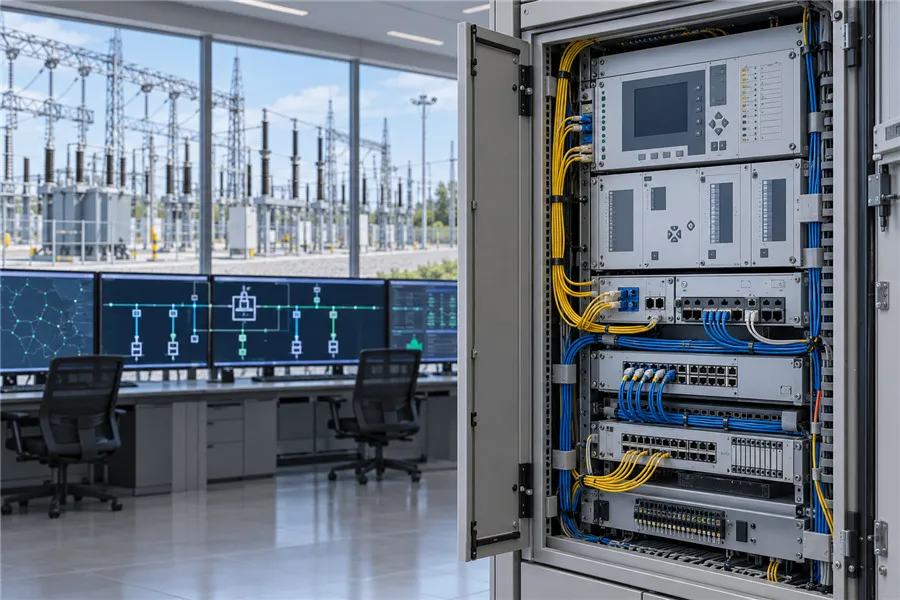
IEC 104 vs IEC 61850: Communication and Information Modeling Are Not the Same
| Aspect | IEC 60870-5-104 | IEC 61850 |
|---|---|---|
| Standard scope | Provides TCP/IP network access for IEC 60870-5-101. | A family of standards for communication networks and systems in power utility automation. |
| Common applications | Transmission of status information, measurements, and remote commands between stations or plants and dispatch/control centers. | IED interoperability within substations, substation automation, and broader power automation applications. |
| Data semantics | Primarily based on information objects and project-specific point lists. | Uses logical nodes, data objects, and service models to give data a more clearly defined meaning. |
| Engineering files | Typically relies on project point lists and vendor-specific configuration. | IEC 61850-6 defines SCL to describe IED and communication system configurations. |
| Security references | Relevant standards include IEC 62351-5. | Relevant standards include IEC 62351-3 and IEC 62351-4 for TCP/IP- and MMS-related security. |
| Common misconception | TCP connectivity is inherently secure. | An IEC 61850 label eliminates the need for engineering verification. |
| Adoption approach | Suited to projects with clearly defined dispatch center interfaces. | Suited to systems requiring comprehensive station-level modeling and coordination between IEDs. |
| Product selection | Verify the specific device’s IEC 104 client/server roles. | Verify the scope of MMS, GOOSE, SV, SCL, and conformance support. |
How to Choose for a Power System Project
If the goal is to connect station or plant measurements, status information, and remote controls to an existing dispatch system, and the upstream interface explicitly requires IEC 104, prioritize implementation around its information objects, causes of transmission, timestamps, and primary/backup communication link requirements.
If the project involves a new or upgraded substation automation system that requires consistent device models, engineering configuration, and interoperability between IEDs, IEC 61850 should form the basis of the system engineering approach.
These two scenarios are compatible. The key is to define the interface boundaries clearly.
Eight Items to Verify Before Selecting Equipment
| Item | Why it matters |
|---|---|
| Device roles | IEC 104 master/outstation roles and IEC 61850 client/server roles must be identified correctly and should not be treated as interchangeable. |
| Communication mappings | Confirm whether the application uses MMS, GOOSE, SV, or an IEC 104 data channel. |
| Data models | Ensure that point lists, logical nodes, data objects, and units are traceable. |
| SCL files | For IEC 61850 projects, define the required deliverables, including ICD, CID, and SCD files. |
| Time synchronization | Sequence-of-events recording and fault analysis depend on a consistent time source. |
| Network redundancy | Assess redundancy against business continuity requirements. Do not treat an ordinary office network as a substation control network. |
| Security controls | Verify accounts, certificates, keys, allowlists, and logging before commissioning. |
| Integration testing | Perform end-to-end verification using actual IEDs, dispatch systems, or suitable simulators. |
Where Do IOTRouter Products Fit?
For power data acquisition applications, the IOTRouter EG8200 series is the first choice for collecting data through IEC power protocols and transmitting it to the cloud.
Why Choose the EG8200?
- Power protocol support: Native support for reading and writing electricity meters using DL/T 645-2007, along with support for IEC power protocols such as IEC 104.
- Comprehensive interfaces: Dual RS485/RS232 serial interfaces for direct connection to electricity meters and multifunction power meters.
- Visual data acquisition: Node-RED graphical programming, with DL/T 645 nodes for directly configuring the data points to be collected.
- GPS positioning: Location tracking for geographically distributed power sites.
- Fast cloud integration: Store-and-forward data transmission during network outages, with support for integration with multiple platforms.
Select the Model That Matches Your Needs
| Vereiste | Recommended model | Key advantage |
|---|---|---|
| Standard power data acquisition | EG8200 — DIN-rail or standard version | The best value for money for standard power data acquisition. |
| IEC 104 communication | EG8200Mini-104 | Suited to projects requiring the IEC 104 protocol. |
| Many metering points and insufficient serial ports | EG8208 | Eight independent serial ports and eight independent sensor power supply channels. |
| Higher performance, comprehensive interfaces, and local storage | EG8200Pro | An octa-core processor, 2 GB RAM, analog input/output interfaces, and a local time-series database. |
FAQ: Common Misconceptions About IEC 104 and IEC 61850
Can IEC 104 transmit IEC 61850 data?
Yes, through clearly defined data mapping. IEC TS 61850-80-1 provides relevant guidance, but each mapping still needs to be specified individually.
Can GOOSE replace all IEC 104 communication?
No. GOOSE is a specific IEC 61850 service, and its intended applications differ from those of telecontrol communication links.
Is IEC 61850 only used in substations?
The standards family has expanded into other areas of power system automation. However, the scope of its use in a particular project is determined by the project specifications.
Does every existing station need to be fully converted to IEC 61850?
No. A phased assessment should consider equipment life, dispatch center interfaces, upgrade risks, and long-term operation and maintenance requirements.
Where should cybersecurity planning begin?
Start with an asset inventory, network segmentation, account permissions, and logging, then implement the relevant IEC 62351 requirements.
Conclusie
IEC 104 is suited to clearly defined TCP/IP telecontrol interfaces, while IEC 61850 is suited to more comprehensive power automation modeling and coordinated system engineering.
When selecting IOTRouter equipment, use the supported protocol roles and tested scope of the specific model as the basis for your decision.
Before choosing gateways and IEDs, finalize the system boundaries, device roles, and acceptance criteria.