Quick Answer: How to Choose Edge AI Accelerator?
For compute-intensive AI workloads, larger models, and high-speed PCIe connectivity, consider LQ50 (up to 160 TOPS, PCIe Gen4 x4, and 12–48GB memory options). For compact LLM/VLM inference and workloads that benefit from high internal memory bandwidth, consider RK182X (20 TOPS INT8, 3D-stacked DRAM, and up to 1TB/s peak internal bandwidth).
These two AI accelerator families serve different purposes rather than replacing each other. Start with your host platform, model size, and application requirements before selecting a card.
1. What Is an Edge AI Accelerator, and Why Are They So Different?
An edge AI accelerator is a computing module installed in an industrial PC, embedded computer, or edge gateway to add dedicated AI processing capability. Often connected through an M.2 PCIe interface, it helps the host run AI models locally without depending entirely on cloud computing.
Although these cards perform similar functions, their chip architectures can differ significantly. This affects computing performance, memory bandwidth, power requirements, and the workloads they handle best.
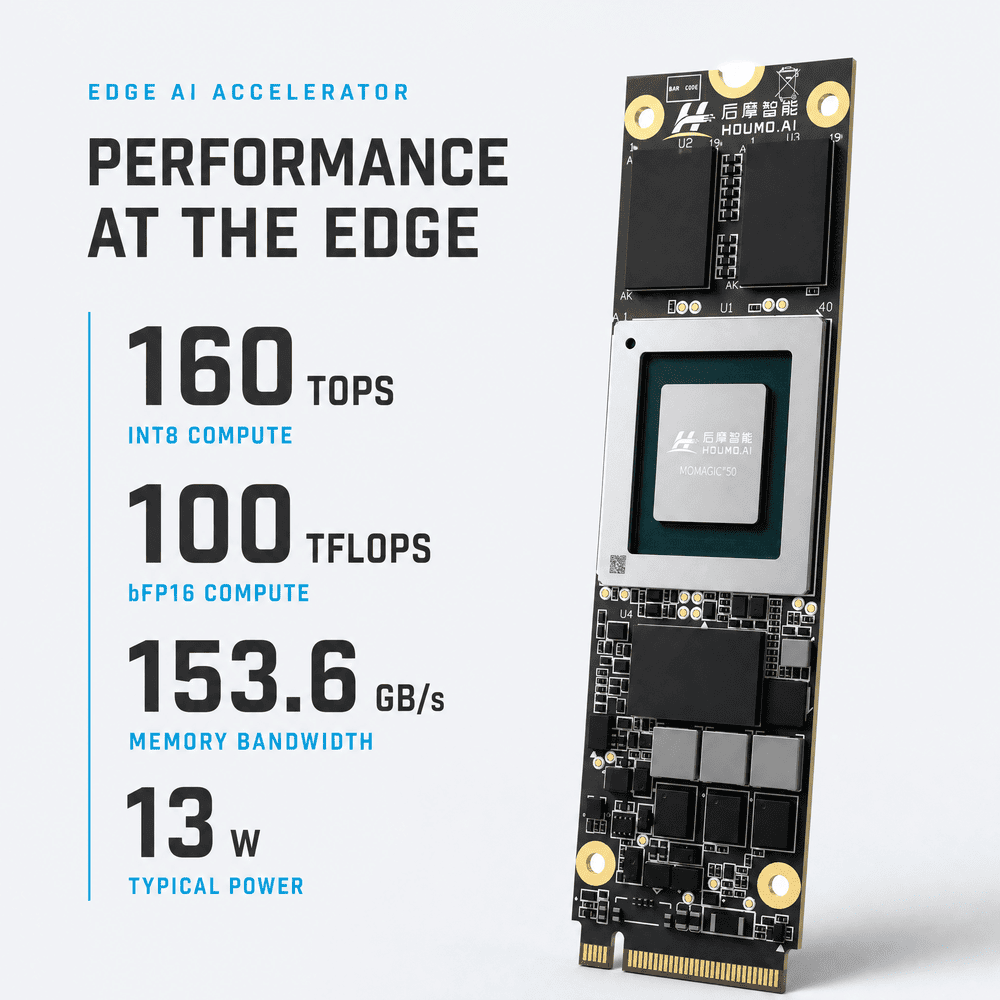
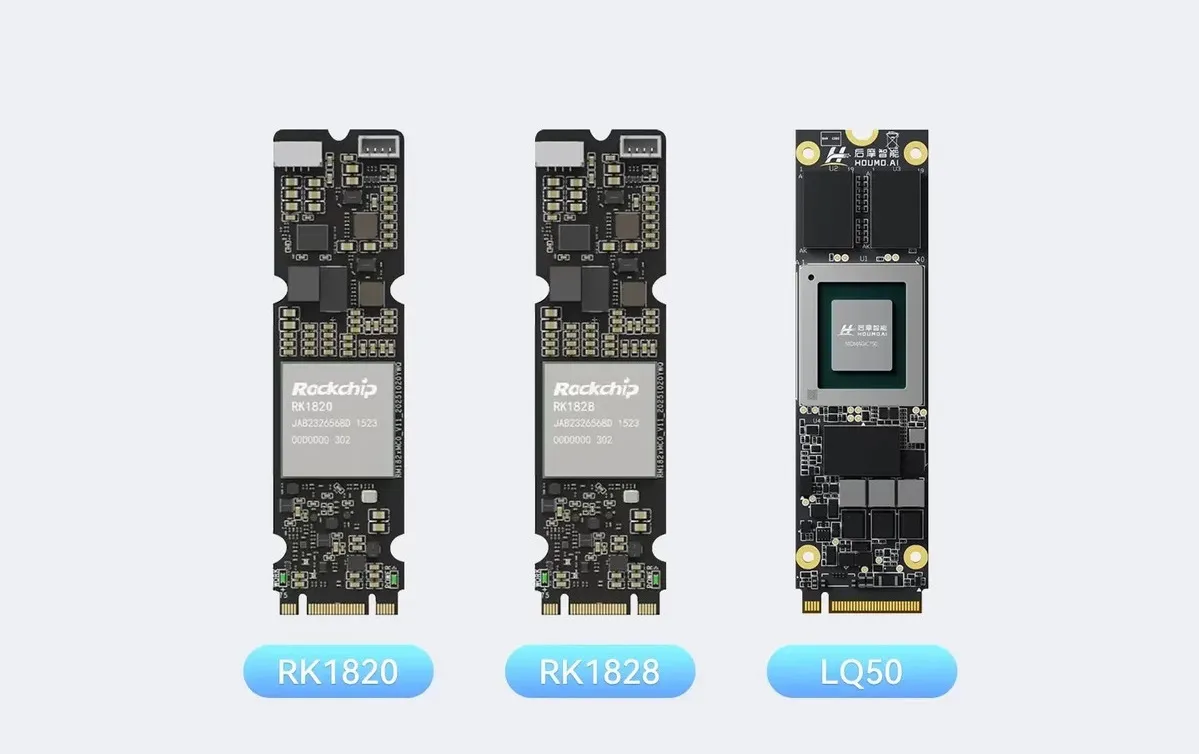
De LQ50 AI Accelerator from HOUMO AI and the RK182X AI Accelerator from Rockchip are two examples.
LQ50 uses a compute-in-memory-oriented architecture. Powered by the HOUMO M50 processor, it delivers up to 160 TOPS and offers 12–48GB LPDDR5/LPDDR5X memory options. It targets applications that need more compute and model memory, including larger LLMs and demanding vision workloads.
RK182X uses a 3D-stacked DRAM architecture. The series provides up to 20 TOPS INT8 performance, with peak internal memory bandwidth reaching the 1TB/s class. Its design focuses on reducing memory-access bottlenecks in suitable local LLM and VLM workloads.
Both use the M.2 form factor, but their strengths come from different approaches to computation and memory access.
2. LQ50, RK1820 and RK1828: Key Specifications
| Specificatie | LQ50 | RK1820 | RK1828 |
|---|---|---|---|
| AI compute | Up to 160 TOPS | 20 TOPS INT8 | 20 TOPS INT8 |
| Architectuur | Compute-in-memory-oriented IPU | 3D-stacked DRAM | 3D-stacked DRAM |
| Geheugen | 12–48GB LPDDR5/5X | 2.5GB DRAM | 5GB DRAM |
| Memory bandwidth | 153.6GB/s (24GB model) | Up to 1TB/s, series peak | Up to 1TB/s, series peak |
| PCIe interface | Gen4, up to x4; backward compatible | PCIe 2.0 x1 | PCIe 2.0 x1 |
| Model positioning | Larger LLM/VLM and vision workloads | 3B-class LLM/VLM | Up to 8B-class LLM/VLM |
Sources: Rockchip RK182X Series Datasheet Rev. 1.1, HOUMO LQ50 M.2 Product Introduction V1.0.7, and IOTRouter product specifications. LQ50 memory bandwidth refers to the documented 24GB model. RK182X bandwidth is a series-level peak specification.
LQ50 offers substantially more peak compute performance and larger memory configurations. RK182X offers much higher advertised internal memory bandwidth.
The distinction matters when running language models. Inference requires repeated access to model weights and other data. When memory access becomes the limiting factor, high internal bandwidth can improve performance even without a higher TOPS rating.
One detail is often overlooked: internal DRAM bandwidth and PCIe bandwidth are not the same thing.
LQ50’s PCIe Gen4 x4 interface provides high-speed communication with the host. RK182X’s 1TB/s-class figure describes data access within its own memory subsystem, not transfers to the host through PCIe.
3. Running 7B Models: What Do the Results Show?
For local 7B language-model inference, RK1828 is an option worth evaluating. It combines 5GB integrated DRAM with a high-bandwidth memory architecture designed for compact, quantized models.
The IOTRouter EC700 product specification includes the following published performance figures:
| Model | Accelerator | Reported decoding speed |
|---|---|---|
| Qwen2.5-3B | RK182X | 102.01 tokens/s |
| Qwen2.5-7B | RK182X | 70.26 tokens/s |
| Qwen2.5-7B | LQ50 | 25.07 tokens/s |
Source: IOTRouter EC700 Product Specification, Large Model Performance Metrics. RK182X results use 128 input and 128 output tokens. The LQ50 Qwen2.5-7B result uses approximately 250 input and 50 output tokens. These are separate test configurations, not a controlled head-to-head benchmark.
The figures show that a 20 TOPS accelerator can deliver strong token-generation performance. RK182X’s high internal memory bandwidth is particularly relevant to LLM inference workloads involving frequent model-weight access.
However, these results do not establish that RK182X is faster than LQ50 in every 7B deployment. Model quantization, inference software, context length, and test conditions also affect performance.
LQ50 offers considerably more compute capability and memory capacity, making it a relevant option for larger models, complex CNN workloads, and compute-intensive vision applications.
4. Host Compatibility: Can These Cards Work with Different Platforms?
Neither accelerator family is limited to RK3588.
According to IOTRouter’s RK182X module information, supported target platforms include x86, RK3588, RK3576, RK3572, RK3562, and RV1126B. RK182X uses a PCIe 2.0 x1 M.2 host interface and provides the RKNN 3.0 development toolchain.
LQ50 supports PCIe Gen4 with up to four lanes and backward compatibility with earlier PCIe generations and narrower lane configurations.
An RK3588 industrial motherboard can therefore be a candidate host, but neither card should be assumed to work simply because an M.2 slot is available.
Engineers should check PCIe connectivity, power delivery, driver support, and the required software environment before integration.
Thermal design also matters. HOUMO specifies 13W typical power consumption for the documented LQ50-24GB module. RK182X module documentation reports different power requirements under extreme conditions, so the two figures should not be used as a direct efficiency comparison.
For industrial installations, verify the accelerator’s operating temperature and cooling requirements separately from those of the host computer.
5. Which AI Accelerator Fits Your Application?
The selection depends on the model and the processing requirements.
| Toepassing | Suggested option | Main consideration |
|---|---|---|
| Local 3B LLM assistant | RK1820 | Compact model deployment |
| 7B local LLM inference | RK1828 | High internal memory bandwidth |
| Larger LLM workloads | LQ50 | More available model memory |
| Complex CNN and vision AI | LQ50 | Higher peak compute capability |
| VLM image understanding | LQ50 or RK182X | Model size and processing requirements |
| Combined language and vision workloads | Validated heterogeneous configuration | Separate compute requirements |
For example, an industrial maintenance assistant running a quantized 7B model may benefit from RK1828’s memory architecture. A vision system handling more demanding detection models may be better suited to LQ50’s additional compute capacity.
Both approaches can also be used in systems designed for heterogeneous AI processing.
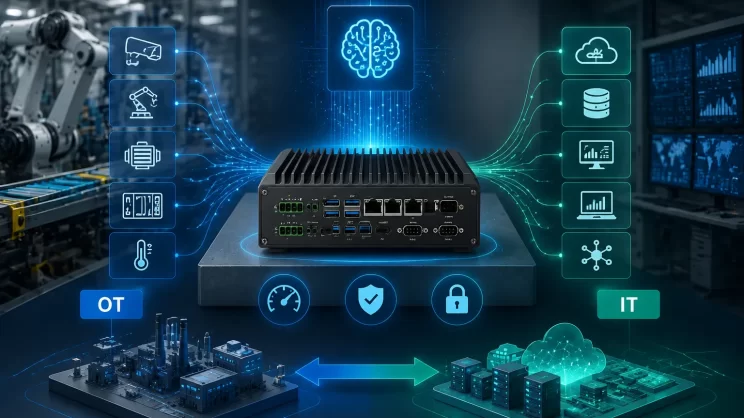
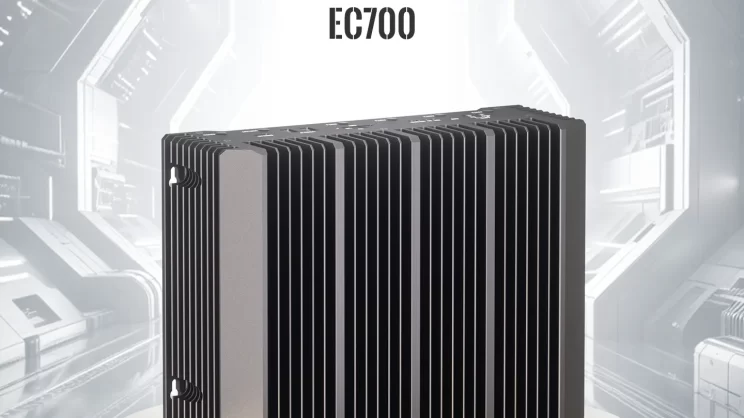
One example is the IOTRouter EC700 Industrial Edge AI Computer, powered by Rockchip RK3588J. It provides two M.2 PCIe expansion interfaces and supports accelerator options including RK182X and LQ50. Specific configurations, particularly mixed dual-card installations, require verification of PCIe resources, power, cooling, and software compatibility.
How to Choose Edge AI Accelerator? In short: choose RK182X for compact LLM/VLM workloads that benefit from high local memory bandwidth. Choose LQ50 when compute performance and larger model memory are the priorities.
FAQ
1. Is LQ50 more powerful than RK182X?
LQ50 provides up to 160 TOPS of AI compute performance, compared with 20 TOPS INT8 for RK182X. However, peak compute capability alone does not determine model inference speed.
2. What is the benefit of RK182X’s 1TB/s memory bandwidth?
It can help reduce memory-access bottlenecks when running workloads that repeatedly access model data. The advertised figure refers to peak internal DRAM bandwidth, not PCIe communication speed.
3. What is the difference between RK1820 and RK1828?
RK1820 has 2.5GB DRAM and targets 3B-class models. RK1828 has 5GB DRAM and is positioned for models up to the 8B class. Both provide up to 20 TOPS INT8 performance. Actual model support depends on quantization and runtime requirements.
4. Can these accelerator cards be used in ordinary PCs or industrial computers?
Yes, provided the host is compatible. M.2 interface availability alone is not sufficient; PCIe configuration, power delivery, drivers, and inference software must also be checked.
Technical References
- Rockchip Electronics, RK182X Series Datasheet, Revision 1.1, September 2025.
- HOUMO AI, LQ50 M.2 Card Product Introduction, Version 1.0.7, July 28, 2026.
- IOTRouter, EC700 Product Specification, Version 1.0, July 2026.
- IOTRouter RK182X Edge AI Accelerator Card
- IOTRouter LQ50 AI Accelerator Card