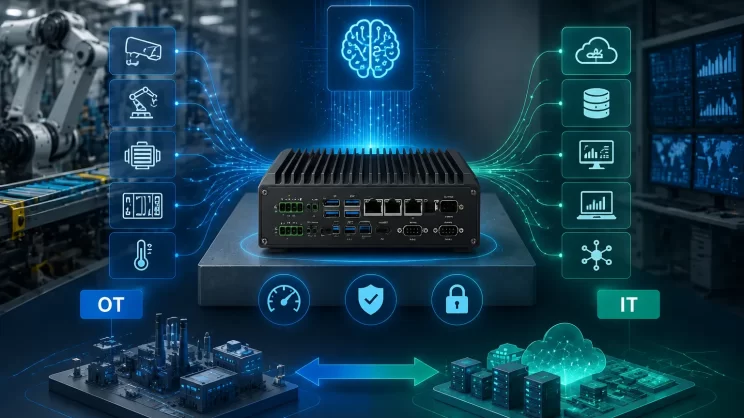
More and more devices are being connected to the industrial IoT. But this also brings a challenge: how to process growing data volumes locally while keeping existing equipment, protocols, and control systems running normally.
Traditional industrial PCs provide high-speed data processing, but they fall short in AI inference, protocol conversion, visualization, and application development, often requiring additional hardware and software layers. These add complexity and make the architecture harder to maintain.
De EC700 simplifies the architecture by integrating ARM computing, AI acceleration, industrial connectivity, and an open software environment into a single industrial computer. It is designed for Edge AI for Industrial Applications, enabling local data processing, AI inference, and intelligent decision-making closer to machines and production lines.
What makes the EC700 different?
The EC700 is powered by the Rockchip RK3588J – an industrial-grade octa-core processor with four Cortex‑A76 big cores and four Cortex‑A55 little cores, plus a Mali‑G610 MC4 GPU. Standard configuration includes 8 GB RAM and 128 GB eMMC storage.
1. AI capabilities
- Built-in 6 TOPS NPU can handle common vision tasks such as classification, detection, and segmentation.
- Standard dual M.2 PCIe high‑speed interfaces allow AI computing power to be expanded up to 320 TOPS.
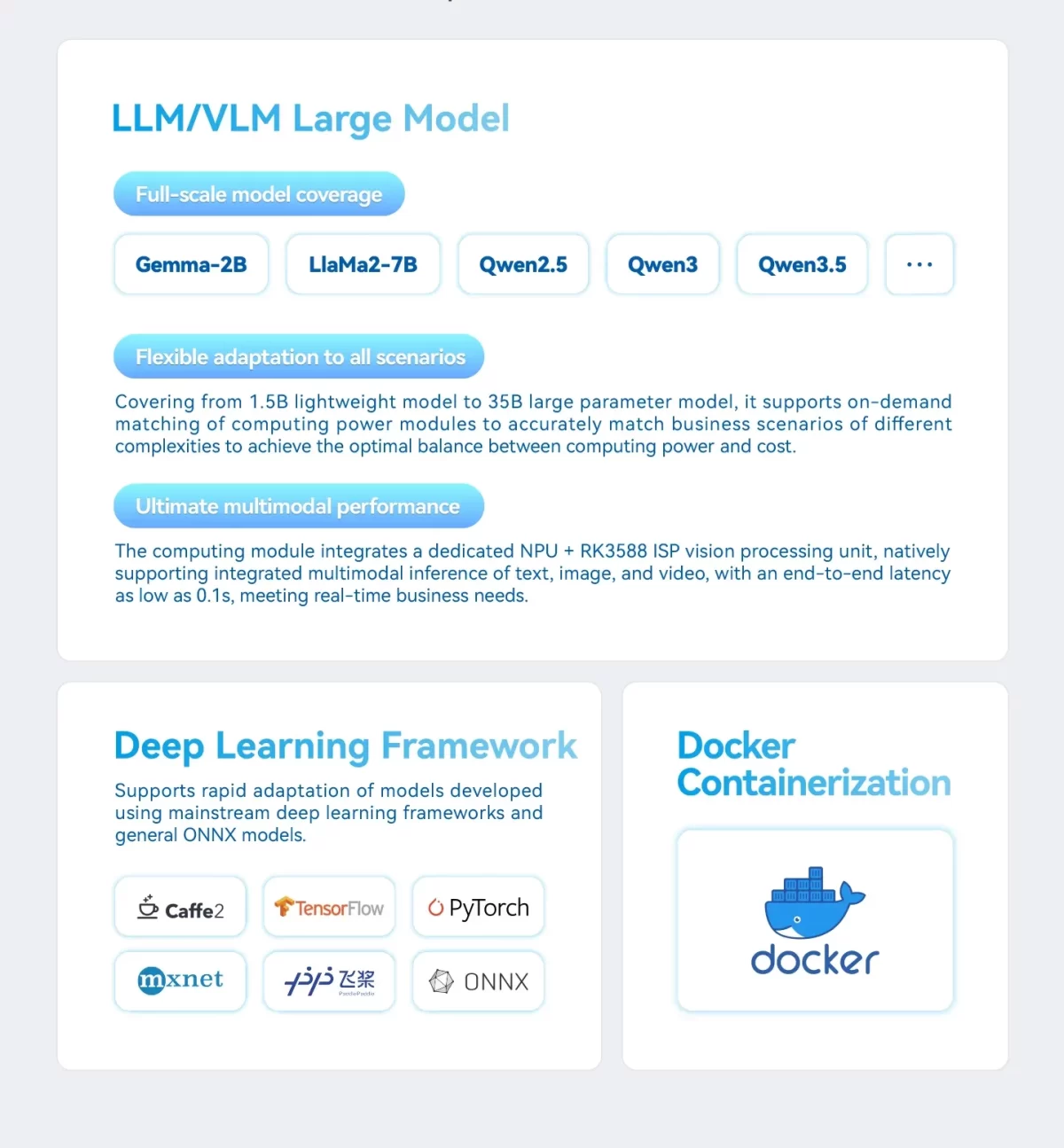
- Depending on the selected module, the EC700 supports local deployment from lightweight neural networks up to 35B‑parameter large models, covering LLM/VLM models in the range of approximately 1.5B to 35B parameters, including Gemma, LLaMA2, Qwen series, and more.
- Compatible with mainstream deep learning frameworks such as TensorFlow and PyTorch, with flexible deployment based on Docker containers.
2. Software
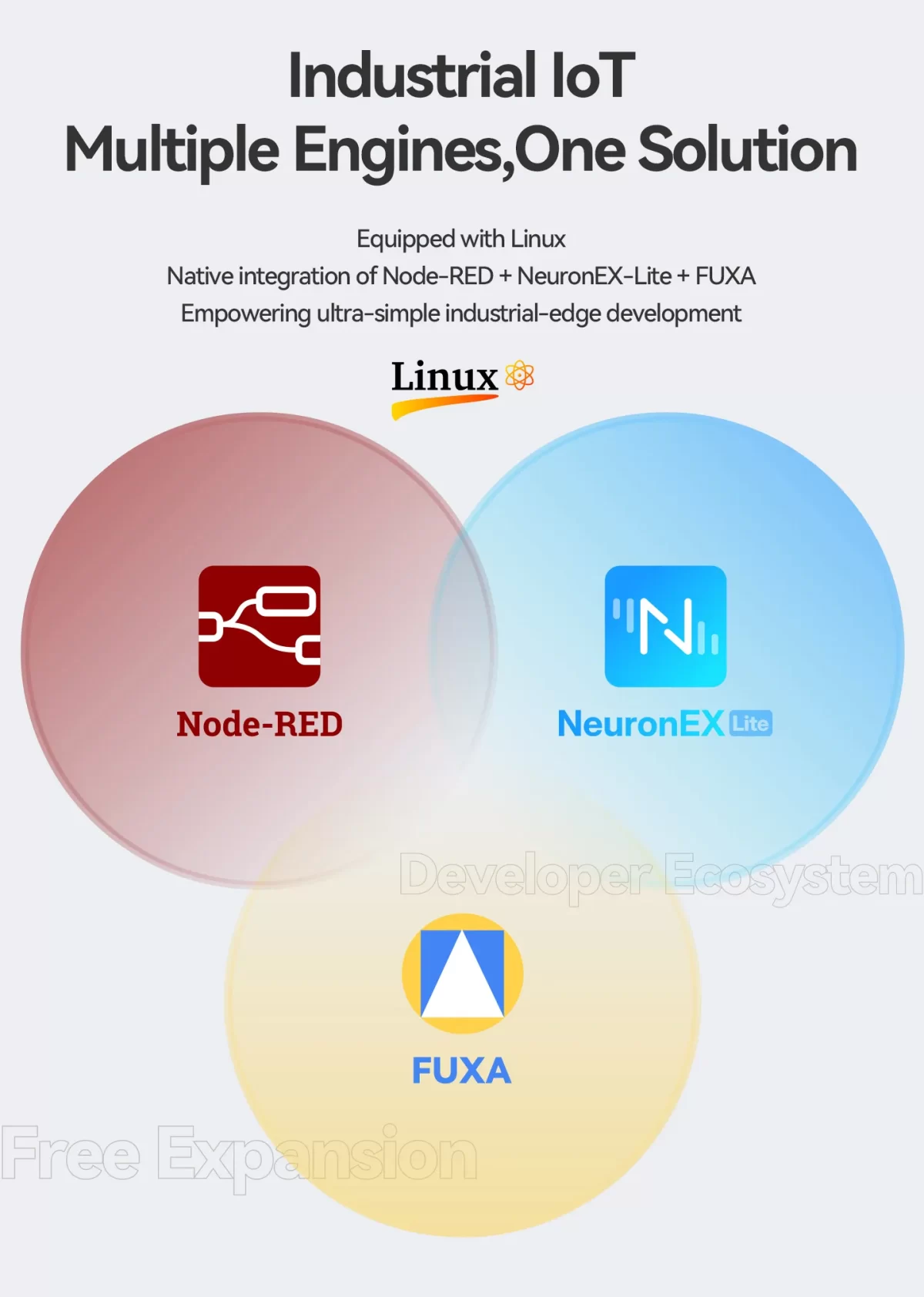
The device comes pre‑installed with three tools that work together:
- Node‑RED 4.0 – visual logic design.
- NeuronEX‑Lite – unified access to 100+ industrial protocols for data acquisition and protocol conversion from PLCs, instruments, sensors, and other equipment.
- FUXA – drag‑and‑drop HMI control interface, supporting a 200+ component library, multi‑end collaboration, and millisecond‑level visualisation of equipment status.
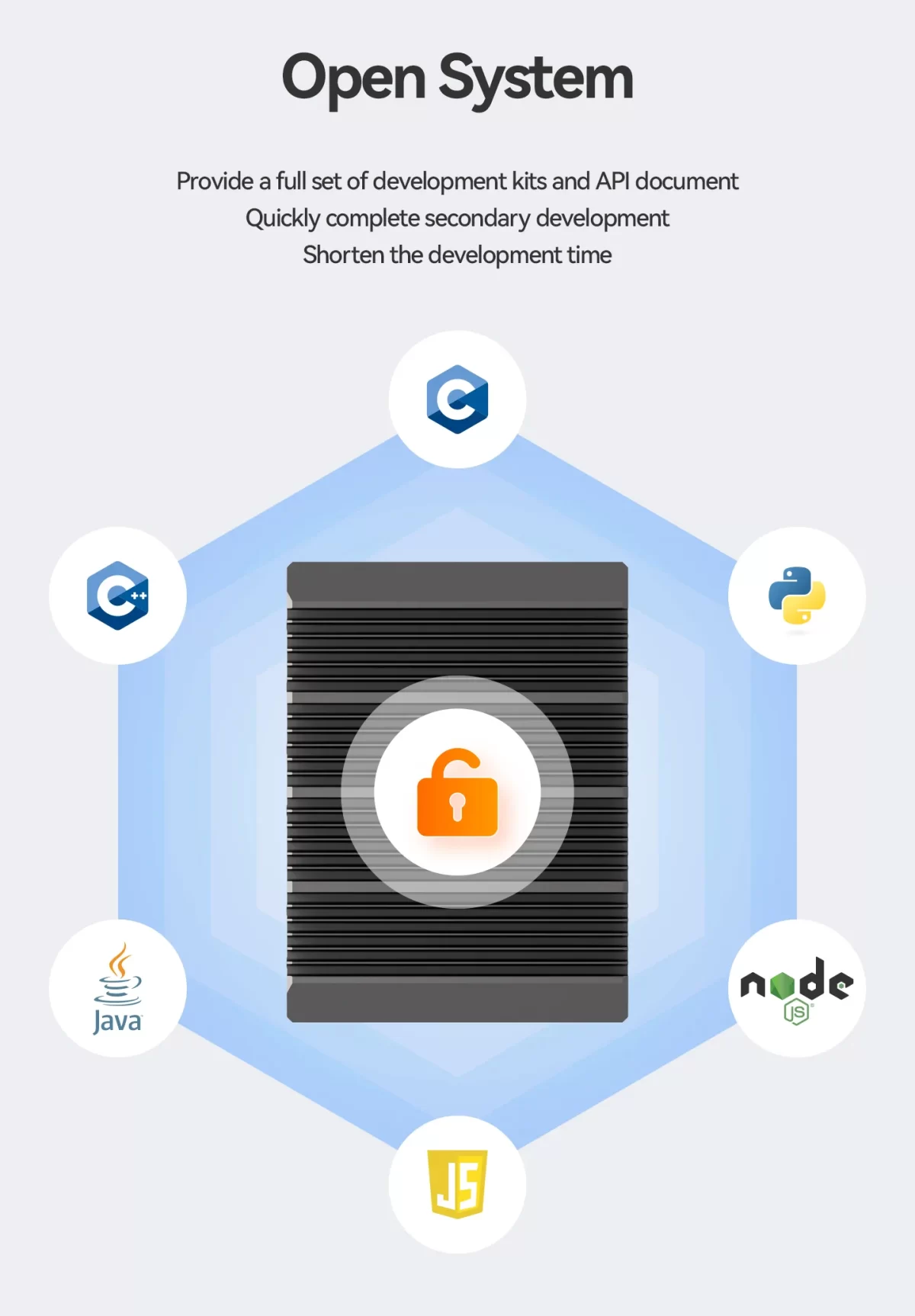
The system is based on Linux and supports secondary development in C/C++, Python, Java, Node.js, and JavaScript. The open architecture allows engineers to freely develop gateway functions according to application requirements, significantly shortening development cycles.
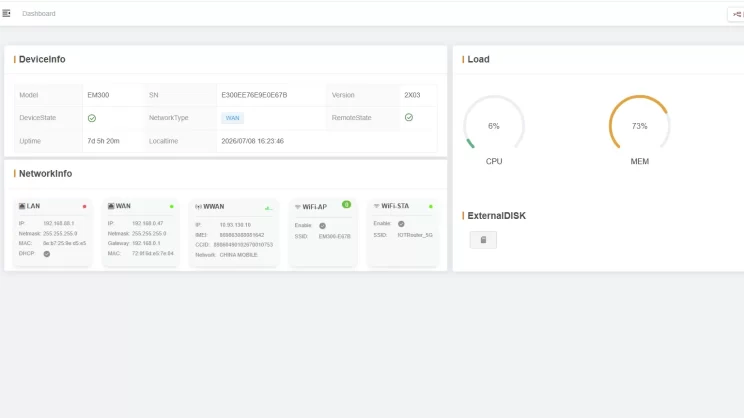
- A complete device management dashboard provides visibility into device running status, CPU/memory/disk load, network configuration, firewall rules, etc., reducing operational maintenance complexity.
- Free remote operation and maintenance software is provided, supporting remote configuration and remote debugging, so device maintenance can be performed efficiently from home, office, or outdoors.
3. Hardware
- Industrial‑grade thermal design: all‑metal finned chassis + dual pure‑copper heat pipes + SoC direct‑contact thermal base.
- Robust quality: wide temperature operation from -20°C to 70°C, DC 12 V power supply, hardware watchdog, fully isolated interfaces, anti‑static, surge protection, reverse polarity protection – multiple protections to withstand industrial environments.
4. Rich I/O interfaces
The EC700 supports a rich set of I/O interfaces, including RS485×2, RS232×1, DI×1, DO×2, USB3.0×4, enabling connection to a variety of equipment interfaces. This means it can not only “compute” but also truly “connect to the field”. This is a key differentiator, because many AI boxes on the market have computing power but lack industrial I/O. In real deployment, they ultimately require external PLCs or I/O modules, which complicates the system. The EC700 is itself an edge computing platform built for industrial sites.
5. Multiple network connections
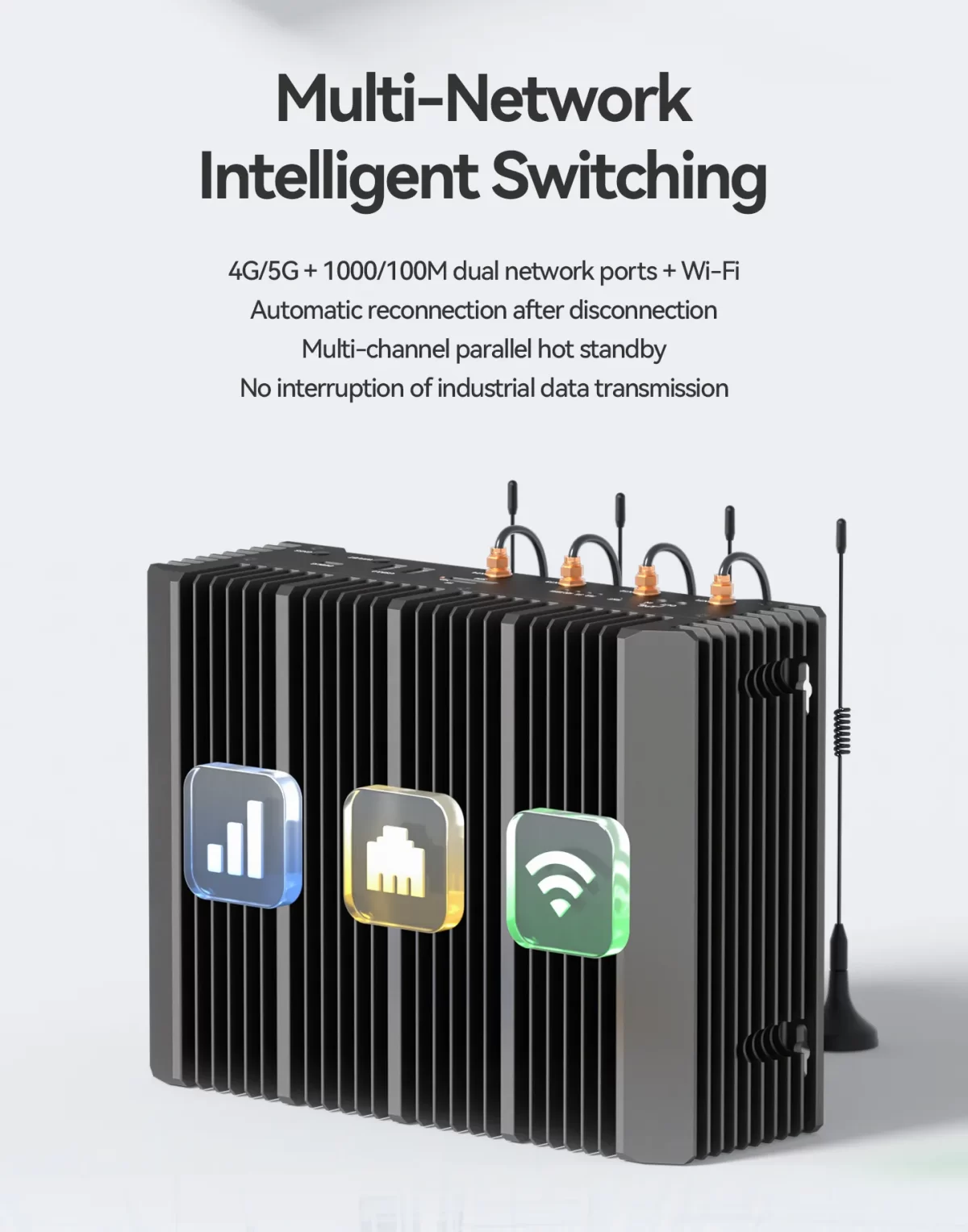
Dual Gigabit Ethernet ports, optional 4G/5G, optional Wi‑Fi 6. Automatic reconnection on disconnection and active‑standby switchover ensure uninterrupted connectivity. This is important for remote sites where network reliability cannot be guaranteed.
EC700 vs. traditional industrial PC
| Aspect | Traditional Industrial PC | EC700 |
|---|---|---|
| Kernfunctie | Focused on general computing | Computing + AI acceleration |
| Protocol gateway | May require external gateway | NeuronEX‑Lite integrated |
| HMI/visualisation | Requires separate HMI software | FUXA integrated |
| AI acceleration | External GPU or external device | Built‑in NPU + M.2 expansion |
| Upgrade path | Replace entire unit | Add M.2 computing module |
| Software environment | General‑purpose OS or custom Linux | Open Linux + Docker + SDK |
| Development tools | Relies on third‑party tools | Node‑RED + API integration |
To upgrade AI capability on a traditional industrial PC, additional hardware or architecture changes are usually needed, whereas the EC700 only requires adding an M.2 computing module. Start with the built‑in NPU for basic tasks, and scale up as model requirements grow, while keeping the base hardware unchanged.
With one EC700, you can easily achieve the core function of running models locally and communicating with cloud systems on demand.
Why are more and more industrial AI applications choosing edge deployment?
Many earlier AI projects used a “cloud recognition” approach: cameras upload video → cloud analysis → return results. This model works in the internet industry, but in industrial settings the problems are obvious:
- Latency is too high. Industrial control often requires millisecond‑level response – for example, defect detection, safety recognition, AGV obstacle avoidance, robotic arm positioning, etc. If you wait for video to be uploaded to the cloud and analysed, the delay is unacceptable.
- Bandwidth costs are too high. A 2‑megapixel camera continuously uploading video streams places extreme demands on the network. In a factory with dozens or hundreds of cameras, network bandwidth and storage costs increase significantly.
- Data security concerns – many manufacturers simply do not allow it. Production video, process data, MES data, PLC data – uploading such sensitive data to the public cloud introduces significant risks.
Therefore, more and more manufacturers are adopting Edge AI for Industrial Applications, using local AI inference and edge computing to improve response time, reduce cloud dependency, and protect industrial data.
What Edge AI Applications Are Suitable for Industrial Environments?
When many people hear “AI”, they think of ChatGPT or large language models. But the biggest market for industrial AI is not chatbots – it is vision + data + control, areas that are more common and more likely to generate real value.
1. Machine vision inspection
Machine vision inspection is one of the most common Edge AI applications in industrial environments and is currently one of the largest application areas for the EC700. Examples include: PCB defect detection, label OCR recognition, product appearance inspection, part dimension measurement, packaging integrity inspection, etc.
The EC700’s built‑in 6 TOPS NPU can directly deploy a variety of models. Collect image data from industrial cameras and perform local AI inference on the EC700, reducing reliance on standalone AI servers and cloud inference resources.
2. AI + PLC data analysis
Industrial sites are not only about images – there is also a large amount of equipment data, such as temperature, pressure, current, vibration, PLC point data, etc. Traditional PLCs can only do logic control, but the EC700 can perform edge AI data analysis locally, which is a typical example of how edge AI is applied in industrial automation. For example, equipment status analysis, anomaly detection, vibration spectrum analysis, etc., greatly lowering the barrier to data analysis.
3. AI AGV and robotics
Another core application area for the EC700 is AGVs, AMRs, and robotics. Why? Because they require video data processing, LiDAR and multi‑sensor data fusion, real‑time control, and AI inference capability. Therefore, they need an AI edge computing device like the EC700.
In AGV scenarios, the EC700 can enable visual navigation, target recognition, path analysis, and PLC interfacing. Previously, this required a combination of industrial PCs, PLCs, I/O modules, AI boxes, etc. Now, a single EC700 can integrate some of the computing, communication, and edge control functions, reducing the number of additional devices.
EC700 is not just an AI box – it is an AI Edge Computing Industrial PC
Many RK3588 products only have HDMI and USB, and are essentially consumer‑grade development boards. The key difference of the EC700 is that it truly considers industrial deployment, including: industrial I/O, industrial protocols, industrial power supply, EMC, wide‑temperature design, DIN‑rail mounting, remote operation and maintenance, Node‑RED, industrial protocol conversion – these are the factors that really determine whether a project can be successfully delivered.
FAQ
What is the EC700 AI Edge Computing Industrial PC?
It is an ARM‑based industrial computer powered by the RK3588J processor, with a built‑in NPU, M.2 PCIe computing module expansion, pre‑installed software (Node‑RED, NeuronEX‑Lite, FUXA), running in an open Linux environment. It is designed for industrial automation, vision inspection, predictive maintenance, and edge AI applications.
Can the EC700 run AI models locally?
Yes. The built‑in 6 TOPS NPU handles common vision models. With M.2 computing modules, the platform supports local inference for up to 35B‑parameter models, depending on module configuration and optimisation.
Which industrial protocols does the EC700 support?
Through NeuronEX‑Lite, it supports more than 100 industrial protocols, including Modbus (RTU/TCP), OPC UA, EtherNet/IP, IEC 60870‑5‑104, and various PLC‑specific drivers.
Can developers install their own applications?
Yes. It runs an open Linux system with root access and provides SDK/API support for C/C++, Python, Java, Node.js, and JavaScript. You can install your own applications and also extend the pre‑installed tools.
What are the benefits of Edge AI for industrial applications?
Edge AI allows AI models to run closer to machines and devices instead of relying entirely on cloud computing. In industrial environments, this helps reduce latency, improve data security, lower bandwidth requirements, and enable real-time decision-making.