Inleiding
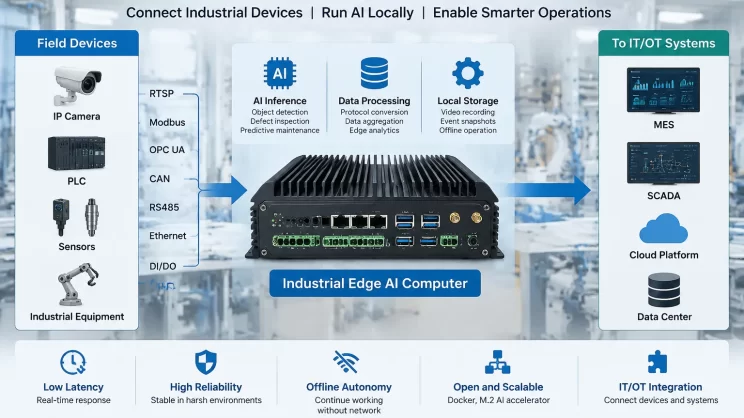
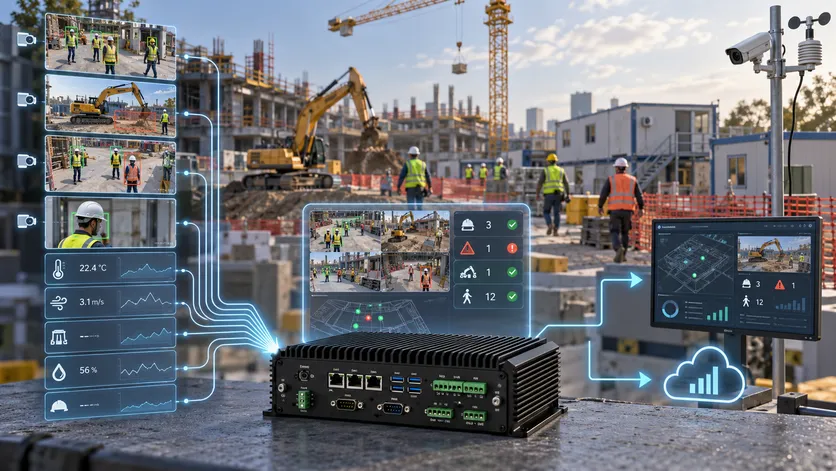
Edge AI for construction sites is an architecture that processes data locally at the jobsite. Construction data is scattered across video, equipment, and environmental systems—and the real challenge is combining them into meaningful safety events on site. By deploying an industrial edge AI computer with on-site AI inference, construction sites can run video decoding and AI inference locally, ingest equipment status and environmental sensor data, and generate safety events through local business logic. This supports PPE (Personal Protective Equipment) monitoring, restricted area monitoring, tower crane safety monitoring, worker-equipment proximity detection, and local video analytics in weak-network environments.
This article uses the EC700 Industrial Edge AI Computer as a reference platform to explain how this architecture supports AI video analytics for construction sites, construction site safety monitoring, and IoT integration.
Why Construction Sites Need Edge AI
Edge AI for construction sites is especially useful when multiple camera streams, time-sensitive safety events, and field-device data need local processing. Before discussing specific applications, it helps to understand three engineering realities that drive the need for local processing. These three realities correspond to the sections that follow: local video analytics, safety monitoring, and IoT integration.
Multiple camera streams. As the number of cameras grows, continuously uploading every stream increases upstream bandwidth usage. On sites relying on temporary 4G or 5G connectivity, cloud-side analytics can also become more sensitive to network quality.
Safety events need fast local response. When a tower crane is operating and a worker enters its lifting zone, a cloud-based pipeline must upload video, process it remotely, and send back a result. That round trip adds latency that can weaken an alert’s effectiveness.
Construction data is more than video. Wind speed, dust concentration, crane status, and equipment operating status can add important context to site safety events. For multi-source applications, an edge system can ingest these data types alongside video and apply business logic that reflects actual site conditions.
Cloud platforms remain useful for centralized management, long-term storage, and multi-site analytics. The edge layer is better suited to time-sensitive processing that benefits from running close to the data source. The next three sections discuss the technical foundation of local video analytics, the core applications in safety monitoring, and how IoT integration makes event decisions more complete.
AI Video Analytics for Construction Sites
AI video analytics for construction sites is the foundational capability of edge AI in this context. Its core task is to complete the full chain from video stream to structured event on site: camera video enters the system, is decoded, frames are sent to an AI model for inference, the model output is evaluated by business logic, and an event is generated.
This processing chain places simultaneous demands on multiple platform resources. Video codec capability affects multi-stream processing capacity; NPU, model architecture, and software optimization together affect AI inference performance; CPU, memory, and storage handle business logic, databases, communication services, and other application workloads. Real system performance depends on the entire processing chain, not on any single parameter. Camera count, FPS, and inference latency depend on the model, resolution, codec, accelerator, memory requirements, and software optimization—and must be validated for the specific application.
Local processing also helps in weak-network environments. Construction sites often rely on temporary connectivity. Depending on the application, the system can upload metadata, snapshots, selected clips, or alarm records instead of continuously sending every raw video stream. When inference and event logic are deployed locally, core site-side functions can continue without relying on a continuous cloud connection. Event synchronization after connectivity is restored depends on the application architecture.
Construction Site Safety Monitoring Applications
Safety monitoring is one of the main applications for edge AI on construction sites. Three relevant deployment scenarios are outlined below.
PPE and Restricted Area Monitoring
This is the most basic form of AI video analytics in safety monitoring. Camera video is decoded at the edge and sent to a vision model, which identifies personnel and PPE status. The application then evaluates whether a restricted area event has occurred based on worker location and pre-configured zone rules.
PPE detection alone provides only one dimension of safety information. PPE status becomes more useful when it is combined with worker location and site rules. If a worker is not wearing a hard hat, recording a single detection result has limited value. But if that worker is also inside a configured hazardous zone, the project can assign a higher priority to that event according to site rules. This requires the edge computer to complete inference locally and immediately evaluate the detection against zone rules to generate a contextual safety event.
In the reference architecture described here, EC700 does not ship with a fixed PPE detection algorithm. System integrators can deploy vision models they have trained or adapted for the project. EC700 provides the NPU compute, video processing capability, open operating system, and containerized deployment environment needed to run these applications. If the project also requires integration with on-site alarms or equipment status, industrial I/O and communication interfaces can connect to the corresponding workflows.
Tower Crane Safety Monitoring
Tower crane safety monitoring raises the bar for local video analytics. It requires not only detecting people, but also combining detection results with crane operating status.
The typical logic chain is: a camera provides the video stream, the edge AI model detects a person, and the edge computer evaluates whether that person is inside the crane’s danger zone. If crane operating status is available through a controller interface or digital input, the application can incorporate that status into its event logic—so the same person entering the danger zone can be assigned different event priorities depending on whether the crane is stationary or slewing.
Construction safety guidance from industry bodies such as the Construction Industry Council (CIC) requires danger zones to be defined through site-specific risk assessment. For tower cranes, the guidance specifies minimum danger-zone extents around the crane hook and lifted load, while mobile plant detection ranges are configured according to site conditions.
The integration challenge is to keep video inference, equipment data, and event logic in the same local workflow. Decoding video, running inference, evaluating zone boundaries, reading crane status, and triggering outputs—if these steps are spread across multiple independent systems, they often increase system integration, data synchronization, and maintenance complexity.
Worker-Equipment Proximity Detection
Excavators, loaders, and trucks create moving danger zones that change with every swing and turn. For mobile equipment, relying on a fixed ROI alone is often insufficient to describe a constantly changing risk area.
CPWR resources on construction struck-by hazards highlight heavy-equipment blind spots as an important risk factor. If a worker enters a machine’s blind spot or a defined risk radius, an edge system can generate a warning.
The real edge AI workload for this application involves concurrent video decoding, AI inference, business logic, database logging, and network communication. When equipment is stationary, a fixed ROI can work. Dynamic danger-zone applications may require project-specific methods to track equipment position or operating state and update the risk zone accordingly. For object-detection workloads, outputs such as bounding boxes, class labels, and confidence scores can enter a business-rules engine that compares detections against the current zone geometry. This is why TOPS alone is an incomplete metric. The system must support the entire processing chain, not just accelerate one stage.
IoT Integration for Construction Sites
The safety monitoring applications above focus mainly on video analytics. But construction sites generate far more than video. Video analytics can identify people and their location, but video alone may not provide tower crane operating status, wind speed, or other equipment data. IoT integration brings this non-video data into the same processing flow to make safety event decisions more complete.
For example, an edge AI application detects a worker entering a tower crane lifting zone from the camera stream. The tower crane controller reports that the crane is operating. A wind sensor reports a value above a threshold configured by the project team. Each input has a value on its own, but combining them provides more context for the event. A project-specific rules engine can combine these inputs and classify the event with a higher priority according to the site’s configured safety logic.
The platform does not define safety rules. It provides the computing environment in which project-specific rules can be implemented. These rules are project-specific, not fixed functions of the hardware.
Industrial interfaces play a key role in this process. RS485 and RS232 can connect compatible sensors and equipment controllers, digital I/O can be incorporated into customer-designed status and alarm workflows, and Ethernet connects cameras, local networks, and upstream systems. An open Linux environment with Docker support allows integrators to deploy their own business logic—whether that is a Python service reading Modbus registers, a Node-RED flow correlating sensor data, or a custom application that writes events to a local database and publishes MQTT messages upstream.
For projects that only need to publish Modbus sensor data to MQTT, a simpler industrial gateway may be sufficient. An edge computing platform is designed for combined workloads: video AI + IoT data + local applications running on the same platform.
Edge AI Computer Requirements for Construction
If system integrators want to deploy local video analytics, safety monitoring, and IoT integration on construction sites, they need an edge computing platform that can handle all three workloads. The following five areas are core evaluation criteria.
| Evaluation Area | Key Considerations |
|---|---|
| Video processing | Multi-stream decoding, resolution, codecs |
| AI inference | Model compatibility, real inference performance, compute expansion |
| Industrial interfaces | Connection methods for sensors, controllers, alarm devices |
| Software environment | Deployment of custom applications, databases, and communication services |
| Industrial reliability | Cooling method, operating temperature, long-term operation |
TOPS does not equal real-world performance. AI inference speed is affected by model architecture, input resolution, quantization method, memory bandwidth, and software optimization. The same NPU compute can produce very different frame rates and latency depending on the model. Selection should be based on actual test results with the target model, not just the nominal compute figure.
Industrial interfaces directly affect how AI + IoT integration is implemented. Video analytics mainly answers “what is seen,” but safety event decisions often require equipment status and environmental data. Serial ports, digital I/O, and industrial Ethernet can connect tower crane controllers, wind sensors, and alarm devices into the same processing flow. Missing industrial interfaces that match the on-site equipment increases the integration complexity between AI video systems and IoT data sources.
Open Linux + Docker increases deployment flexibility for system integrators. Safety rules, alarm logic, and platform integration methods vary from project to project. Some fixed-function AI boxes are designed around preset algorithms and applications, while an open Linux and Docker environment allows integrators to deploy their own AI inference services, local databases, MQTT or REST communication services, dashboards, and business logic. This is a key difference between open edge computing platforms and fixed-function AI boxes.
How EC700 Maps to These Requirements
EC700 is based on the RK3588J, integrates a 6 TOPS NPU, and supports 8K video decoding and 4K encoding. For higher AI compute requirements, it can be expanded via an M.2 PCIe AI accelerator, with configurations up to 320 TOPS. The device also provides RS485, RS232, digital I/O, dual Gigabit Ethernet, and an open Linux and Docker environment, with a fanless design and an operating temperature range of -20°C to 70°C.
These capabilities do not directly determine camera count or model performance. They provide a unified operating platform for video AI, IoT data ingestion, and customer applications. Actual performance still needs to be validated against the specific model and workload.
Reference Architecture
A tower crane monitoring system shows how these requirements come together in practice. Figure 1 shows the basic data flow.
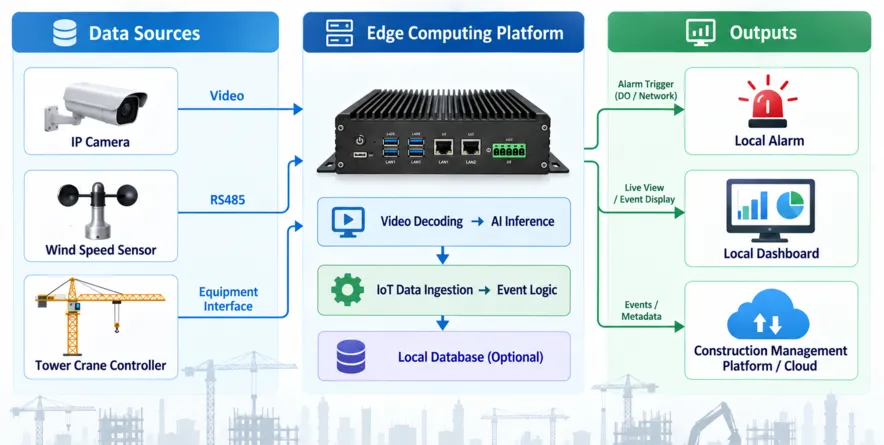
In this architecture, the edge computing platform receives data from cameras, sensors, and equipment controllers simultaneously. It completes video decoding, AI inference, IoT data ingestion, and event logic evaluation locally. If the evaluation result meets the trigger conditions, the platform can trigger a local alarm through a digital output or network interface and, depending on the application configuration, send events, metadata, snapshots, or other necessary results to the construction management platform—rather than continuously uploading all raw video streams.
For example, camera video enters the edge computing platform, and the AI model running on the platform detects a person inside the tower crane danger zone. The platform reads the crane operating status from the crane controller, and the wind sensor reports a value above the preset threshold. The rules engine in the platform classifies the event according to the project’s pre-configured safety logic. When the corresponding trigger conditions are met, the application can use EC700’s digital output or network interface to interact with customer-configured audible and visual alarm devices, and simultaneously send an event record to the construction management platform.
The specific connection method depends on the interfaces or protocols actually available on the tower crane controller.
In this architecture, EC700 can serve as one option for the edge computing platform. It provides a unified local operating platform for video processing, AI inference, IoT data ingestion, and customer applications, allowing integrators to complete system integration around their own AI models and business logic.
This flow reflects the goals of smart construction site safety systems. CIC guidance on smart site safety systems describes automated warning methods for detecting unauthorized entry into defined danger zones and alerting relevant personnel.
Deployment Validation
The reference architecture explains how the system should operate, but several key points still need to be validated before actual deployment. Before selecting a specific hardware configuration, integrators should validate the following four items for the construction site project.
Camera resolution and codec compatibility. Confirm that the video streams required by the project—resolution, codec, frame rate—are supported by the platform’s decoding capability. The specific combination of concurrent video streams must be tested against the actual deployment scenario.
Model compatibility. Verify that the AI models planned for deployment can be converted, deployed, and executed on the target NPU while meeting the project’s accuracy and response-time requirements. Model architecture, input resolution, and quantization method all affect inference speed and accuracy.
CPU, NPU, and RAM combined load. A construction site edge system rarely runs just one model. It may run object detection, zone logic, database operations, MQTT publishing, and a local dashboard simultaneously. The memory and storage configuration must be evaluated against the full application combination. Memory and storage headroom matter as much as TOPS.
End-to-end alarm response. The time from video input to the intended response—including decoding, inference, business logic evaluation, and local alarm or platform event output—should be measured against project requirements.
Conclusie
The value of construction AI is not just in detecting people, equipment, or events. It comes from combining video, equipment status, and sensor data to better understand what is happening on site and support faster local response.
Edge AI for construction sites brings that processing closer to the source. As these systems become more integrated, the edge will play a bigger role in turning raw site data into decisions that can be acted on immediately.
References and Further Reading

Agnes Wang is IoT-oplossingsspecialist bij IOTRouter en richt zich op industriële IoT-gateways, edge computing en oplossingen voor industriële automatisering.
Ze is gespecialiseerd in industriële communicatietechnologieën, waaronder Modbus, IEC 60870-5-104, MQTT, OPC UA, PLC-integratie en toepassingen voor monitoring op afstand. Ze levert bijdragen aan technische artikelen en toepassingsgidsen over industriële IoT-oplossingen, protocolconversie en edge computing.