As introduced in other articles on this site, ZigBee is a short-distance wireless communication technology, which is characterized by flexible networking, easy use, reliable operation, and low price. In many IoT applications, ZigBee is used for communication. In some terminals of functional home appliances, including some IoT solutions converged through gateways, ZigBee is used in downlink communication. ZigBee technology is a short-distance, low-speed Power-consuming wireless communication technology characterized by short distance, low complexity, self-organization, low power consumption, and low data rate.
Esistono tre metodi principali di collegamento in rete Zigbee network topologia. Parliamone uno per uno. I tre metodi di rete di Zigbee network topologia:
1. Topologia ad albero
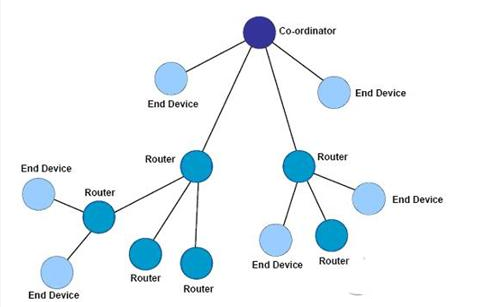
The tree topology includes a Coordinator and a series of Router and End Device nodes. Coordinator connects a series of Routers and End Devices, and its sub-node Routers can also connect a series of Routers and End Devices. This can be repeated for multiple levels. The structure of the tree topology is shown in the figure below:
Have to be aware of:
Coordinator and Router nodes can contain their own child nodes.
End devices cannot have their own child nodes.
I nodi con lo stesso nodo padre sono chiamati nodi fratelli.
I nodi con lo stesso nodo nonno sono chiamati nodi cugini.
Regole di comunicazione nella topologia ad albero:
Ogni nodo può comunicare solo con il proprio nodo genitore e con i nodi figli.
Se i dati devono essere inviati da un nodo all'altro, le informazioni vengono trasmesse lungo il percorso dell'albero fino al nodo antenato più vicino e poi giù fino al nodo di destinazione.
Lo svantaggio di questa topologia è che esiste un solo canale di instradamento per le informazioni. Inoltre, l'instradamento delle informazioni è gestito dal livello dello stack protocollare e l'intero processo di instradamento è completamente trasparente al livello applicativo.
2. Topologia a stella
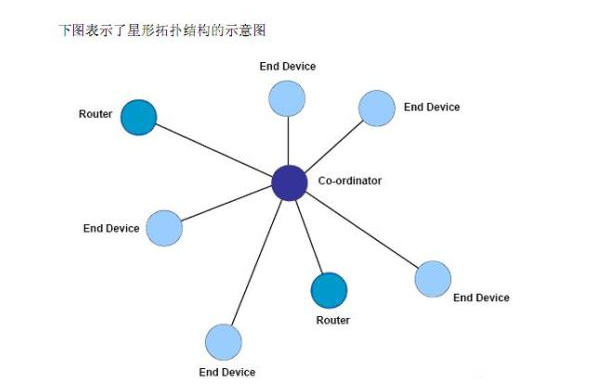
It is the simplest form of topology. It contains a Coordinator node and a series of End Device nodes. Each End Device node can only communicate with the Coordinator node. If communication is required between two End Device nodes, information must be forwarded through the Coordinator node.
3. Topologia della rete
Mesh topology includes a Coordinator and a series of Routers and End Devices. This form of network topology is the same as a tree topology; please refer to the tree network topology mentioned above. However, mesh network topology has more flexible information routing rules, and routing nodes can communicate directly with each other when possible. This routing mechanism makes the communication of information more efficient, and means that once a problem occurs on one routing path, the information can be automatically transmitted along other routing paths. A schematic diagram of a mesh topology is shown below:
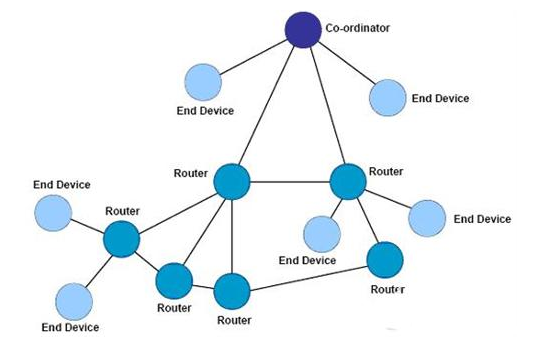
Usually, in the implementation of a supporting mesh network, the network layer will provide a corresponding route exploration function. This feature allows the network layer to find the optimal path for information transmission. It should be noted that the above-mentioned features are all implemented by the network layer, and the application layer does not need to participate.
The above is the relevant introduction to “ZigBee network topology “, I hope it will be helpful to you! Although ZigBee can reach hundreds of meters in point-to-point open scenes, in some application scenarios, such as smart parking scenarios, when a large object like a car blocks the signal, the signal attenuation will be very severe, and the compatibility of different ZigBee chips is poor. ZigBee network is more flexible and difficult to maintain.