
China’s IoT is entering a new era—China IoT 2026—driven by edge AI, satellite connectivity, and outcome-based business models. In 2026, IoT is no longer just about connecting devices—it is becoming the invisible infrastructure of the intelligent economy.
China IoT 2026: A Turning Point for the Industry
The term “Internet of Things” no longer appears as a standalone concept in China’s government work report or the 15th Five-Year Plan (2026–2030). Instead, it has been absorbed into broader concepts such as “smart terminals,” “intelligent agents,” “satellite internet,” and “data elements.”
This is not a shift in priorities. It signals that IoT has reached a new stage of maturity.
A useful analogy is electricity. A century ago, “electrification” was a central policy focus. Today, electricity is simply assumed—it is the foundation, not the headline. IoT is undergoing a similar transition.
The 15th Five-Year Plan outlines initiatives to build a “new form of intelligent economy”:
-
Expanding “AI+” applications
-
Developing satellite internet
-
Upgrading “5G + Industrial Internet”
-
Establishing systems for data as a production factor
These initiatives collectively highlight how IoT underpins China’s next phase of digital and industrial transformation.
Edge AI in China IoT 2026: Industrial Use Cases and Trends
By 2026, edge AI will have moved from pilot projects to large-scale deployment as technology and economics converge. This shift is a defining characteristic of China IoT 2026, where efficiency and real-world value take priority over simple connectivity.
What makes this possible is the combination of smaller models and more powerful chips. Vision models are now compressed to under 10MB while maintaining over 95% accuracy, making it feasible to run AI directly on end devices. At the same time, SoCs with integrated NPUs have become standard, while new architectures such as in-memory computing are entering commercial use.
RedCap is also reaching scale. Module prices have dropped to around US$10, making them competitive with LTE Cat4. According to a 2025 report by IoT Analytics, shipments exceeded 10 million units by the end of 2025.
On the network side, 5G-Advanced now provides the necessary backbone, with nationwide coverage in major cities, 1Gbps uplink speeds, and millisecond-level latency—enabling real-time edge intelligence.
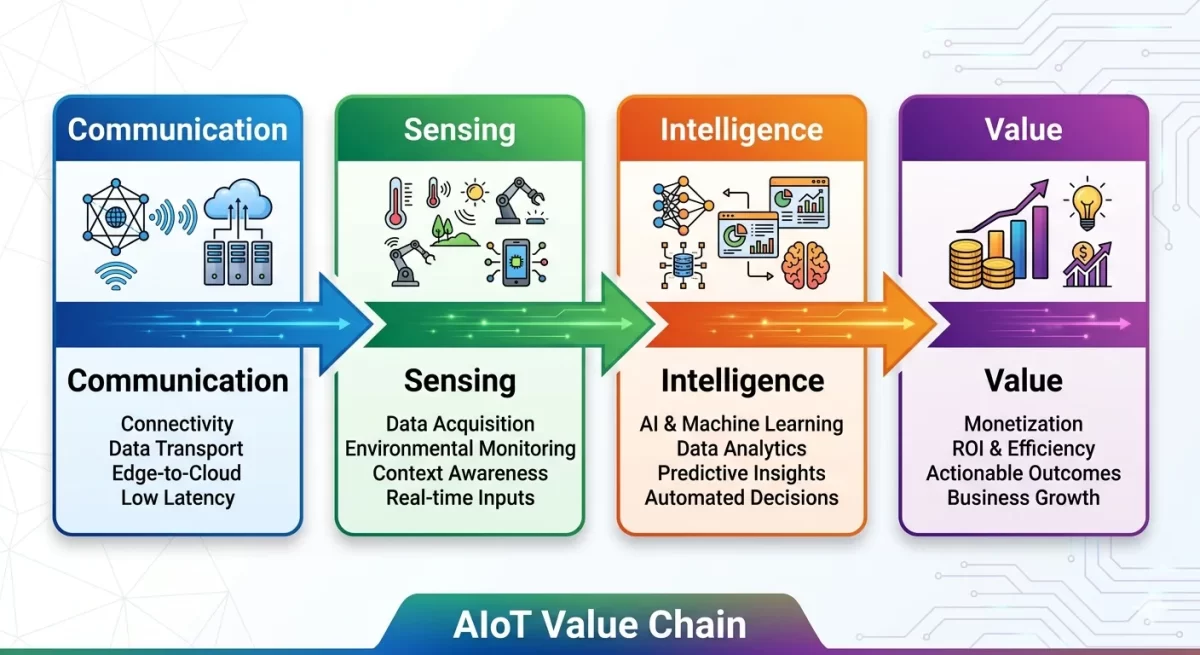
Il 2026 China AIoT Industry Panorama Report introduced a “Communication-Sensing-Intelligence-Value” four-dimensional framework:
| Dimension | Role |
|---|---|
| Communication | Provides connectivity |
| Sensing | Captures real-world data |
| Intelligence | Enables analysis and decision-making |
| Valore | Completes the business loop |
Together, these four dimensions form an integrated value chain that spans applications from connected vehicles to space-ground integrated networks, and from industrial intelligence to smart homes.
Among these, industrial IoT stands out as one of the most demanding and representative environments, where real-time data processing and system reliability are critical.
In real-world deployments, edge intelligence depends heavily on reliable connectivity and protocol integration. This is where industrial IoT gateways play a critical role—bridging sensors, edge AI, and cloud platforms while ensuring stable data transmission across complex environments.
Satellite IoT in China: Maritime and Emergency Use Cases
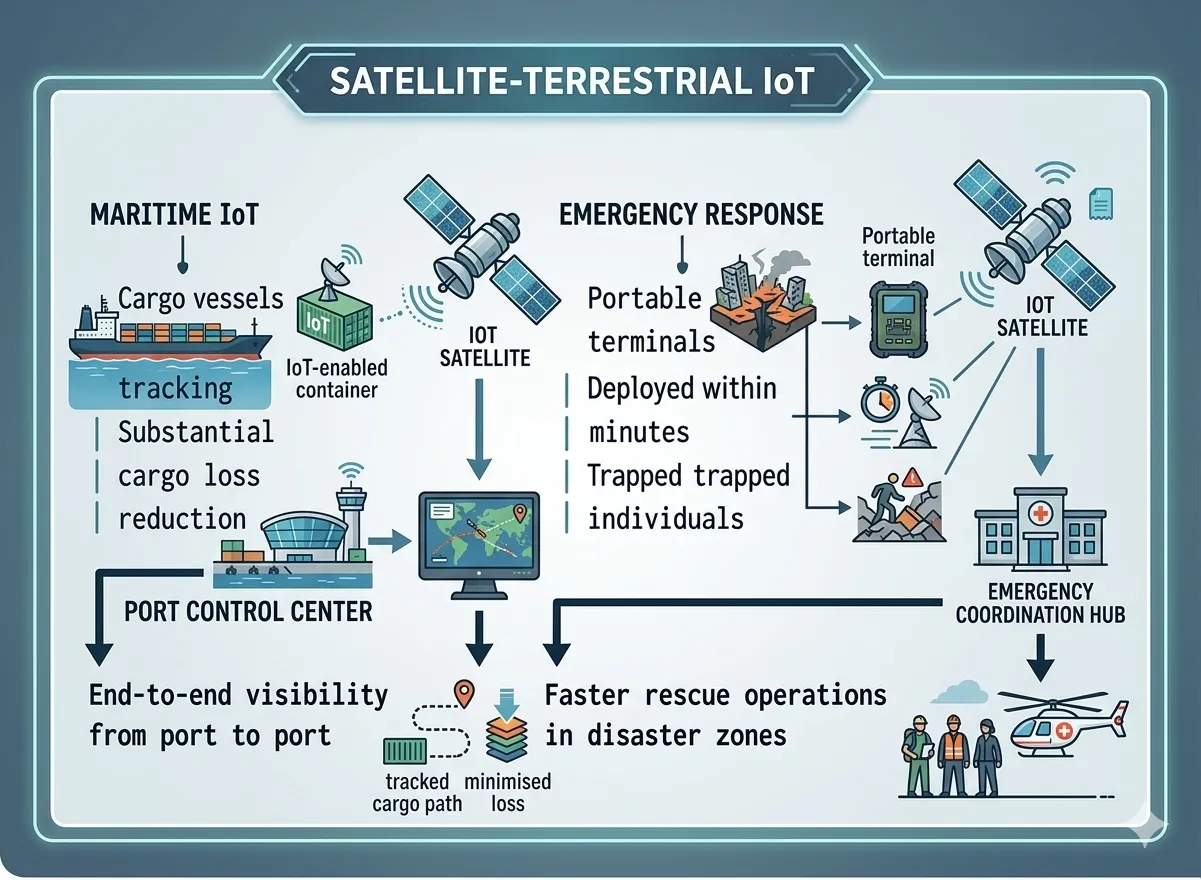
Satellite-terrestrial integration is a key enabler of IoT development in China, turning ubiquitous connectivity into a commercial reality—especially in environments where traditional networks fail. This trend is becoming a defining feature of China IoT 2026 in remote and industrial environments.
Key applications include maritime tracking and emergency response, where real-time connectivity improves visibility, coordination, and operational efficiency across previously unreachable environments.
Value-Based IoT Models: From Connectivity to Business Outcomes
The IoT industry has long faced a core challenge: rapid growth in connected devices has not translated into real business value.
In 2026, this is beginning to change.
Connectivity is scaling from billions to trillions, enabled by passive IoT technologies that eliminate batteries and reduce costs. At the same time, the focus is shifting from simply connecting devices to keeping them continuously online, enabling real-time visibility of physical assets.
More importantly, value is moving from connectivity to outcomes. Instead of charging for data, companies are delivering measurable business results, with AI acting as the key driver. As Huawei’s wireless division noted, “AI + IoT can multiply value by 100 times.”
At the same time, IoT is expanding beyond traditional B2B use cases, with growing demand for 5G-enabled experiences in wearables, connected vehicles, and AI-powered devices.
Industrial IoT Case Study: Passive IoT in Smart Manufacturing
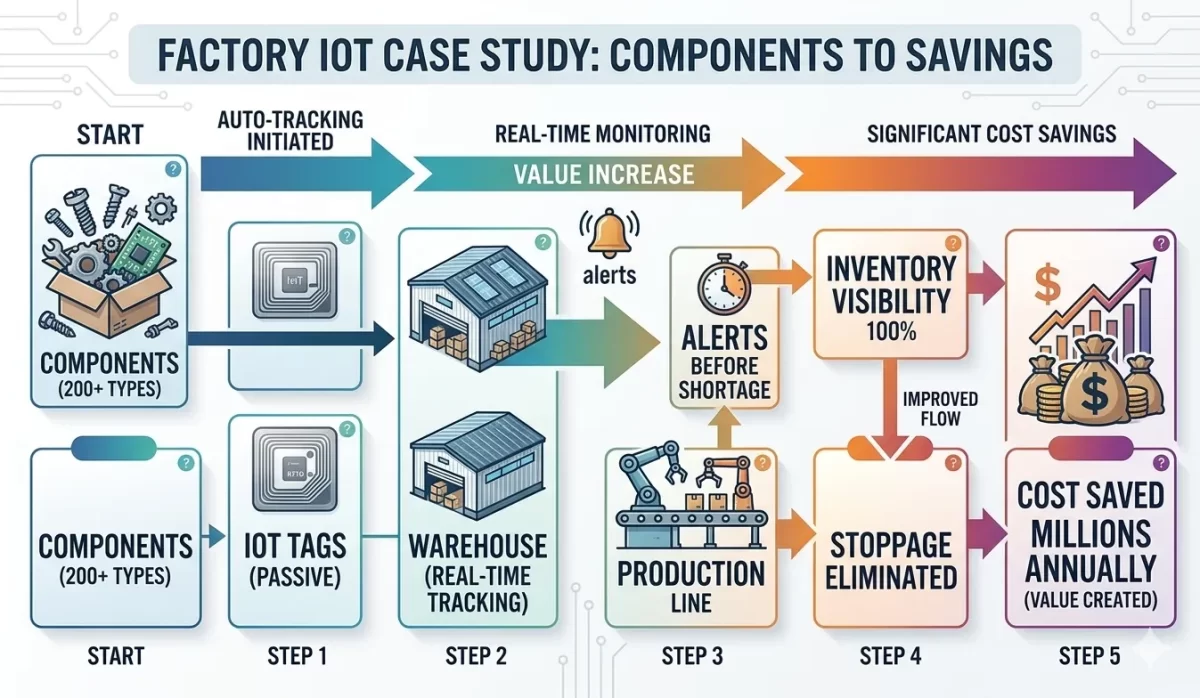
A manufacturing facility in Qingdao illustrates how value-based IoT works in practice.
The challenge was simple but costly: when a production line ran out of a specific component, the entire line stopped—resulting in millions of yuan in annual losses.
To solve this, the factory deployed passive cellular IoT tags across nearly 200 types of components, enabling real-time tracking across warehouses and production lines.
Passive IoT was chosen in this scenario because it enables large-scale, low-cost asset tracking without the need for batteries or continuous connectivity—making it ideal for inventory management in complex industrial environments.
The results were significant:
– 100% inventory accuracy
– Over 90% efficiency improvement
– Millions of yuan in annual savings
More importantly, the pricing model changed. The factory now pays based on outcomes, not the number of connected devices.
This case reflects a broader shift in China IoT 2026—from infrastructure deployment to measurable business outcomes.
IoT Challenges & Security Risks for AI-Powered Systems
Capability gaps. Firms built around device counts now need industry expertise, data operations, and end-to-end integration skills. These capabilities take time to build.
Many traditional manufacturers don’t first need large language models. What they need is an IoT infrastructure to collect data and run lightweight edge models. This market gap remains largely untapped.
Security risks. As AI agents enter the physical world—factory robots, autonomous vehicles, home assistants—risks multiply:
-
Data poisoning and model hallucinations
-
Supply chain vulnerabilities
-
Signal hijacking of exposed devices
IoT must provide end-to-end protection, yet most companies remain underinvested in security. Invest early to protect AI-powered IoT deployments.
China IoT Market Outlook (2026–2030)
Looking ahead, China’s IoT market in 2026 is expected to scale rapidly, with trillions of connected devices and a market size exceeding 4.53 trillion yuan. According to the China Commercial Industry Research Institute:
China IoT & AIoT Market Forecast (2026–2030)
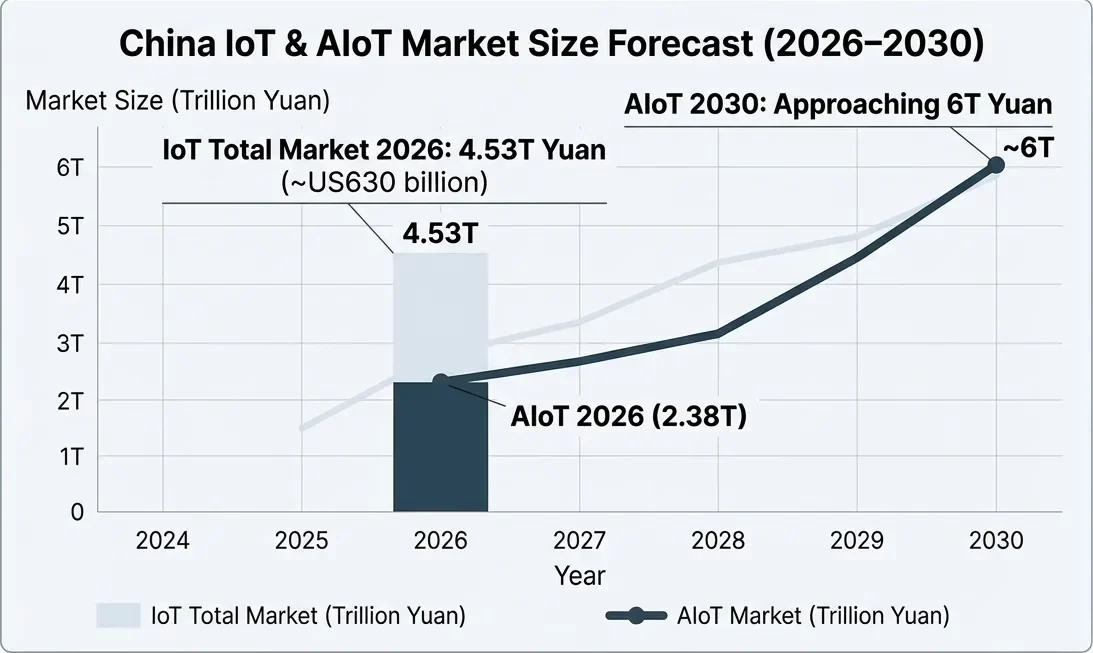
| Metric | Valore |
|---|---|
| China IoT market size 2026 (forecast) | 4.53 trillion yuan (~US$630 billion) |
| China AIoT market size 2026 | 2.38 trillion yuan |
| China AIoT market size 2030 | Approaching 6 trillion yuan |
The Ministry of Industry and Information Technology (MIIT) has set a target of 3.6 billion mobile IoT connections by 2027, with trillions of connected devices on the horizon.
On the technology front, 6G will incorporate satellite-terrestrial integration and native AI capabilities. The rise of Physical AI—AI that understands and acts upon the physical world—will depend entirely on IoT’s sensing and data collection. This growth reflects both policy support and accelerating industrial adoption across China IoT 2026.
Sintesi
In China IoT 2026, the focus is shifting from connectivity to measurable outcomes. As edge AI scales and ubiquitous connectivity becomes reality, competitive advantage will depend on the ability to turn data into real-world value. IoT may become less visible, but its role as the foundation of the intelligent economy will only deepen. The companies that succeed in China IoT 2026 will not be those that connect the most devices—but those that extract the most value from data.
Key Data Sources
| Dati | Source |
|---|---|
| 2026 China IoT market size forecast | China Commercial Industry Research Institute |
| 2030 AIoT market size forecast | China Commercial Industry Research Institute |
| RedCap shipments (end-2025) | IoT Analytics |
| 2027 mobile IoT connections target (3.6 billion) | Ministry of Industry and Information Technology (MIIT) |
| Passive IoT case study (100% accuracy, 90% efficiency) | SASAC / People’s Posts and Telecommunications News |