Oil and gas (O&G) production has historically been highly complex and unstable. Due to the remoteness and isolation of offshore drilling platforms, it was difficult for companies to gain timely and accurate visibility into ongoing operations. Today, however, the Internet of Things technology in offshore oil and gas monitoring brings endless opportunities to overcome these challenges.
Without it, operators often don’t know when machine and process variables are out of specification, potentially leading to asset failure and costly downtime. Worse, inadequate monitoring capabilities can lead to catastrophic explosions that wreak havoc on the environment, workers’ lives, and a company’s credibility.
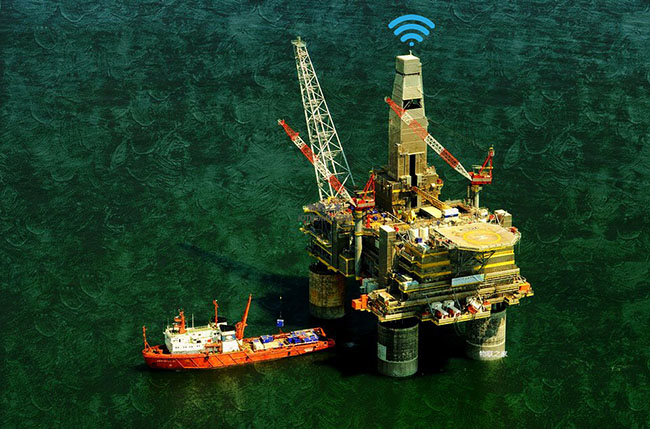
Barriere di connettività per il monitoraggio delle piattaforme offshore
To optimize efficiency and safety, upstream offshore oil and gas production requires round-the-clock monitoring of various equipment (pipelines, valves, wellheads, storage tanks, etc.) and parameters (temperature, vibration, pressure, flow rate, corrosion, gas leakage, etc.).
Traditional communications solutions are either limited, expensive, or cumbersome for connecting the large number of disparate assets on offshore drilling platforms.
Wired infrastructure such as SCADA systems, while ideal for real-time control tasks, are not designed for data collection and therefore cannot be used for remote monitoring.
Cellular mobile connectivity may not exist in the ocean. Furthermore, building a mesh network is often a difficult task given the sheer size and complex and dense structure of oil drilling platforms.
Due to their seamlessness and ubiquity, satellite networks have become the most common choice for wireless implementation at sea. However, high costs mean that satellite networks mainly involve high-bandwidth voice and data transmission while connecting only a few high-value critical data points.
Due to a lack of cost-effective and scalable communications solutions, oil and gas companies used to rely heavily on manual data reading and visual inspections to monitor much of their operations, equipment, and facilities. Needless to say, this is highly inefficient and error-prone, while exposing workers to significant site hazards and hazards.
Internet of Things technology in offshore oil and gas monitoring
Emerging IoT connectivity solutions such as Reti Wide Area a basso consumo (LPWAN) are expanding the boundaries of Internet of Things technology in offshore oil and gas monitoring. LPWAN provides a cheap, low-bandwidth wireless network for small, low-compute devices that will form the backbone of large-scale sensor networks to aggregate granular telemetry data from countless endpoints.
The simple star topology coupled with broad coverage makes LPWAN versatile for IoT deployments in large, complex facilities such as O&G platforms. Proprietary LPWANs, in particular, allow companies the flexibility to tailor network coverage to suit the unique needs of isolated, remote offshore sites.
The LPWAN-satellite hybrid architecture provides offshore oil and gas organizations with a highly reliable and cost-effective way to proactively monitor and manage offshore infrastructure from hundreds of kilometers away. Data from distributed field sensors are aggregated at local IoT base stations via LPWAN wireless networks and then forwarded to a centralized command center on land using satellite networks. With this architecture in place, companies can leverage new troves of asset, environmental, and process data to gain a complete view of their production operations.
Enhanced visibility and oversight bring the following compelling benefits:
1. Manutenzione degli asset
I sensori intelligenti installati su centinaia di asset diversi segnalano variabili operative critiche che aiutano a rivelare le anomalie che precedono i guasti. Ciò consente agli operatori di inviare tempestivamente il personale per l'ispezione e la manutenzione prima che si verifichino guasti gravi, per ridurre al minimo i tempi di inattività della produzione e ottimizzare l'utilizzo delle risorse.
2. Gestione dei rischi e sicurezza dei lavoratori
Distributed environmental sensors continuously check the atmosphere for the presence of flammable gases and toxic vapors. At the same time, 24/7 asset monitoring helps predict catastrophic asset failures leading to explosions or oil spills at sea. In the event of an emergency, on-site alarms can be triggered in time so that immediate response measures can be taken to protect workers and prevent serious, irreversible disasters.
3. Gestione delle strutture
Diversi dati sulla struttura dell'impianto di perforazione (come deformazioni, vibrazioni, rumori di crepe, ecc.) e sulle condizioni meteorologiche esterne vengono raccolti e analizzati continuamente per fornire una valutazione affidabile dell'integrità dell'impianto di perforazione, per una diagnosi precoce di eventuali danni strutturali. Allo stesso modo, è possibile monitorare 24 ore su 24 le infrastrutture critiche, come le porte stagne e i serbatoi di zavorra.
4. Conformità normativa
Grazie ai dati di produzione completi, i dirigenti delle società petrolifere e del gas possono monitorare e registrare efficacemente la conformità alle normative per garantire operazioni trasparenti e conformi agli standard.
5. Sicurezza e controllo degli accessi
I sensori wireless possono identificare attività sospette in aree riservate per migliorare la sicurezza in loco.
Riassumere
Due to its asset density and complexity, the oil and gas industry is believed to benefit greatly from IoT and big data. The ability to connect large-scale equipment and processes gives companies unprecedented visibility and control over their operations. Particularly on offshore platforms, Internet of Things technology in offshore oil and gas monitoring is taking remote monitoring and digitization to the next level to increase efficiency and safety while minimizing human intervention.