
En el ámbito de la automatización industrial y la conectividad de equipos, los estándares RS232, RS422 y RS485 son probablemente los términos técnicos más conocidos pero más fáciles de confundir entre los ingenieros.
Los tres pertenecen a la “familia” de protocolos de comunicación serie. Aunque pueden tener una apariencia similar (a menudo utilizan conectores DB9 o bloques de terminales), sus métodos de transmisión de señales y escenarios de aplicación difieren enormemente. Elegir uno equivocado puede provocar desde una comunicación inestable hasta el cierre completo del sistema.
Hoy exploraremos las diferencias entre estos “tríos de puertos serie” y cómo ayudamos a los clientes a elegir la mejor opción entre las distintas pasarelas y aplicaciones de IOTRouter.
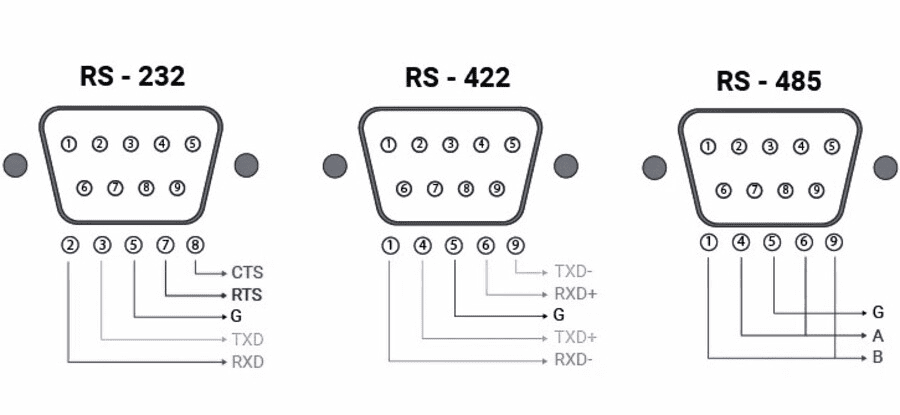
¿Cómo distinguirlos?
En pocas palabras, he aquí un rápido desglose: RS232 es como un “walkie-talkie personal”, RS422 funciona como un “altavoz unidireccional” y RS485 funciona como una “multiconferencia”. Para comprender su esencia, debemos examinar sus principios básicos de transmisión de señales.
RS232
En primer lugar, hablemos del hermano mayor, RS232. Emplea la transmisión de señales en un solo extremo: un cable representa el “1” lógico (tensión negativa, de -3V a -15V), otro cable representa el “0” lógico (tensión positiva, de +3V a +15V), más un cable de tierra como referencia. Este diseño se asemeja al de dos personas gritando a distancia, por lo que es muy susceptible a las interferencias electromagnéticas externas. Además, la propia tensión de la señal se degrada rápidamente al aumentar la resistencia y la longitud del cable.
En consecuencia, su distancia de transmisión está estrictamente limitada a menos de 15 metros. La velocidad de transmisión sigue siendo baja, con un máximo de unos 20 kbps, y la comunicación es estrictamente punto a punto. A pesar de estas limitaciones, su sencillez (sólo requiere tres hilos para la comunicación) y su amplia base de dispositivos heredados lo hacen insustituible para interfaces de configuración y depuración de PC a dispositivo de corto alcance. Muchas pasarelas IOTRouter siguen incorporando un puerto de configuración RS232 para depuración local.
RS422
Para hacer frente a las limitaciones de distancia e interferencias de RS232, RS422 introdujo el revolucionario concepto de señalización diferencial.
Ya no depende de una referencia de tierra común. En su lugar, transmite una señal -datos “1” o “0”- utilizando un par de hilos trenzados (Línea A y Línea B), donde la señal viene determinada por la diferencia de tensión entre estos dos hilos.
El ruido externo en modo común afecta a ambos hilos simultáneamente y por igual, mientras que al receptor sólo le importa su “diferencia”, por lo que anula perfectamente el ruido.
Este diseño amplía sin esfuerzo la distancia de transmisión de RS422 hasta 1200 metros (a baja velocidad), alcanza velocidades de transmisión de datos de hasta 10 Mbps y ofrece una sólida capacidad de transmisión de uno a muchos: un dispositivo maestro puede transmitir hasta a 10 dispositivos esclavos simultáneamente.
Sin embargo, sigue siendo unidireccional, lo que significa que los datos fluyen en una sola dirección a la vez. La comunicación bidireccional requiere dos pares de hilos.
RS485
Partiendo de la sólida base de RS422, RS485 permite además la “comunicación multiparte”.”
Conserva todas las ventajas de la transmisión diferencial al tiempo que permite que varios dispositivos (hasta 32 cargas estándar) conecten sus transceptores al mismo par de bus. Al permitir el control de la señal, cualquier dispositivo puede convertirse en el “altavoz” cuando sea necesario, y los demás actuar como “oyentes”, lo que posibilita una auténtica comunicación de red multipunto, bidireccional y semidúplex.
Esta topología basada en bus permite que un único bus conecte docenas de sensores, instrumentos o controladores, lo que simplifica significativamente el cableado y reduce los costes. Esto lo convierte en el líder indiscutible en bus de campo industrial, automatización de edificios y sistemas de adquisición de datos.
En las pasarelas IoT industriales de IOTRouter, la interfaz RS485 es casi un equipo estándar, que conecta varios sensores de protocolo Modbus RTU, como medidores de temperatura/humedad, energía y agua.
En consecuencia, muchos Pasarelas industriales IOTRouter, los ordenadores y los routers dan prioridad a RS485 como una de sus interfaces de adquisición de datos subyacentes más críticas.
Para ayudarle a visualizar sus diferencias con mayor claridad, he aquí una sencilla comparación:
| RS232 | RS422 | RS485 | |
| Modo de comunicación | Punto a punto | Punto a punto | Multipunto |
| Señal | Un solo extremo | Diferencial | Diferencial |
| Velocidad | Bajo | Alta | Medio |
| Distancia | Corto | Largo | Largo |
| Resistencia a las interferencias | Débil | Fuerte | Fuerte |
| Aplicaciones típicas | Conexiones de dispositivos de corto alcance | Punto a punto de alta velocidad | Bus industrial, comunicación multinodo |

Preguntas más frecuentes (FAQ)
Q1: Mi distancia real de comunicación RS485 supera con creces los 1200 metros. ¿A qué se debe?
A1: 1200 metros es la distancia teórica garantizada en condiciones estándar a velocidades de transmisión más bajas (por ejemplo, 9,6kbps). En la práctica, el uso de un cable de par trenzado de alta calidad y baja atenuación, las velocidades de transmisión adecuadas y la correcta instalación de resistencias de terminación de 120Ω en ambos extremos para eliminar las reflexiones de la señal hacen que una comunicación estable que supere los 1500 metros sea totalmente factible a velocidades más bajas.
Q2: ¿Por qué son necesarias las resistencias de terminación en los buses RS485? ¿Se pueden omitir?
A2: Las reflexiones de la señal se producen en los extremos del cable, superponiéndose a la señal original y causando distorsión y errores de bits. La instalación de resistencias adaptadas a la impedancia característica del cable (normalmente 120Ω) en ambos extremos (sólo en ambos) absorbe la energía de la señal y elimina las reflexiones. En entornos estáticos de baja velocidad y corta distancia (por ejemplo, menos de 50 metros), los problemas pueden no ser “perceptibles”, pero para la fiabilidad del sistema, se recomienda encarecidamente seguir las especificaciones y añadirlas.
Q3: ¿Cuál es la relación entre RS232/422/485 y Ethernet? ¿Los sustituirá Ethernet?
A3: Representan distintas capas de la tecnología de la comunicación. La serie RS define normas eléctricas en las capas física y de enlace, especificando “cómo representar 0 y 1 con niveles de tensión” y reglas fundamentales de transmisión/recepción. Ethernet, en cambio, es una familia de protocolos de red más compleja y de alta velocidad.
En entornos industriales, coexisten en lugar de sustituirse. Muchas de nuestras pasarelas actúan como “convertidores de protocolos”, convirtiendo de forma eficiente y fiable los datos de los dispositivos desde los buses RS485 del front-end y transmitiéndolos a las redes Ethernet o inalámbricas (4G/5G/Wi-Fi) del back-end para su integración en la nube.
En el ámbito de la comunicación industrial, no hay tecnologías obsoletas, sólo soluciones mal aplicadas. Los tres “veteranos clásicos” -RS232, RS422 y RS485- han resistido décadas de cambios. Gracias a su inigualable fiabilidad, rendimiento en tiempo real y ventajas económicas, siguen desempeñando un papel insustituible en sus respectivos ámbitos.
Comprender su funcionamiento interno abre la llave para equipar diversos escenarios de aplicación con las “herramientas de transporte” más adecuadas. Para IOTRouter, Pero nuestra misión va más allá del suministro de hardware de primera calidad para estas interfaces: ayudamos a nuestros clientes a crear rutas de datos estables y eficientes hacia soluciones inteligentes en entornos industriales complejos.