Einführung
Industrial AI is moving beyond proof-of-concept projects and entering real production environments. Factory floors, not data centers, are becoming the proving ground for edge intelligence—running visual inspection, equipment monitoring, and quality control where the actual work happens.
But industrial environments are not like controlled labs. They are dusty, hot, vibration-prone, and often lack reliable internet connectivity. Deploying AI in these conditions demands hardware that can handle the physical environment and adapt to changing AI workloads.
Industrial vision inspection has become one of the fastest-growing use cases driving this shift. Factories increasingly need AI systems that can run custom models directly on the production line, close to cameras and sensors, without relying on cloud round-trips.
Cloud-based APIs still work well for some applications, but not all. Monthly token fees accumulate quickly in high-throughput scenarios. Some production data cannot leave the facility—whether due to internal security policies or industry regulations. And many industrial sites lack the stable, high-bandwidth internet connection that cloud inference requires.
These constraints push more system integrators and automation engineers toward local deployment.
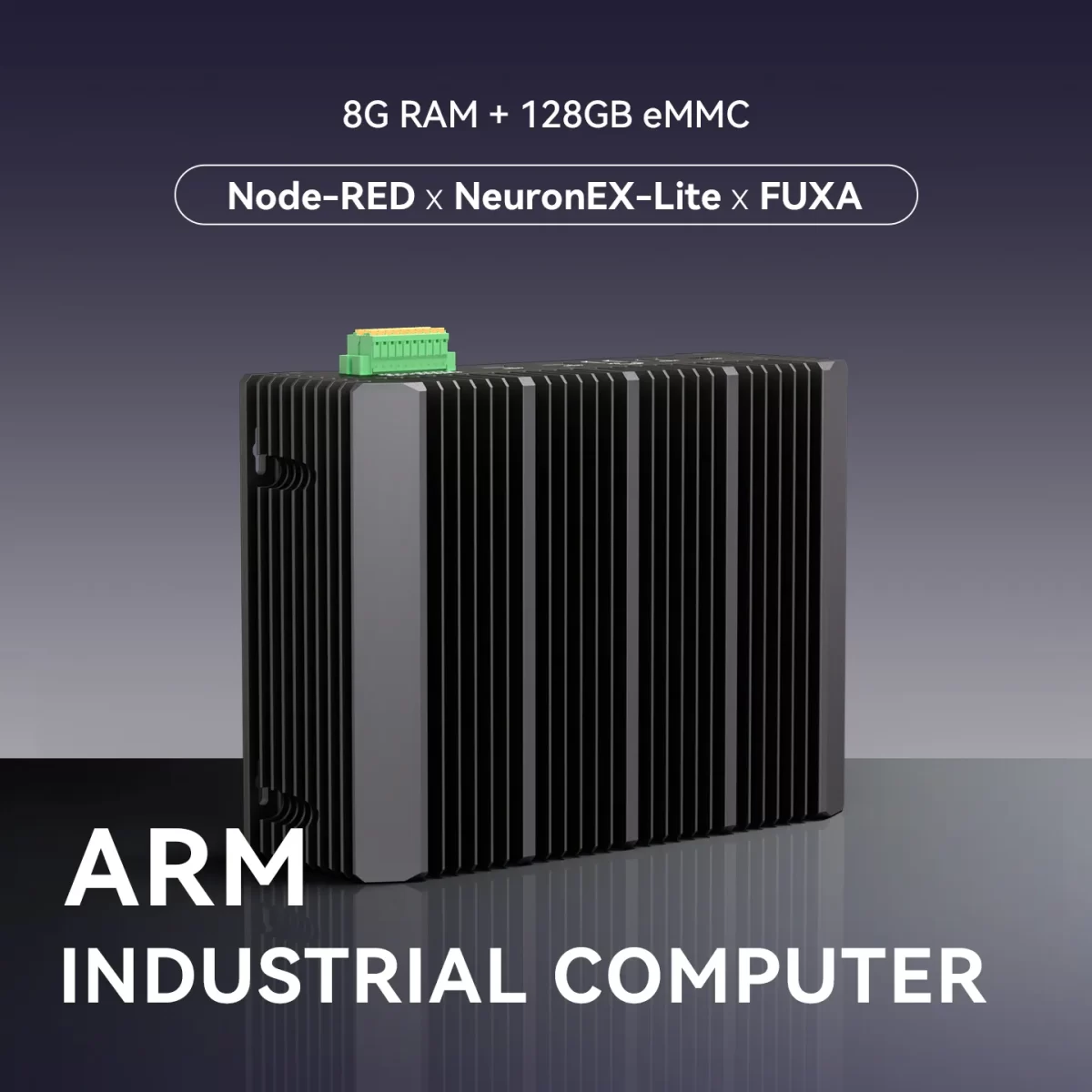
ARM-based industrial AI computers with standard expansion interfaces offer a practical middle ground. This architecture separates industrial control workloads from AI workloads, allowing each part to scale independently. It combines industrial-grade processors, open Linux environments, and M.2 expansion interfaces to create a new generation of industrial AI computers designed for real-world factory conditions.
The Limitation of Fixed-Compute Designs
In a typical edge AI deployment, computing power is locked at the time of purchase. Devices with integrated NPUs have a fixed performance ceiling that cannot be expanded later.
This becomes a problem when newer vision models or language models—newer vision models or multimodal AI models—are released after the hardware is already installed. Upgrading usually means replacing the entire unit, which is expensive and interrupts operations.
One way around this is to separate the base computing platform from the AI acceleration module. The main processor stays the same; the AI accelerator gets swapped out when requirements change. This is one of the key advantages enabled by M.2 expansion.
Why M.2 Expansion Changes the Equation
One base platform, upgradeable AI performance.
M.2-based acceleration separates AI compute from the host system. Different AI accelerator modules can be selected according to workload requirements. Choosing the right module, however, involves more than comparing TOPS. Memory, PCIe data flow, thermal design, and software compatibility can all affect real-world performance. See our guide on how to choose an M.2 AI accelerator for a more detailed discussion.
When models become more demanding, a higher-performance module can be swapped in later—without replacing the entire computing platform.
This flexibility extends the usable life of the hardware. The same hardware platform that supports lightweight models today can be upgraded for more demanding AI workloads as application requirements evolve. Over time, this reduces both capital expenditure and the operational overhead of redeploying new hardware.
EC700 Industrial AI Computer Architecture: Open Linux, Scalable AI, Industrial I/O
One example of this architecture is the IOTRouter EC700, built around three core ideas: an open software stack, pluggable AI acceleration, and native connectivity for industrial equipment.
1. Open Linux Platform
The EC700 runs an open Embedded Linux platform, providing developers with greater flexibility for application deployment and system customization. This matters for system integrators who need to:
-
Deploy custom AI models and applications
-
Integrate required software frameworks
-
Build customized industrial solutions
-
Adapt the software stack to different project requirements
Unlike closed AI appliances that restrict users to predefined functions, the EC700 gives engineers the freedom to develop their own AI applications, optimize inference pipelines, and integrate proprietary algorithms. An open platform means engineering teams are not locked into a vendor’s software timeline. They can maintain their own application stack and update it on their own schedule.
2. Industrial Main Processor
The EC700 is powered by the industrial-grade RK3588J octa-core processor (4× Cortex-A76 + 4× Cortex-A55), with 8GB RAM, 128GB eMMC storage, and an integrated 6 TOPS NPU. This provides the processing headroom for multi-channel video capture and system-level tasks.
When applications need more AI throughput than the built-in NPU provides, M.2 expansion slots offer an upgrade path.
The design uses passive cooling—an aluminum enclosure, heatsink fins, and direct contact with the processor—which removes the reliability risks that fans introduce in dusty or vibration-heavy environments.
3. M.2 AI Accelerator Expansion
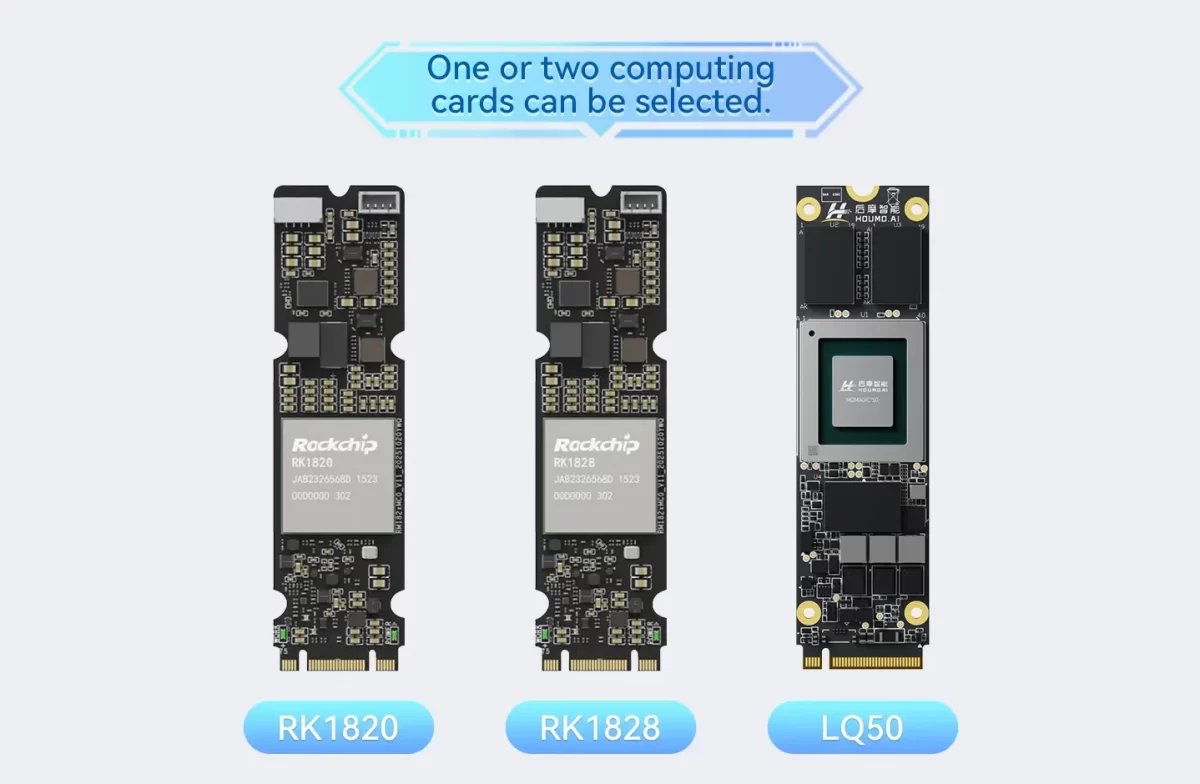
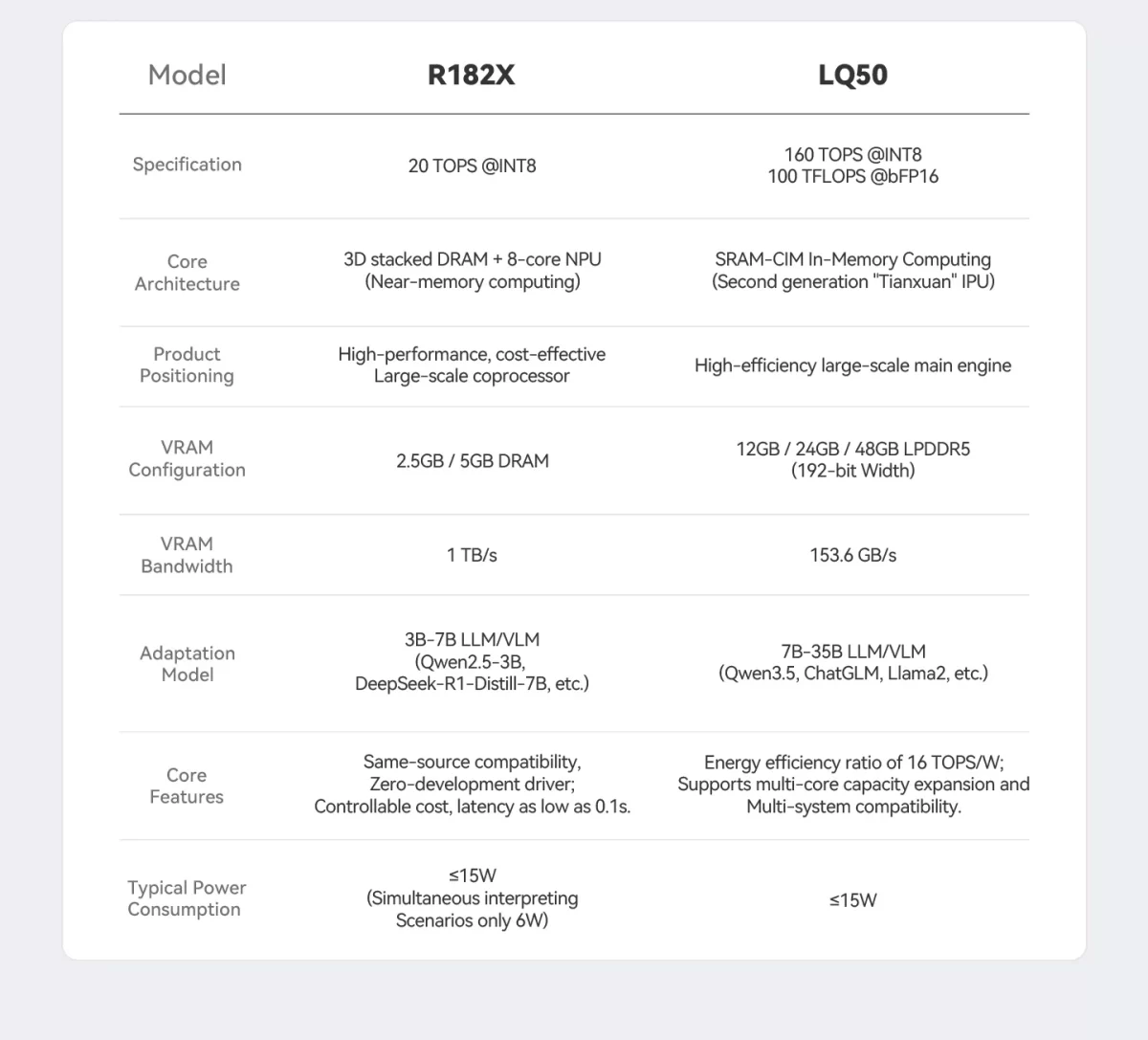
The EC700 provides two M.2 PCIe high-speed interfaces for configurable computing modules, enabling scalable AI acceleration up to 320 TOPS. The integrated NPU covers lightweight tasks, while M.2 modules extend capability for more demanding workloads:
| Compute Configuration | Typical Workload |
|---|---|
| 6 TOPS integrated NPU | Lightweight AI inference |
| M.2 AI acceleration | Vision inspection and more demanding AI workloads |
| Expanded heterogeneous computing | Larger LLM/VLM and multimodal workloads |
From a practical standpoint, this means a system integrator can ship a base configuration and upgrade the AI module on-site when application needs evolve—without redesigning the whole edge node.
4. Industrial Connectivity
Processing power alone does not make an industrial device. The EC700 includes native interfaces that reduce the need for external gateways:
-
Dual Gigabit Ethernet (1×WAN, 1×LAN)
-
2×RS485, 1×RS232, 1×DI, 2×DO
-
HDMI input and output
-
4×USB 3.0, Type-C debug port
-
Optional 4G/5G and Wi-Fi 6
PLCs, cameras, sensors, and actuators connect directly. This reduces both system complexity and potential failure points in demanding installations.
5. Heterogeneous Compute
General processing and AI-specific workloads are handled separately:
-
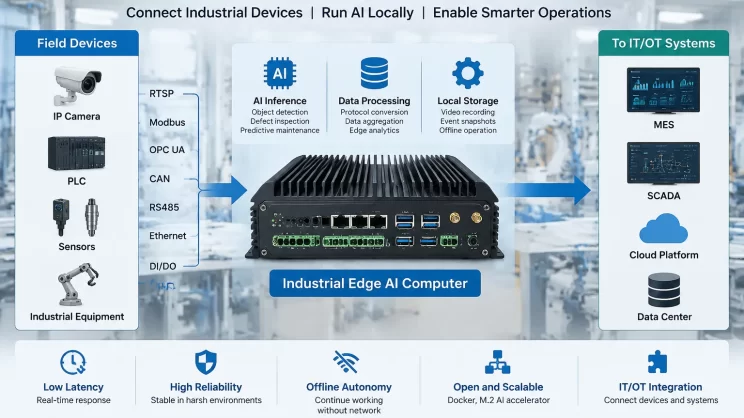
Main processor: video I/O, peripheral communication, protocol stacks, orchestration
-
M.2 AI accelerator: vision inference, LLM/VLM processing, compute-intensive AI
Resource contention is reduced. Multi-channel video capture, device control, and AI inference can run concurrently with more stable performance than single-chip designs trying to do everything at once.
AI Vision Inspection: Building Custom Machine Vision Systems with EC700
Unlike fixed-function vision controllers, the EC700 lets integrators deploy models trained on their own production data. This makes it well-suited for visual quality control on production lines.
Traditional inspection methods fall into two categories. Smart cameras come with pre-programmed algorithms but are difficult to retrain for new defect types. PC-based systems are flexible but large, power-hungry, and often require active cooling that does not always hold up well on a factory floor.
The EC700 sits between these two. It is a compact, fanless platform that runs custom vision models—surface defect detection, assembly verification, OCR, anomaly detection—without being locked into a fixed algorithm set. This matters for manufacturers whose defect types are specific to their process and not covered by off-the-shelf vision libraries. For more demanding vision workloads, M.2 AI acceleration can provide additional inference capacity, while the RK3588J handles system processing, video I/O, and industrial connectivity.
For machine vision engineers, this is a programmable foundation rather than a black box. They control the models, the deployment pipeline, and the iteration cycle. When production requirements change, they do not have to wait for a vendor to update a proprietary vision library.
The industrial temperature rating and passive cooling matter here. Factory floors are often hot, dusty, and vibration-prone—exactly the conditions where fans become maintenance problems.
Why Local Inference Is Relevant for Industrial Settings
Industrial deployments are different from cloud-based or enterprise office environments. Three factors come up repeatedly in real projects.
Data privacy and compliance. Government, defense, finance, and certain manufacturing sectors are subject to rules that restrict operational data from leaving the facility. Production images, equipment logs, and recorded communications often fall under these policies. Local inference keeps raw data inside the facility boundary, which simplifies compliance.
Cost structure. Cloud inference is billed per inference or per token. For high-frequency vision inspection, processing thousands or millions of images per day, costs scale directly with throughput. On-premise hardware involves a fixed capital outlay with minimal marginal cost per inference. For multi-site deployments, this difference adds up quickly.
Connectivity constraints. Many industrial installations do not have reliable high-bandwidth internet. Some have none at all. Local deployment means AI functionality continues working regardless of network status, without depending on cloud round-trips.
Other Deployment Scenarios
Industrial knowledge base and maintenance support. On-premise document retrieval systems can be set up for equipment manuals, maintenance guides, and troubleshooting documents. Operators and field technicians query internal knowledge bases without sending sensitive technical materials to external cloud services.
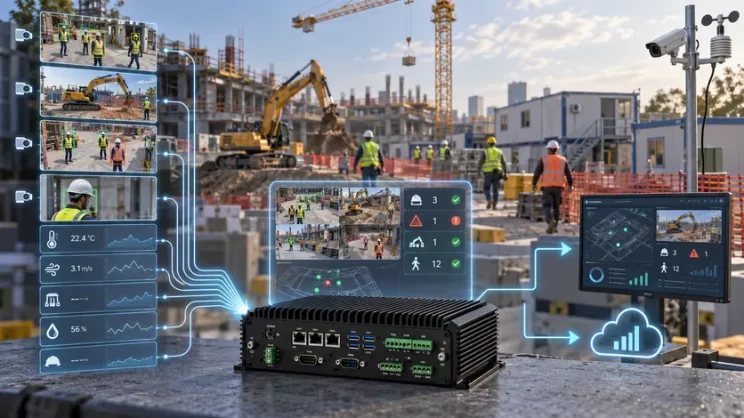
Multi-camera monitoring and event detection. The video processing capability supports local analysis of multiple camera feeds. Common applications include person detection, vehicle tracking, and behavior monitoring for safety or operations. Analysis results can be communicated to industrial devices through RS485 or used to trigger external equipment through the DO outputs.
Private AI-assisted meeting and communication. For facilities with confidentiality requirements, local speech-to-text and summarization tools support meeting documentation without sending data outside. This is distinct from consumer transcription services that rely on cloud APIs.
Comparison with Alternative Approaches
The table below compares expandable ARM-based edge AI platforms with other common deployment models:
| Criteria | Fixed-Compute AI Box | Cloud AI API | EC700 Expandable Platform |
|---|---|---|---|
| AI Model Flexibility | Tied to integrated NPU capabilities | Any model accessible via API | Custom models + Docker deployment |
| Computing Scalability | Keine | Flexible (metered) | M.2 pluggable upgrade |
| Local Inference | Ja | No | Ja |
| Data Governance | Local, but model selection is limited | Data transmitted to third-party | On-premise data processing |
| Industrial I/O | Often limited | Requires separate gateway | Native RS485/DI/DO/Ethernet |
For industrial automation teams, the EC700 combines programmability, upgradeable compute, and industrial connectivity in a way that many single-function appliances and cloud-only systems do not.
It is not a replacement for every scenario, but for applications where flexibility, local control, and physical footprint matter, it offers a useful alternative.
Outlook
A few trends point to continued interest in expandable ARM-based edge AI platforms for industrial use.
Modular AI acceleration is becoming more common. M.2-based AI modules are showing up across ARM edge hardware. Dual-slot designs that support parallel acceleration provide room for larger vision transformers and more complex multi-model workflows.
The AI model landscape is diversifying. Cloud providers still offer broad access to models, but on-premise deployment of open-source LLMs—Qwen, ChatGLM, DeepSeek, and others—is becoming more practical. Embedded Linux and standard toolchains reduce the friction of running these models locally.
Industrial AI use cases are growing beyond single-task vision. Quality inspection, predictive maintenance, document retrieval, and equipment diagnostics are starting to converge into unified operational intelligence platforms. That demands edge hardware capable of handling mixed workloads.
Inference optimization keeps improving. Quantization and framework-level optimizations have made larger models increasingly practical for edge deployment. Expandable ARM-based platforms are well-positioned to take advantage of this progression, since they can accommodate newer accelerators without a full system overhaul.
Häufig gestellte Fragen
1. Can an RK3588J Industrial AI Computer run large language models locally?
Yes, but it depends on the model architecture, quantization, memory configuration, inference framework, and the specific accelerator installed. The EC700 can support local deployment of LLMs and VLMs across a range of model sizes—covering the full range from 1.5B to 35B. M.2 expansion adds compute capacity for more demanding workloads.
2. Why use an M.2 AI accelerator instead of a fixed NPU?
Fixed NPUs are convenient but cannot be upgraded. When new models require more compute, the whole device often needs to be replaced. M.2 accelerators let the AI module be upgraded independently, which extends hardware life and reduces long-term costs.
3. Can the EC700 be used for AI vision inspection?
Yes. The EC700 can serve as a programmable platform for developing AI vision inspection systems. It runs custom vision models—surface defect detection, assembly verification, OCR, anomaly detection—and provides native interfaces for cameras, PLC-connected systems, and actuators.
4. Does the EC700 support custom AI model deployment?
Yes. As an open Embedded Linux platform, the EC700 runs custom models trained on proprietary data. It supports TensorFlow, PyTorch, and PaddlePaddle, with Docker containerization for deployment flexibility.
5. What is the difference between an EC700 and a smart camera?
Smart cameras typically come with fixed, pre-programmed algorithms designed for specific inspection tasks. They are easy to set up but difficult to retrain or adapt when defect types change. The EC700 is an open industrial AI computer that provides a programmable platform where engineers can develop, deploy, and iterate on their own custom vision models. It connects to standard industrial cameras and PLC-connected systems, offering flexibility that dedicated smart cameras cannot match.

Agnes Wang ist Spezialistin für IoT-Lösungen bei IOTRouter und konzentriert sich auf industrielle IoT-Gateways, Edge-Computing und Lösungen für die industrielle Automatisierung.
Sie ist auf industrielle Kommunikationstechnologien spezialisiert, darunter Modbus, IEC 60870-5-104, MQTT, OPC UA, SPS-Integration und Fernüberwachungsanwendungen. Sie verfasst Fachartikel und Anwendungsleitfäden zu industriellen IoT-Lösungen, Protokollkonvertierung und Edge-Computing.