In the previous article on this site, “Short-distance Wireless Communication Networking Technology“, there was a brief introduction to LoRa. The space is limited, and it is certainly not possible to explain the LoRa technology in detail, so today we will write a special article about LoRa Technical Principles. The protagonist of the article is LoRa, which will be used throughout the article.
Wie bereits im vorherigen Artikel erwähnt, ist LoRa eine von vielen LPWAN-Kommunikationstechnologien. Es handelt sich um eine drahtlose Langstreckenübertragungstechnologie, die auf der Spreizspektrumstechnologie basiert. Sie wurde zuerst von dem amerikanischen Unternehmen Semtech eingeführt und gefördert.
LoRa is a physical layer or wireless modulation used to establish long-distance communication links. Many traditional wireless systems use frequency shift keying (FSK) modulation as the physical layer because it is a very efficient modulation that achieves low power consumption.
LoRa® is based on linear frequency modulation spread spectrum, which maintains low power consumption while increasing communication distance. LoRa uses Chirp Spread Spectrum (CSS) with a configurable Spreading Factor (SF), allowing users to balance communication range against data rate. Linear spread spectrum has been used in military and space communications for decades due to its ability to achieve long communication ranges and robustness to interference, but LoRa® is the first low-cost implementation for commercial use.
1. LoRa network architecture and principles
In einem Mesh-Netz leiten einzelne Endknoten Informationen von anderen Knoten weiter, um die Kommunikationsentfernung des Netzes und die Größe des Netzbereichs zu erhöhen. Dies erhöht zwar die Reichweite, erhöht aber auch die Komplexität, verringert die Netzwerkkapazität und verkürzt die Batterielebensdauer, da die Knoten Informationen von anderen Knoten annehmen und weiterleiten, die für sie möglicherweise nicht relevant sind. Bei der Implementierung von Verbindungen über große Entfernungen ist die Sternarchitektur über große Entfernungen am sinnvollsten, um die Batterielebensdauer zu schützen.
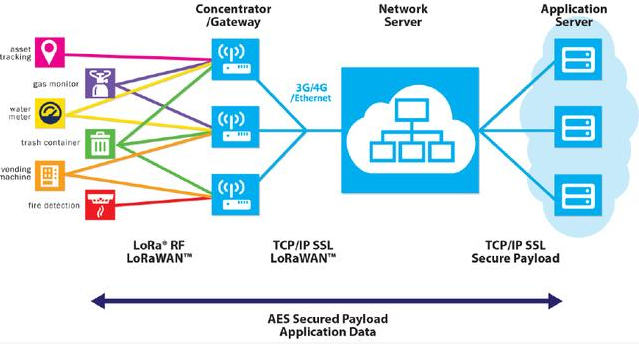
In einem LoRaWAN®-Netz sind die Knoten nicht mit speziellen Gateways verbunden. Im Gegensatz dazu werden Daten, die von einem Knoten übertragen werden, normalerweise von mehreren Gateways empfangen. Jedes Gateway leitet die vom Endknoten empfangenen Pakete über eine Art Backhaul (Mobilfunk, Ethernet usw.) an einen Cloud-basierten Netzwerkserver weiter. Die Intelligenz und die Komplexität liegen auf dem Server, der das Netz verwaltet und eingehende Daten auf Redundanz filtert, Sicherheitsprüfungen durchführt, Bestätigungen durch optimale Gateways plant und adaptive Datenraten durchführt, usw.
2. Zusammensetzung des LoRa-Funknetzes
The LoRa network is mainly composed of four parts: terminal (can have a built-in LoRa module), gateway (or base station), server, and cloud. Application data can be transferred in both directions.
LoRa Alliance The LoRa Alliance is an open, non-profit organization led by Semtech in March 2015. Its founding members include French Actility, Chinese AUGTEK, and Royal Dutch Telecom KPN. In less than a year, the alliance has developed more than 150 member companies, including many heavyweight manufacturers such as IBM, Cisco, and Orange of France. There are a large number of companies in each link of the industrial chain (terminal hardware manufacturers, chip manufacturers, module gateway manufacturers, software manufacturers, system integrators, network operators). The openness of this technology makes competition and cooperation more difficult. The adequacy has promoted the rapid development and ecological prosperity of LoRa.
3. LoRa Communication Range
The communication range of LoRa depends on factors such as spreading factor (SF), bandwidth, transmit power, antenna gain, and environmental conditions.
In urban environments, LoRa devices typically achieve communication distances of 2–5 km. In suburban or rural areas with fewer obstacles, communication ranges of 10–20 km are common, while line-of-sight deployments can sometimes exceed 30 km.
However, actual performance varies depending on interference levels, building density, and gateway placement.
4. LoRaWAN network topology
LoRaWAN is based on a star-of-stars topology, where end devices communicate with gateways, and gateways forward packets to network servers. Mesh networking can be achieved at the application level but is not part of the standard LoRaWAN architecture.
In this network architecture, the LoRa gateway is responsible for data aggregation and connecting terminal devices and back-end cloud data servers. The gateway and server are connected via a TCP/IP network. There is two-way communication between all nodes and the gateway. Considering the battery-powered situation, the terminal node usually sleeps. When there is data to be sent, it wakes up and then sends the data.
Therefore, using LoRa technology, we are able to obtain longer transmission distances with low transmit power. This low-power wide-area technology is necessary for the large-scale deployment of wireless sensor networks.
5. Introduction to LoRaWAN protocol
LoRaWAN is a low-power wide-area network communication protocol based on the open-source MAC layer protocol released by the LoRa Alliance. It mainly provides local, national, or global network communication protocols for battery-powered wireless devices.
LoRaWAN? defines the network’s communication protocol and system architecture, and the LoRa® physical layer enables long-distance communication links. Designed from the bottom up, LoRaWAN optimizes LPWAN (Low Power Wide Area Network) for battery life, capacity, distance, and cost. An overview of the LoRaWAN specifications across regions is provided, along with a high-level comparison of the technologies competing in the LPWAN space.
While LoRa technology is widely used in industrial IoT, many users still have practical questions about deployment, coverage, licensing, and network capacity. The following FAQs address some of the most common concerns.
Frequently Asked Questions About LoRa Technology
1. Can LoRa signals pass through walls and buildings?
LoRa generally provides better signal penetration than Wi-Fi because it commonly operates in sub-GHz frequency bands. However, obstacles such as reinforced concrete, metal structures, and underground environments can still reduce signal strength and communication distance.
2. Do I need a license to use LoRa?
In most countries, LoRa operates in unlicensed ISM frequency bands, allowing users to deploy LoRa networks without purchasing spectrum licenses. However, available frequencies and transmission regulations vary by region.
3. Why use LoRa instead of Wi-Fi for IoT devices?
LoRa is designed for low-power, long-range communication, making it suitable for battery-powered sensors deployed over large areas. Wi-Fi offers higher data rates but typically consumes more power and provides shorter coverage distances.
4. Is LoRa better than Zigbee?
Neither technology is universally better. LoRa is commonly used for long-range communication across wide geographic areas, while Zigbee is often preferred for short-range mesh networking in buildings and industrial facilities.
5. When should LoRa not be used?
LoRa is not suitable for applications that require high bandwidth, real-time video transmission, or ultra-low-latency communication. It is primarily optimized for sending small amounts of data over long distances with minimal power consumption.
6. How many devices can connect to a LoRa network?
A LoRa network can support thousands of devices depending on gateway capacity, network design, transmission frequency, and payload size. Network scalability is one of the key advantages of LoRaWAN deployments.
7. Can LoRa work without the Internet?
Yes. LoRa communication between devices and gateways can operate without Internet access. However, cloud platforms, remote monitoring systems, and centralized data management typically require an Internet connection. In practical deployments, gateways are commonly used to bridge LoRa sensor networks with Ethernet, cellular networks, MQTT brokers, and cloud platforms.