Why autonomous tractor CAN bus integration breaks down in the field
RTK positioning on autonomous tractors now routinely delivers sub-5cm accuracy. Path planning algorithms have been validated across commercial deployments. Yet field engineers working on autonomous tractor retrofits keep running into the same failure mode: the system works under controlled conditions but breaks down mid-season during actual field operations.
In most retrofit projects, the breakdown traces back to the same place — not the GNSS antenna, not the path algorithm, but the CAN bus integration layer on the vehicle itself. No reliable protocol translation. No local control loop. Steering commands routing through infrastructure that was never designed for real-time vehicle control.
This article covers three things: what causes CAN bus integration failures in autonomous tractor deployments, why common architectural choices make them worse, and what a purpose-built CAN bus gateway for autonomous tractors actually does at the system level.

1. Heterogeneous bus protocols with no unified translation layer
A CAN bus gateway for autonomous tractors exists to solve a problem that shows up early in every retrofit project: the vehicle runs multiple incompatible buses simultaneously, and nothing bridges them.
A typical autonomous tractor retrofit runs at least four incompatible communication buses simultaneously:
- Steering controller and engine ECU on CAN bus — J1939 protocol, typically 250Kbps or 500Kbps
- RTK-GNSS receiver outputting NMEA sentences over RS232
- IMU and soil sensors on RS485 running Modbus RTU
- Implement position feedback on digital inputs (DI)
These buses are physically and logically incompatible. J1939 frames don’t map to Modbus registers. NMEA sentences don’t parse into CAN signals. Without a device that bridges all of them locally, sensor data cannot reach the control algorithm, and steering commands cannot reach the actuator.
In retrofit projects, the common workaround is to use separate protocol converters chained over an IPC. That solves compatibility while adding wiring complexity, more failure points, and no improvement in control latency.
2. Latency accumulation in cloud-routed steering loops
This is where CAN bus gateway architecture for autonomous tractors diverges most sharply from cloud-centric designs — and where field failures are hardest to diagnose.
In field deployments, network speed is rarely the limiting factor. Variability is.
Some autonomous tractor architectures route the steering correction loop through a remote server: sensor data uploads, deviation is calculated remotely, correction command comes back down. When the network performs well, round-trip latency is manageable. In agricultural fields with uneven 4G coverage, it frequently doesn’t. At 6–8 km/h field operating speed, a 150–200ms spike in command delivery produces measurable cross-track error that compounds over a pass.
Placing a time-sensitive control loop across a variable-latency link is an architectural mismatch. CAN bus steering control requires deterministic local response — not a cloud-dependent one.
3. Environmental reliability across a full growing season
Reliability requirements for a CAN bus gateway on autonomous tractors are different from standard industrial deployments — and most general-purpose hardware doesn’t survive the comparison.
Cab temperatures in summer field operations regularly hit 50–65°C. Add sustained vibration across rough terrain, dust from tillage and harvest operations, and periodic pressure washing. In retrofit projects, hardware that passes bench testing often fails within one growing season. Fan-cooled enclosures accumulate dust. Connectors loosen under vibration. Components rated to 70°C have no thermal headroom in a cab that regularly runs hotter.
CAN bus gateway vs. IPC vs. PLC: autonomous tractor control architecture compared
For engineers evaluating control architecture on an autonomous tractor project, the CAN bus gateway vs. IPC vs. PLC decision determines integration complexity, maintenance overhead, and long-term reliability in field conditions.
Each approach has a legitimate use case — the question is which matches the actual requirements of an autonomous tractor CAN bus system.
PLC
PLCs deliver deterministic local control with decades of proven reliability in industrial automation. The limitation in autonomous tractor applications is protocol breadth. Standard PLCs don’t natively handle J1939 frame decoding, NMEA sentence parsing, and path deviation calculation running in parallel. Adding those capabilities through modules increases hardware cost and integration complexity. PLCs fit well where control sequences are fixed and protocol requirements are limited — implement lifting logic tied to field boundary signals, for example.
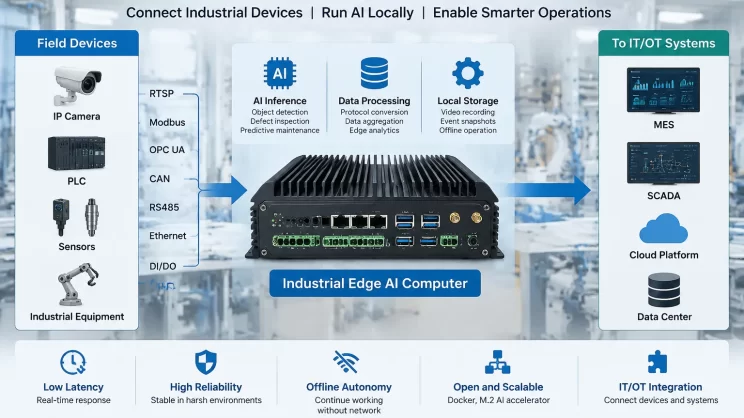
Industrial IPC
An IPC running Linux handles the full protocol mix with appropriate interface cards and has the compute headroom for demanding tasks: full navigation stacks, computer vision for obstacle detection, complex sensor fusion. The practical problem in agricultural cab installation is environmental. Fan-based cooling is a dust accumulation liability in tillage and harvest conditions. The form factor is larger than most cabs can comfortably accommodate. Power draw on 12V/24V vehicle electrical systems requires additional power management. For high-compute autonomous tractor applications, an IPC is often still the correct answer. For RTK-GNSS guidance with CAN bus steering and ISOBUS implement control, it requires more hardware than the task requires.
CAN bus gateway for agricultural vehicles
A fanless industrial gateway with native CAN, RS232, RS485, and digital I/O handles the protocol bridging problem directly without the environmental liabilities of a fan-cooled IPC. The local control loop runs on the gateway — no network dependency in the steering path. Compact form factor fits cab installations. Wide-range DC input connects directly to vehicle electrical systems without additional power conversion.
The trade-off is compute ceiling. Vision-based tasks and full navigation stacks exceed what current agricultural edge gateways can process.
For autonomous tractor deployments using RTK-GNSS positioning with CAN bus steering control and ISOBUS implement management, a dedicated CAN bus gateway is the architecturally appropriate choice — not because it’s simpler, but because it matches the actual workload and the environmental constraints.
J1939 and ISOBUS compatibility: what CAN bus integration actually requires
Getting J1939 and ISOBUS compatibility right is one of the less-documented challenges in autonomous tractor CAN bus gateway deployment — and one of the most common sources of integration delays in real projects.
Agricultural machinery from John Deere, Trimble, Topcon, AGCO, and most major OEMs communicates over CAN using J1939 as the base protocol layer. ISOBUS (ISO 11783) extends J1939 with standardized messaging for implement attachment and cross-brand control — the reason a Trimble display can command an implement from a different OEM over the same CAN bus.
In practice, J1939 and ISOBUS define the frame structure. Integrating specific devices requires decoding manufacturer-specific parameter groups (PGNs) and suspect parameter numbers (SPNs). In retrofit projects, it’s common to encounter steering controllers that use standard J1939 frame structure with proprietary PGN assignments, or ISOBUS implementations that include vendor extensions alongside the standard message set.
A CAN bus gateway with configurable frame parsing handles this without rewriting application code per device. The integrator configures field offsets, data types, and scaling per PGN at the gateway level. Incoming frames are decoded automatically. Outgoing commands are assembled from configured parameters. When the next device uses a different frame layout, the gateway configuration changes — the control application doesn’t.
This matters practically when a retrofit project mixes steering controllers, engine ECUs, and components from different manufacturers. Without configurable frame parsing at the gateway, each new device combination requires custom integration work at the application layer.
How the CAN bus gateway local control loop works on the vehicle
The core value of a CAN bus gateway for autonomous tractors is that the steering control loop never leaves the vehicle — and understanding why that matters requires tracing exactly how the loop runs.
The gateway connects directly to the vehicle CAN bus, to the RTK-GNSS receiver over RS232, and to sensors over RS485. Protocol translation runs locally — J1939 frames decoded, NMEA sentences parsed, Modbus registers read — and normalized data feeds the local control application.
When the vehicle drifts from the planned path, the gateway’s control logic calculates the correction and issues the steering command over CAN directly to the steering controller. That full cycle — sensor input to actuator command — stays on the vehicle. No external network in the loop.
Network connectivity handles data logging to the cloud platform and remote fleet monitoring. It has no role in real-time steering control. In field deployments where 4G drops mid-operation, the steering control loop continues without interruption. Data buffers locally and syncs when connectivity returns.
EG8200 specifications for autonomous tractor CAN bus gateway deployment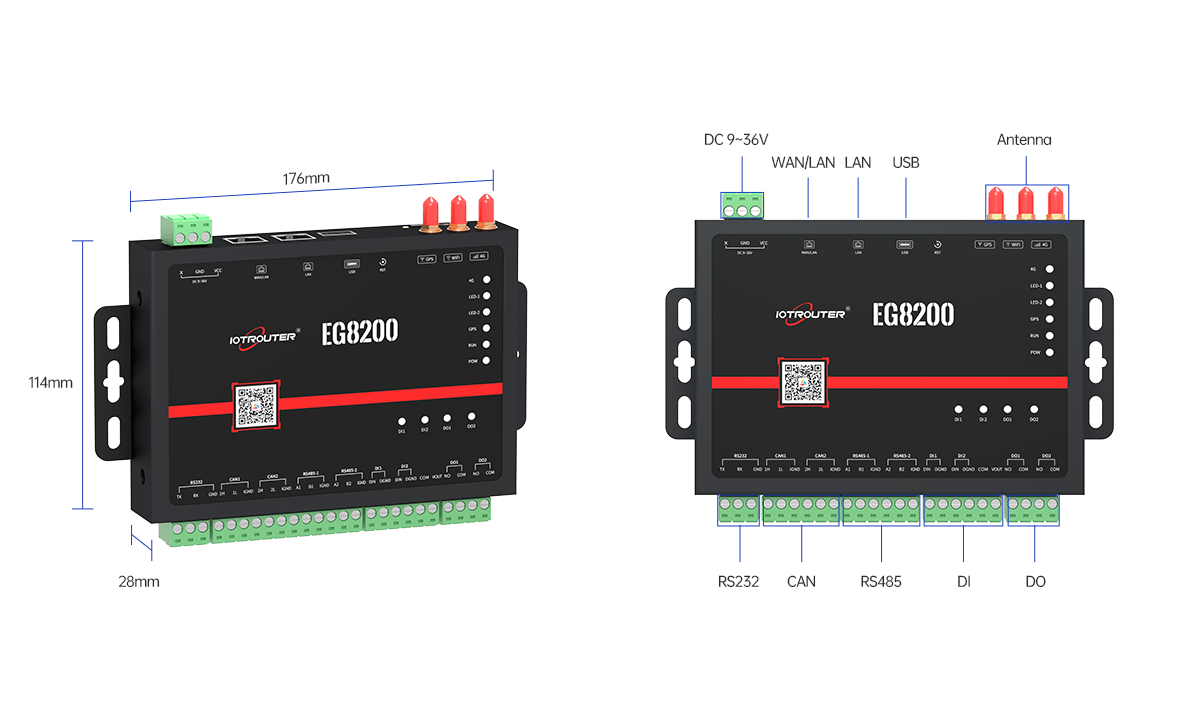
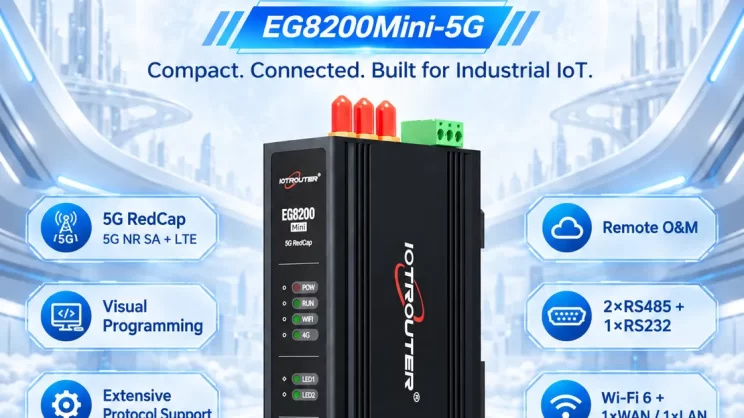
The IOTRouter’s EG8200 is designed as a CAN bus gateway for autonomous tractor and agricultural vehicle applications — the only model in the EG series with native CAN interface support.
| Parameter | Specification |
|---|---|
| CAN ports | 2× independent, standard + extended ID frames |
| CAN baud rate | 125Kbps–1Mbps, independently configurable per port |
| Protocol support | J1939, ISOBUS (ISO 11783), configurable PGN-level frame parsing |
| RS232 | 1× — RTK-GNSS receiver |
| RS485 | 2× — IMU, soil sensors, Modbus devices |
| Digital I/O | 2× DI, 2× DO |
| Processor | Dual-core Cortex-A7, 1.2GHz |
| Memory | 512MB RAM, 4GB storage |
| Integrated GNSS | BeiDou/GPS dual-mode, WGS84 |
| Cellular | 4G LTE, tri-carrier support |
| WiFi | Dual-band WiFi6, 2.4GHz + 5GHz simultaneous |
| Power input | 9–36V DC wide-range, 280mA @ 12V |
| Operating temperature | -40°C to +85°C |
| Enclosure | Galvanized steel, fanless passive cooling |
| EMC | ESD air Level 3, surge Level 2, burst Level 2 |
Two independent CAN ports allow simultaneous connection to separate bus networks — powertrain J1939 at 500Kbps and ISOBUS implement network at 250Kbps on a single device, without a separate converter.
Fanless passive cooling eliminates dust accumulation in agricultural operating environments. At -40°C to +85°C operating range, the device covers typical cab thermal conditions with headroom above the 65°C ceiling observed in field measurements.
Integrated BeiDou/GPS gives the gateway an independent position fix separate from the RTK receiver — useful for fleet tracking and correlating operational data with field location when the RTK data stream is unavailable.
Installation: What field deployment experience shows matters most
Deploying a CAN bus gateway on an autonomous tractor involves a small set of installation decisions that have outsized impact on long-term reliability — most of which don’t appear in product documentation.
CAN bus termination — verify before connecting
Vehicle CAN networks are designed with 120Ω termination resistors at each physical end of the bus. Connecting the gateway at a mid-bus tap without accounting for existing termination creates incorrect bus impedance and signal reflections. In field deployments, this shows up as intermittent CAN communication errors that correlate with temperature and vibration — easy to misdiagnose as a hardware fault. Before connecting, confirm the bus has the correct termination at both ends. Don’t add a third termination point.
Mounting location — surface temperature is not the same as ambient
The EG8200 is rated to +85°C. Cab interior temperatures in summer field operations typically run 50–65°C. A device mounted where direct sunlight hits the enclosure can run 15–20°C above ambient — enough to close the margin. Mount in a shaded location inside the cab or in a sealed enclosure away from solar exposure.
Node-RED for field commissioning
The gateway runs Node-RED for local control application logic. CAN ID filtering, baud rate configuration, RS232 parameters, sensor processing logic, and DO output conditions are configured through the visual interface without device-level code. In retrofit projects where parameters need adjustment during commissioning, changes happen through the interface without physical access to the device each time.
Multi-vehicle fleet deployment
One EG8200 per vehicle as an independent edge node. Remote firmware updates over 4G cover routine maintenance without field visits. AP mode supports up to 20 simultaneous WiFi client connections for local field network scenarios.
CAN bus gateway integration FAQ for autonomous tractor projects
These questions come up consistently in autonomous tractor CAN bus gateway deployments — particularly in multi-brand retrofit projects where J1939 and ISOBUS devices from different manufacturers need to coexist on the same vehicle network.
Can both CAN ports run at different baud rates simultaneously?
Yes. Each port configures independently across 125Kbps–1Mbps. In deployments where powertrain J1939 runs at 500Kbps, and ISOBUS implements run at 250Kbps, both connect to a single EG8200 without a separate converter.
How does the gateway handle proprietary CAN frames from specific manufacturers?
The advanced CAN node operates at the frame level and is protocol-agnostic. Field offsets, data types, and scaling factors are configured per CAN ID. Standard J1939 PGNs and proprietary extensions use the same mechanism. When a new device has a different frame layout, the gateway configuration changes — the control application doesn’t.
Does 4G signal loss affect the steering control loop?
No. The steering control loop runs locally on the gateway. 4G carries operational data to the cloud platform; it is not in the real-time control path. In field deployments where the signal drops mid-operation, local control continues normally and buffered data syncs when connectivity returns.
When does an IPC make more sense than a CAN bus gateway for autonomous tractors?
When the application requires computer vision, a full ROS navigation stack, or sensor fusion workloads that exceed a 1.2GHz dual-core processor’s capacity — an IPC is the correct hardware. For RTK-GNSS-based autonomous guidance with CAN bus steering and ISOBUS implement control, the EG8200’s processing handles the workload, and the fanless form factor, wide-voltage input, and native CAN ports reduce integration work compared to an IPC with add-on adapters.
What autonomous tractor applications is this gateway not suited for?
Vision-based obstacle detection, LiDAR point cloud processing, and applications running full autonomous navigation stacks exceed the EG8200’s compute ceiling. For those workloads, an IPC or purpose-built autonomous vehicle compute platform is the appropriate hardware. The EG8200 handles the CAN bus gateway and local control layer — not the perception layer.

Agnes Wang is an IoT Solutions Specialist at IOTRouter, focusing on industrial IoT gateways, edge computing, and industrial automation solutions.
She specializes in industrial communication technologies, including Modbus, IEC 60870-5-104, MQTT, OPC UA, PLC integration, and remote monitoring applications. She contributes to technical articles and application guides covering industrial IoT solutions, protocol conversion, and edge computing.