LoRa spread spectrum is the core reason why LoRa can achieve long‑range, low‑power communication in IoT systems.
LoRa can transmit data over several kilometers with very low power consumption. This is achieved through LoRa spread spectrum technology, also known as Chirp Spread Spectrum (CSS). The key reason is not high transmit power, but the receiver’s ability to decode signals even when they are weaker than the ambient noise floor. This capability is essential for IoT devices, which are typically battery‑powered, widely scattered, and rarely serviced. They cannot use large antennas or high transmit power.
This capability comes from the modulation scheme underlying LoRa: Chirp Spread Spectrum. LoRa is Semtech’s engineering implementation of CSS, which makes it fundamentally different from traditional narrowband communication. When people refer to “LoRa transmission,” they are essentially using CSS to transmit data.
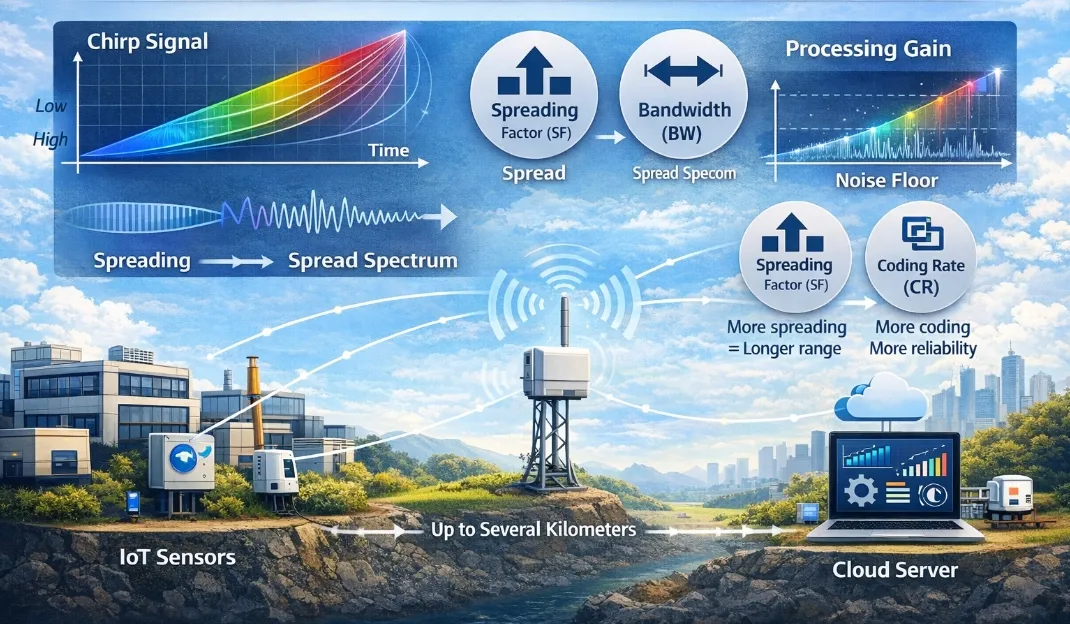
Why LoRa spread spectrum works better than narrowband communication
Conventional wireless communication concentrates signal energy into a narrow frequency band. This is spectrally efficient, but the weak point is that any interference on that band can break the link. IoT environments are full of interference: motor noise on factory floors, random RF emissions in agricultural fields, and congested ISM bands in cities.
LoRa does the opposite. It deliberately spreads a narrowband signal across the entire channel bandwidth. Instead of using a fixed frequency, it uses a pulse whose frequency linearly sweeps from low to high (a chirp). Within each symbol period, the frequency starts at a certain value and sweeps across the whole bandwidth. The energy is evenly spread over the wide band, so any narrowband interference affects only a small fraction, and its impact is diluted after despreading.
The receiver is the key. A LoRa receiver generates a local reference chirp and correlates it with the incoming signal (usually implemented with an FFT). This process re‑collects the spread energy into a sharp peak, while the noise remains spread out.
As a result, even when the original signal is more than 10 dB weaker than the noise, the receiver can still extract it. This capability is called processing gain. For LoRa, each increment of the spreading factor (SF) improves sensitivity by about 2.5 to 3 dB. At SF7, sensitivity is approximately -117 dBm; at SF12, it reaches about -137 dBm, and the system can operate at signal‑to‑noise ratios as low as -20 dB.
The trade‑off is obvious. The cost of CSS is a low data rate. At SF12, the data rate is only tens of bits per second, while at SF7 it can reach tens of kilobits per second — a difference of two orders of magnitude. However, most IoT sensors — temperature, humidity, liquid level, vibration, meter reading, GPS location — transmit only a few tens of bytes per message, and intervals range from minutes to hours. Low data rate is not a problem. Thus, LoRa trades data rate for distance and power efficiency.
In practice, these three parameters are always adjusted together depending on the deployment environment. The trade‑offs are roughly as follows:
| Parameter | What it affects | Trade‑off |
|---|---|---|
| Spreading Factor (SF) | Range ↑ | Data rate ↓ |
| Bandwidth (BW) | Data rate ↑ | Sensitivity ↓ |
| Coding Rate (CR) | Reliability ↑ | Overhead ↑ |
When configuring a link, engineers look for the best trade‑off for the specific environment: indoor with many walls, open outdoor, heavy industrial interference, or agricultural plains. This flexibility is important for IoT because deployment conditions vary widely; no single parameter set works everywhere.
Real-world scenario: machine health monitoring in a factory
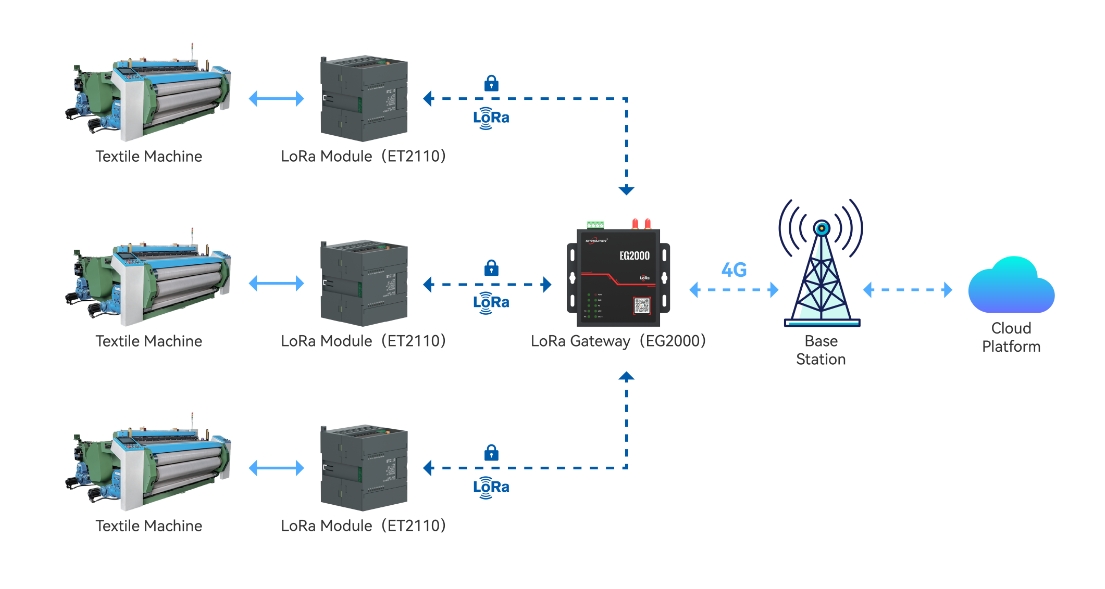
Consider a typical smart factory requirement: deploy dozens of vibration sensors along a production line to monitor motor health and predict bearing wear or shaft imbalance. These motors may be scattered across the workshop, some behind metal cabinets, some in underground pump rooms.
Wi‑Fi cannot penetrate, ZigBee lacks range, and cellular modules consume too much power (not to mention a SIM card per sensor). What you need is a physical layer technology that uses very low power (batteries lasting two to three years) yet can penetrate several walls and reach a gateway hundreds of meters or even one to two kilometers away. LoRa fits exactly into this gap.
Industrial sites are rich in interference: variable‑frequency drives, motor start/stop transients, welding equipment — all produce burst noise in the ISM band. A conventional narrowband wireless sensor, once hit by strong interference on its frequency, loses the packet and must retransmit, wasting power.
LoRa spreads the signal across the entire channel bandwidth (e.g., 125 kHz or 250 kHz). Any narrowband interference affects only a small portion. The receiver performs matched filtering to recollect the spread energy while the interference is diluted. This is why, with the same transmit power of 14 dBm (about 25 mW), an ordinary module may become unreachable after a few hundred meters, while LoRa can reach several kilometers.
In machine health monitoring, the low data rate is not a drawback. A vibration sensor reports peak acceleration, RMS, or FFT amplitude values once every 10 minutes or every hour, with tens to a few hundred bytes per message. Real‑time video or millisecond response is not required. You can configure a node with SF10, 125 kHz bandwidth, and 14 dBm transmit power, and the battery will last two to three years.
In a real deployment, the LoRa gateway is usually mounted in a central location of the workshop, for example, 500 meters from the farthest node. It receives data from dozens of nodes and then forwards it to the cloud or a local SCADA system via 4G or Ethernet. In setups like this, industrial LoRa gateways (for example, devices like EG2000) are typically used to handle data aggregation and uplink.
They operate in the 850–930 MHz band (common for international versions), with a maximum transmit power of 30 dBm and a nominal line‑of‑sight range of 8 kilometers. In a factory environment with obstructions, the actual range is lower, but it still covers a production line or half a workshop. In most deployments, a single gateway can cover dozens of nodes, depending on the environment and configuration.
To return to the initial question: LoRa achieves long range and low power consumption not by transmitting more strongly, but by using chirp spread spectrum to spread the signal and then recollect it, gaining the ability to operate at negative signal‑to‑noise ratios.
This is the fundamental reason why LoRa spread spectrum is widely used in long‑range IoT. For industrial monitoring, agricultural fields, outdoor asset tracking, and similar scenarios, this is not a luxury — it is a necessity. IoT devices are often deployed in places where no one changes batteries frequently, antennas are small, and the environment is noisy. LoRa spread spectrum handles these difficulties, trading bandwidth and latency for the two things IoT values most: distance and power savings. In other words, LoRa is not designed to be fast — it is designed to be reliable over distance with minimal power.
FAQ
Why can LoRa work below the noise floor?
Because spread spectrum distributes signal energy across a wide bandwidth, the receiver reconstructs it using processing gain (correlation with a reference chirp).
Does higher SF always mean better performance?
Not necessarily. Higher SF improves sensitivity and range, but significantly reduces data rate and increases airtime. For dense deployments, a lower SF may be preferable to avoid collisions.
Is LoRa suitable for real‑time applications?
LoRa is optimized for low data rate, long‑range communication, not real‑time transmission. It is designed for periodic sensor reporting, not for low‑latency or streaming applications.

Agnes Wang is an IoT Solutions Specialist at IOTRouter, focusing on industrial IoT gateways, edge computing, and industrial automation solutions.
She specializes in industrial communication technologies, including Modbus, IEC 60870-5-104, MQTT, OPC UA, PLC integration, and remote monitoring applications. She contributes to technical articles and application guides covering industrial IoT solutions, protocol conversion, and edge computing.