Modbus-Gateways finden in der Industrie 4.0 breite Anwendung und bieten wichtige Funktionen zur Anbindung von SPSen und industriellen Geräten an IoT-Plattformen. In diesem Artikel erläutern wir, wie Modbus funktioniert und warum dieses Protokoll auch heute noch eine wichtige Rolle in modernen industriellen Anwendungen spielt.
1. Was ist Modbus?
Im Jahr 1979 suchte Modicon (heute Schneider Electric) nach einer Möglichkeit, seine SPSen untereinander und mit anderen Geräten zu vernetzen, und brachte daher Modbus. Auch rund vierzig Jahre später ist es immer noch das am weitesten verbreitete Kommunikationsprotokoll in der Industrie.
Warum hat es so lange überdauert? Drei Gründe:
-
Öffnen. Es handelt sich um ein offenes Protokoll – jeder kann es ohne Lizenzgebühren implementieren. Das trug dazu bei, dass es sich ab den 1980er Jahren rasend schnell in Zählern, Antrieben, Sensoren und allen möglichen Feldgeräten verbreitete.
-
Ganz einfach. Das Register-Lese-/Schreibmodell ist unkompliziert. Geringer Implementierungsaufwand, niedrige Einstiegshürde bei der Fehlersuche. Gerätehersteller können es problemlos integrieren, und das Wartungspersonal benötigt keinen Doktortitel, um damit umzugehen.
-
Weitgehend kompatibel. So gut wie jedes industrielle Gerät auf dem Markt unterstützt dieses Protokoll. SPSen, Stromzähler, Wasserzähler, Temperatur- und Feuchtigkeitssensoren sowie Regler – sie alle kommunizieren auch heute noch über Modbus in der Fertigung.
2. Modbus RTU, Modbus ASCII und Modbus TCP
Modbus gibt es in drei Hauptvarianten, je nach physikalischer Schicht und Übertragungsverfahren.
Modbus RTU – Der in der Praxis am häufigsten verwendete Modus. Er läuft über serielle RS-232- oder RS-485-Busse, nutzt eine binäre Kodierung mit CRC16-Prüfsumme und stützt sich auf Pausen zwischen den Zeichen (3,5 Zeichenzeiten), um die Rahmen abzugrenzen. RTU ist effizient, einfach zu implementieren und die erste Wahl für Messgeräte, Sensoren und Antriebe.
Modbus ASCII – Die Daten werden als ASCII-Zeichen übertragen – jedes Byte wird in zwei Hexadezimalzeichen umgewandelt, eingeleitet durch einen Doppelpunkt (:) am Anfang und CRLF am Ende, mit einer LRC-Prüfsumme. Der Vorteil: Die Daten sind für Menschen lesbar. Man kann sie auf einem seriellen Terminal betrachten und erkennen, was vor sich geht – der Nachteil: Die Effizienz beträgt nur die Hälfte der einer RTU.
Allerdings kommt Modbus ASCII in modernen Anlagen nur noch selten zum Einsatz. In modernen Industrieanlagen ist Modbus ASCII weniger verbreitet, während die meisten Industrie-Gateways vor allem auf die Unterstützung von Modbus RTU und Modbus TCP ausgerichtet sind.
Modbus TCP – Der Modbus-Frame wird in TCP/IP eingebettet, Standardport 502. Der RTU-Zeitsteuerungsmechanismus wird durch einen 7-Byte-MBAP-Header ersetzt, und TCP übernimmt die Fehlerprüfung. Modbus TCP wird mit Ethernet-fähigen SPSen, Steuerungen und HMIs verwendet und unterstützt mehrere gleichzeitige Clients.
Modbus RTU vs. Modbus TCP – worauf es in der Praxis ankommt
| Aspekt | Modbus RTU | Modbus TCP |
|---|---|---|
| Physikalische Schicht | RS-232 / RS-485 (seriell) | Ethernet |
| Netzwerktyp | Serielle Kommunikation | IP-Netzwerk |
| Rahmenbegrenzung | Stille zwischen den Frames (3,5 Zeichen) | MBAP-Header (7 Byte) |
| Fehlerprüfung | CRC16 (2 Byte) | Wird vom TCP-Stack verarbeitet |
| Typische Geräte | Messgeräte, Sensoren, Antriebe | SPS, Steuerungen, Host-Systeme |
| Kabelänge | RS-485 bis zu 1200 m (abhängig von der Kabelqualität und der Baudrate) | Hängt von der Netzwerktopologie ab |
| Topologie | Bus, Einzel-Master | Stern-/Baumstruktur, mehrere Clients |
Kurz gesagt: RTU wird auf RS-485-Feldgeräten wie Zählern und Sensoren eingesetzt. TCP wird auf Ethernet-SPSen und Steuerungen eingesetzt. Einen detaillierten Vergleich der Modbus-RTU- und Modbus-TCP-Kommunikation finden Sie in unserem Leitfaden unter Modbus RTU im Vergleich zu Modbus TCP.
In realen Projekten kommen oft beide nebeneinander vor. In einer Anlage können beispielsweise Leistungszähler über RTU und SPSen über TCP verbunden sein – das Gateway muss beide gleichzeitig verarbeiten.
3. Warum Modbus im industriellen IoT nach wie vor eine wichtige Rolle spielt
Wenn man eine beliebige Fabrik, ein Umspannwerk oder einen Technikraum betritt, findet man dort ältere SPSen, die seit Jahren produktionskritische Prozesse steuern. Diese verschwinden nicht einfach, nur weil jemand beschließt, “auf digital umzusteigen”. Ihr Austausch bedeutet Ausfallzeiten, Neuinbetriebnahme und Neuvalidierung – enorme Kosten und Risiken.
Die eigentliche Frage lautet also nicht “Sollten wir sie austauschen?”, sondern “Wie können wir ihre Daten in ein modernes IoT-System integrieren?”
Hier kommen industrielle Gateways ins Spiel. Sie schließen die Lücke zwischen Modbus-Geräten und Cloud-Plattformen. Das Gateway ruft Daten über Modbus von Feldgeräten ab und überträgt sie anschließend über MQTT in die Cloud.
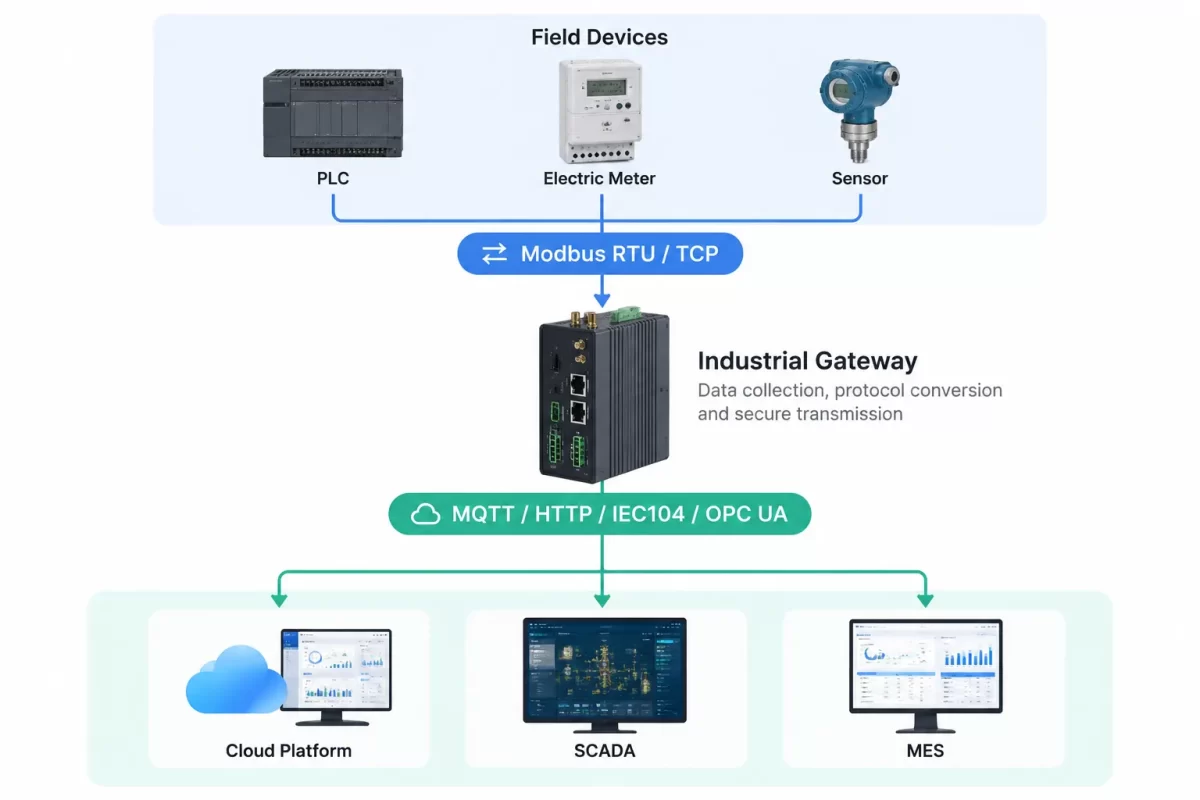
Wo befindet sich das Gateway im Datenfluss?
Ein industrielles Modbus-Gateway erfüllt drei Aufgaben: erfassen, übersetzen und übermitteln.
-
Sammeln: Das Gateway liest Modbus-Register auf der Grundlage einer Gerätezuordnungskonfiguration aus. Der Techniker richtet anhand des Gerätehandbuchs eine Registertabelle ein, und das Gateway fragt die Feldgeräte in konfigurierten Intervallen ab.
-
Übersetzen: Rohwerte aus den Registern werden in aussagekräftige technische Daten umgewandelt – das umfasst die Analyse der Datentypen, die Skalierung und die Einheitenumrechnung. In einigen Fällen übernimmt das Gateway auch die Protokollübersetzung – beispielsweise von Modbus nach IEC 60870-5-104 für die SCADA-Integration im Energiebereich.
-
Senden: Die aufbereiteten Daten – nun mit echten Einheiten und Kontext – werden über MQTT, HTTP oder ein anderes Industrieprotokoll übertragen. MQTT ist eines der am häufigsten verwendeten Protokolle für die Cloud-Anbindung bei industriellen Gateways. Erfahren Sie mehr über Wie MQTT SPSen und Feldgeräte mit Industrial-IoT-Plattformen verbindet. Die übergeordneten Systeme nutzen diese standardisierten Daten für Überwachung, Analyse und Steuerung.
4. Wichtigste Anwendungsszenarien für Modbus-Gateways
Modbus-Gateways kommen in vier zentralen Branchen zum Einsatz: Fertigung, Energie, Energieversorgungsunternehmen und Gebäudetechnik.
Intelligente Fabriken – In Produktionslinien kommen in der Regel mehrere SPSen und Steuerungen zum Einsatz, die Modbus RTU oder TCP nutzen. Beispiele hierfür sind SPSen wie Die Delta DVP-Serie kann über Modbus TCP mit IoT-Gateways verbunden werden. zur Fernüberwachung und Datenerfassung. Das Gateway erfasst Betriebsdaten – Laufzeit, Produktionszahlen, Fehlercodes – und leitet diese an MES- oder Cloud-Plattformen weiter. Herkömmliche Konfigurationen erforderten oft zusätzliche Softwareebenen wie SCADA- oder Protokollserver. Ein Gateway vereinfacht die Datenerfassungsebene, indem es unnötige Middleware überflüssig macht.
Energieüberwachung – Die Strommessung im Gewerbe- und Industriebereich ist ein idealer Anwendungsbereich für Modbus RTU. In einem Verteilerraum können Dutzende von Multifunktionszählern in Reihe an einem RS-485-Bus angeschlossen sein, die alle Modbus RTU verwenden. Das Gateway ruft Spannungs-, Strom-, Leistungsfaktor- und Energiedaten von all diesen Zählern ab und leitet diese anschließend an ein Energiemanagementsystem (EMS) weiter, um Trendanalysen, Effizienzoptimierungen und die Erkennung von Anomalien zu ermöglichen. Diese Konfiguration wird häufig in gewerblichen und industriellen Speichersystemen, im Energiemanagement von Campusgeländen sowie bei der PUE-Überwachung in Rechenzentren eingesetzt.
Energieautomatisierung – Die Energiewirtschaft verfügt über eigene Kommunikationsstandards. Automatisierungssysteme für Umspannwerke erfordern in der Regel IEC 60870-5-104 (IEC104), doch die Schutz- und Steuerungsgeräte vor Ort kommunizieren möglicherweise ausschließlich über Modbus. Das Gateway übernimmt die Übersetzung von Modbus nach IEC104 und verarbeitet dabei die Mess- und Steuerungsdaten, die die Versorgungssysteme benötigen. In diesen Szenarien ist ein Modbus-zu-IEC104-Gateway kann Feldgerätedaten in IEC-104-Meldungen für SCADA-Systeme umwandeln, ohne dass bestehende SPS-Programme geändert werden müssen.
Gebäudeautomatisierung – Gebäudemanagement, HLK, Pumpenräume – das sind klassische Anwendungsfälle für die “unbeaufsichtigte Fernüberwachung”. Bei Smart-Building-Projekten, Edge-Controller können Modbus-Geräte, HLK-Systeme und BMS-Plattformen über eine einheitliche Kommunikation integrieren. Feldgeräte werden über Modbus mit einem Edge-Gateway verbunden, und das Gateway überträgt die Daten über 4G oder Ethernet in die Cloud. Produkte wie das EM300 Edge-Controller sind genau dafür ausgelegt – sie fungieren als Modbus-RTU/TCP-Master, stellen Verbindungen zu zahlreichen Gebäudegeräten her, führen lokale Edge-Logik aus (wie beispielsweise Temperaturregelungs-Verriegelungen) und senden nur wichtige Daten an übergeordnete Systeme.
5. So wählen Sie ein Modbus-Gateway aus
Achten Sie bei der Auswahl eines Gateways auf folgende Aspekte:
Doppelte RTU/TCP-Unterstützung – Beide Protokolle sind in der Praxis weit verbreitet und werden häufig kombiniert. Das Gateway sollte sowohl als Modbus-RTU-Master (für RS485-Geräte) als auch als Modbus-TCP-Client (für Ethernet-SPSen) fungieren – idealerweise auch mit transparentem RTU-zu-TCP-Routing.
Isolierte RS485-Schnittstellen – Eine Isolierung in Industriequalität schützt das Gerät vor elektrischen Störungen. In Feldumgebungen herrschen starke elektromagnetische Störungen und Überspannungen – eine Isolierung ist kein Luxus, sondern eine grundlegende Voraussetzung für die Zuverlässigkeit.
Multiprotokoll-Übersetzung – Es geht nicht nur um Modbus-zu-MQTT. In realen Projekten werden häufig Modbus-zu-OPC-UA, Modbus-zu-IEC 104 und Modbus-zu-BACnet (für Gebäude) benötigt. Je mehr Protokolle ein Gateway unterstützt, desto häufiger können Sie es projektübergreifend wiederverwenden, ohne unterschiedliche Hardware vorrätig halten zu müssen.
Cloud-Konnektivität und Edge-Computing – Moderne Gateways sollten MQTT unterstützen, um eine zuverlässige Datenerfassung in der Cloud zu gewährleisten. Zu den wichtigsten Funktionen zählen MQTT-QoS, TLS-Verschlüsselung, Offline-Caching und sichere Kommunikation. Dank Edge-Computing-Funktionen können Sie lokale Filterung, Alarmauswertung und Verriegelungslogik durchführen – wodurch sich die Menge der in die Cloud übertragenen Rohdaten reduziert.
Auslegung auf Zuverlässigkeit – Industrielle Umgebungen sind rund um die Uhr an 365 Tagen im Jahr in Betrieb. Achten Sie auf MTBF, einen großen Temperaturbereich, Stromversorgungsredundanz und Watchdog-Timer – diese Faktoren entscheiden darüber, ob das Gateway jahrelang in einer Produktionsumgebung eingesetzt werden kann, ohne auszufallen.
6. Häufig gestellte Fragen
1. Können Modbus-Geräte eine Verbindung zur Cloud herstellen?
Ja. Ein Industrie-Gateway wandelt Modbus-Daten in MQTT- oder HTTP-Nachrichten um und sendet diese an die Cloud – bestehende Feldgeräte müssen nicht ausgetauscht werden.
2. Muss ich meine vorhandenen SPSen austauschen, um IoT zu nutzen?
Nein. Die meisten industriellen SPSen unterstützen Modbus. Über ein Gateway lassen sie sich ohne Hardware-Austausch oder Änderungen am SPS-Programm in eine IoT-Plattform integrieren.
3. Was ist der Unterschied zwischen einem Modbus-Gateway und einem Protokollkonverter?
Ein Protokollkonverter führt in der Regel eine einzige, einfache Formatkonvertierung durch (z. B. RTU ↔ TCP). Ein Industrie-Gateway ist ein umfassenderes Gerät – es übernimmt die Datenerfassung, Edge-Computing, MQTT-Upload, Store-and-Forward bei Netzwerkausfällen und vieles mehr.
4. Mit wie vielen Modbus-Geräten kann ein Gateway verbunden werden?
Das hängt von der Hardware des Gateways, der Baudrate, dem Abfragezyklus und den Reaktionszeiten der Geräte ab. Durch mehrere serielle Anschlüsse oder Ethernet-Schnittstellen lässt sich die Anzahl der Geräte erhöhen.
5. Können RTU- und TCP-Geräte eine Verbindung zum selben Gateway herstellen?
Ja. Viele Industrie-Gateways unterstützen sowohl Modbus RTU als auch TCP, sodass RS485-Feldgeräte und Ethernet-SPSen in einem System nebeneinander betrieben werden können. Dies ist in gemischten Umgebungen üblich – Messgeräte über RTU, SPSen über TCP, die alle Daten an dasselbe Gateway übermitteln, um sie einheitlich in die Cloud hochzuladen.
7. Abschließende Gedanken
Warum sprechen wir heute noch über Modbus?
Denn die installierte Basis ist riesig und wird so schnell nicht verschwinden. Die SPSen, die schon seit einem Jahrzehnt im Einsatz sind, die an RS485-Bussen angeschlossenen Messgeräte, die Sensoren in den Schaltschränken – sie alle kommunizieren über Modbus, und das wird auch so bleiben.
Die eigentliche Herausforderung im industriellen IoT besteht nicht darin, neue Protokolle zu entwickeln. Vielmehr geht es darum, die Daten all dieser Modbus-Geräte an einen Ort zu leiten, an dem sie sinnvoll genutzt werden können. Ein industrielles Gateway erfüllt genau diese Aufgabe: Es liest Modbus-Daten aus, wandelt sie um und überträgt sie über moderne Protokolle in die Cloud.
Modbus übernimmt die Kommunikation auf Feldebene. MQTT bietet einen schlanken, zuverlässigen Kanal für die Cloud-Anbindung in vielen IIoT-Anwendungen.
Zusammen – Modbus, das Gateway und MQTT – bilden sie einen praktischen, bewährten Weg, um bestehende industrielle Anlagen mit den heutigen IoT-Plattformen zu verbinden.

Agnes Wang ist Spezialistin für IoT-Lösungen bei IOTRouter und konzentriert sich auf industrielle IoT-Gateways, Edge-Computing und Lösungen für die industrielle Automatisierung.
Sie ist auf industrielle Kommunikationstechnologien spezialisiert, darunter Modbus, IEC 60870-5-104, MQTT, OPC UA, SPS-Integration und Fernüberwachungsanwendungen. Sie verfasst Fachartikel und Anwendungsleitfäden zu industriellen IoT-Lösungen, Protokollkonvertierung und Edge-Computing.