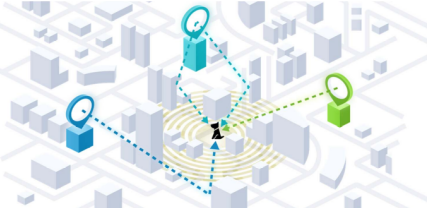
How does LoRa achieve positioning? LoRa uses Time Difference of Arrival (TDOA) to achieve geographical positioning.
A technology based on LORA positioning, including an information transmission system, a network transmission system and an information processing system, characterized in that the output end of the information transmission system is connected to the input end of the network transmission system, and the output end of the network transmission system Connected to the input end of the information processing system, the information transmission system includes Beacon beacon, GPS satellite, base signal tower, LORA tag and LORA area network, the input end of the Beacon beacon, GPS satellite and base signal tower The input end of the LORA tag is connected to the input end of the LORA tag. The output end of the LORA tag is connected to the input end of the LORA area network. The network transmission system includes a LORA gateway, a network connection and a wide area network. The output end of the LORA gateway is connected to the input end of the network connection. end connection. The arrangement of Beacon beacons, GPS satellites and base signal towers in the present invention makes the system more accurate in positioning personnel and has a wider scope of application, thereby ensuring the accuracy of personnel positioning.
1. Das Prinzip der LoRa-Ortung
To understand how LoRa positioning works, it is necessary to look at the data transmission steps from the end node to the server. The premise of LoRa positioning is that all base stations or gateways share a common time base, which is very important.
Wenn ein LoRaWAN-Endgerät ein Datenpaket sendet, wird dieses von allen Gateways innerhalb der Netzwerkreichweite empfangen, und jedes Paket wird an den Netzwerkserver gemeldet. Alle Gateways funktionieren gleich: Sie empfangen jederzeit Signale mit allen Datenraten auf allen Kanälen. Das bedeutet, dass für LoRa-Endgeräte kein Mehraufwand entsteht, da sie nicht nach einem bestimmten Gateway suchen und eine Verbindung zu diesem herstellen müssen. Der Sensor wird einfach aktiviert, sendet ein Paket, und alle Gateways innerhalb der Netzwerkreichweite können es empfangen.
Alle Gateways leiten die empfangenen Pakete unverändert an den Netzwerkserver weiter und erfassen dabei die Ankunftszeiten mit hoher Genauigkeit mithilfe spezieller Hardware und Software, die in die Gateways der neuesten Generation integriert ist. Algorithmen auf dem Netzwerkserver vergleichen Ankunftszeit, Signalstärke, Signal-Rausch-Verhältnis und andere Parameter, um den wahrscheinlichsten Standort des Endknotens zu berechnen. Für die Zukunft erwarten wir, dass hybride Datenfusionstechnologie und Verbesserungen beim Kartenabgleich dazu beitragen werden, die Ankunftszeitdifferenzen zu verringern und die Ortungsgenauigkeit zu erhöhen.
Um eine genauere Standortbestimmung zu ermöglichen, müssen mindestens drei Gateways die Pakete empfangen. Eine größere Anzahl von Gateways und ein dichteres Netzwerk verbessern die Ortungsgenauigkeit und die Kapazität. Denn wenn mehr Gateways dasselbe Paket empfangen, erhält der Serveralgorithmus mehr Informationen, wodurch sich die Genauigkeit der Standortbestimmung verbessert.
Im Inneren des LoRa-Gateways ist eine neue Hardware-Generation erforderlich, um bestimmte Parameter zu berechnen, die bei der Geolokalisierung zum Einsatz kommen, wie beispielsweise die hochpräzise Ankunftszeit. Semtech hat Anfang 2016 ein Referenzdesign für die neue Version des Gateways entwickelt, das in vielen Gateways erfolgreich implementiert wurde. Das Referenzdesign umfasst die erforderlichen hochwertigen Zeitstempel-Funktionen und steht autorisierten Gateway-Partnern zur Verfügung. Dadurch wird sichergestellt, dass Lösungen verschiedener Anbieter konsistent zusammenarbeiten, um hochwertige Zeitstempel zu liefern, was Geolokalisierungsdienste von höchster Qualität ermöglicht.
Es ist wichtig zu beachten, dass die Standortbestimmung vollständig von der Gateway- und Netzwerktechnologie abhängt. Sobald also das Gateway aktualisiert wurde, steht die Standortbestimmung allen Geräten zur Verfügung.
Semtech stellt zudem ein Programm zur Standortbestimmung bereit. Der allgemeine Solver ist keine dedizierte Anwendung und unabhängig vom Endknoten, was einen guten Einstieg in LoRa-Standortbestimmungsdienste bietet. Darüber hinaus wurde eine API definiert, die es Systemintegratoren ermöglicht, Algorithmen von Drittanbietern zu nutzen, um die verfügbare Positionsgenauigkeit zu verbessern. Durch dieses offene Modell fördert Semtech Innovation und die Entwicklung von Lösungstechnologien, um eine kontinuierliche Verbesserung der LoRaWAN-basierten Geolokalisierung sicherzustellen.
Wenn ein Paket das Gateway erreicht, weiß dieses nicht, von welchem Endgerät das Paket stammt. Daher versieht das Gateway jedes empfangene Paket mit einem Zeitstempel und leitet es an den Server weiter. Da der Zugriff auf Geolokalisierungsdienste wertvoll ist, werden diese Zeitstempel im Gateway durch Verschlüsselung geschützt. Der Zeitstempel wird an den Netzwerkserver übertragen, und Semtech erteilt dem Netzwerkanbieter die Berechtigung zur Entschlüsselung. Der Webserver-Anbieter kann die Daten je nach gebuchtem Servicelevel entschlüsseln.
Eine der größten Herausforderungen bei der Bereitstellung einer guten Standortabdeckung ist die Reduzierung von Mehrwegausbreitung. Wie in der folgenden Abbildung dargestellt, gelangen einige Datenpakete direkt zum Gateway, andere nicht, weisen jedoch ein reflektiertes Signal auf, und bei wieder anderen Datenpaketen treten beide Situationen auf. Die Reduzierung von Mehrwegausbreitung durch eine erhöhte Anzahl von Paketübertragungen kann über mehr Kanäle, mehr Gateways, mehr Antennen sowie durch den Einsatz von maschinellem Lernen oder statistischen Verfahren erfolgen.
The technology based on LORA positioning includes an information transmission system, a network transmission system and an information processing system. It is characterized in that the output end of the information transmission system is connected to the input end of the network transmission system, and the output end of the network transmission system is connected to the information processing system. The input end of the processing system is connected. The information sending system includes Beacon beacon, GPS satellite, base signal tower, LORA tag and LORA area network. The input end of the Beacon beacon, GPS satellite and base signal tower is connected with LORA. The input end of the tag is connected, and the output end of the LORA tag is connected to the input end of the LORA area network;
The network transmission system includes a LORA gateway, a network connection and a wide area network. The output end of the LORA gateway is connected to the input end of the network connection. The output end of the network connection is connected to the input end of the wide area network. The information processing system includes a management system. Server, cloud network server, management client and mobile management client;
2. Controllable parameters of LoRa positioning
Frequency diversity:
By repeatedly sending a message on all available channels, geolocation results improved by 50% on average. A static end node working on an 8-channel network will improve its results by 50% by sending 8 packets on 8 different channels.
Die Form des Gateway-Netzes. Die Auswirkungen des Gateway-Netzes belaufen sich auf etwa 25%. Ein langes, feines Netz schneidet bei 25% schlechter ab als ein quadratisches Netz. Daher sollte bei der Netzwerkbereitstellung so weit wie möglich darauf geachtet werden, die Gateways in einem quadratischen Muster zu platzieren.
Gateway Diversity:
Generally speaking, the more gateways receiving the signal, the more accurate the results. However, beyond 6 gateways, the geolocation improvements start to become less noticeable. At 3 to 4 gateways, there is about a 25% improvement, and beyond 4 gateways the geographical location improvement starts to decrease.
Die Antennendiversität wirkt sich am stärksten auf die schwächsten Signale aus. Befindet sich ein Gerät also an einem Standort mit gutem Empfang über drei Gateways und wird ein viertes, schwächeres Gateway hinzugefügt, sorgt die Antennendiversität in der Regel dafür, dass die über das vierte Gateway empfangenen Pakete von „nicht verfügbar“ auf „verfügbar“ wechseln. In diesem Fall kann dies zu einer Standortverbesserung von 25% führen.
1. The output end of the LORA area network is connected to the input end of the LORA gateway, and the output end of the wide area network is connected to the input end of the management server, cloud network server, management client and mobile management client respectively.
2. A technology based on LORA positioning according to claim 1, characterized in that the output terminals of the Beacon beacon, GPS satellite, base signal tower and the input terminal of the LORA tag are all wirelessly connected.
3. A technology based on LORA positioning according to claim 1, characterized in that the LORA tag is worn on the wrist of the human body.
4. A technology based on LORA positioning according to claim 1, characterized in that the output end of the LORA gateway and the input end of the network connection are wireless network connections.
5. A technology based on LORA positioning according to claim 1, characterized in that the output end of the management client is connected to the input end of the cloud network server.
6. A technology based on LORA positioning according to claim 1, characterized in that the mobile management client is a touch screen mobile phone.
7. A technology based on LORA positioning according to claim 1, characterized in that the information processing system is provided with a monitoring center, and the output end of the monitoring center is connected to the input end of the management server.
Schlüsselwörter: lora