Commercial solar-storage projects often underperform not because of hardware limitations, but because the energy management system (EMS) fails to optimize power flow, demand response, and settlement-grade data across the site. How well an EMS interprets real-time measurements, coordinates battery and PV dispatch, and ensures compliance ultimately determines whether a project achieves a 2-year payback or stretches to 5 years.
Even when the hardware meets specifications, these performance gaps become apparent during commissioning. A typical site may show PV output matching design specifications and battery state-of-charge tracking correctly, yet inspection of the energy management dashboard often reveals power flow running on generic presets, demand charge windows closing without load shedding, and CT ratios still set to factory defaults from unrelated installations.
Why Most C&I Energy Storage Systems Underperform
The core issue is treating the EMS as a reporting layer rather than a control layer. Data arrives at the dashboard; nothing acts on it fast enough to matter.
A capable energy management platform operates across two time domains simultaneously:
- Power closed-loop control — millisecond-to-second response, handling PCS modulation, frequency events, and fault isolation
- Energy dispatch — second-to-minute scheduling against TOU tariffs, demand windows, and contractual import limits
When those two loops aren’t tightly integrated, the system reacts instead of anticipating. The battery discharges at the wrong time. Peak demand slips through. The economy deteriorates.
The Demand Charge Problem Is a Timing Problem
Demand charges often represent 30–50% of a C&I electricity bill. They’re calculated on a rolling 15-minute average — which means a single 14-minute spike can reset the billing cycle regardless of how well the site managed the other 10 hours.
The table below illustrates why dispatch resolution matters: the difference between a platform that schedules in 15-minute blocks and one that tracks in real time is, in many utility structures, the difference between capturing the demand savings or missing them entirely.
| Time Window | Grid Price | EMS Action |
|---|---|---|
| Off-peak (22:00–08:00) | Low | Charge from grid / solar excess |
| Shoulder (08:00–11:00) | Medium | Hold reserve; monitor ramp |
| Peak (11:00–21:00) | High | Discharge to cap demand; solar self-consumption priority |
| Demand window close | Billed avg | Reset cycle; log metered data |
Note on dispatch resolution: A commercial EMS platform that only schedules in 15-minute blocks can miss intra-window demand spikes entirely. Sub-minute control logic is what closes that gap.
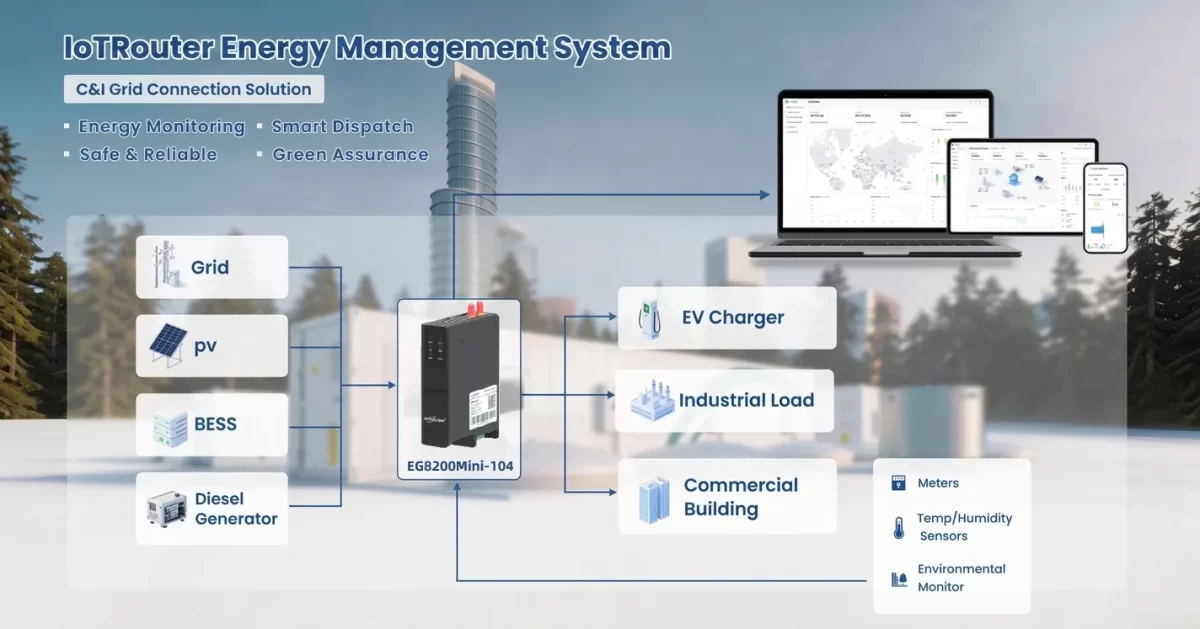
The IoTRouter Solar PV and Energy Storage Management System tracks rolling demand in real time and pre-empts breaches before the billing window closes — rather than logging them after the fact.
What the Data Layer Has to Get Right
None of the dispatch logic above works if the underlying data is wrong. This is where field installations actually fail.
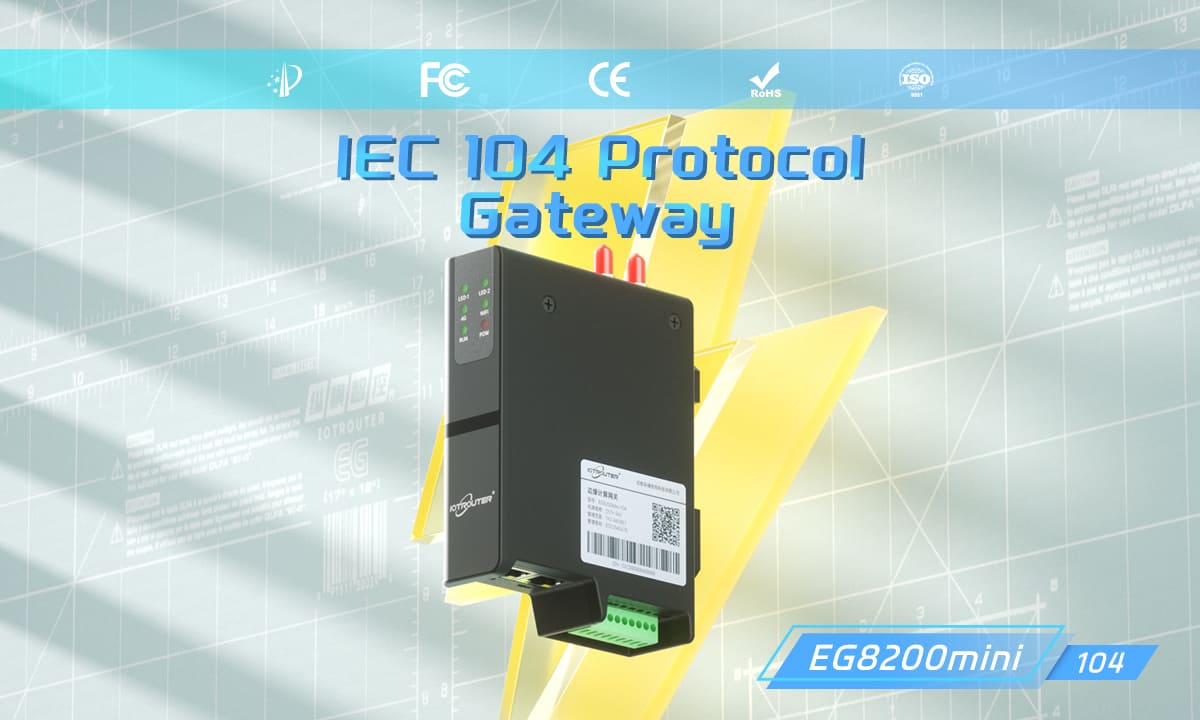
Measurement integrity starts at the sensor level. The EG8200Mini-104 gateway supports data acquisition down to the microsecond level, with configurable reporting intervals per device type — Mini S, S, Min, or Hour depending on the measurement class. For BMS parameters, second-level polling is standard. For PCS power control, the response loop operates in milliseconds.
Two configuration details affect data quality that rarely appear in vendor brochures. First, PT/CT ratio remote configuration: if the transformer ratio is locked at commissioning, any hardware change downstream forces a site visit. Second, phase sequence adaptation: on three-phase industrial sites, phase sequence varies by building section, and a platform that can’t auto-detect it will calculate active power incorrectly from day one.
Settlement data is a separate concern from operational data. Utility billing disputes are common on C&I storage projects. The IoTRouter system handles this by freezing billing calculations at the meter — auditable figures stay at the source, while the platform handles aggregation and reporting. Decoupled architecture means report templates can be reconfigured without touching the underlying metered data.
Offline resilience matters for remote sites. The breakpoint-resume function buffers local data during connectivity loss and resyncs in sequence when the link restores — no gaps in the historical record, no manual reconciliation.
Grid Compliance Isn’t Optional
Larger C&I systems feeding into the distribution grid carry interconnection requirements that the energy management platform has to handle natively.
The most commonly misunderstood is anti-islanding protection. Anti-islanding detects a grid outage and immediately disconnects the distributed resource — the purpose is to prevent the site from continuing to energize a de-energized grid segment, which creates live-line hazards for utility crews. It is not a response to outages; it is a safeguard against backfeeding during them. Any EMS claiming grid compliance needs to demonstrate that this function is active, logged, and testable.
The IoTRouter system supports IEC 61850, IEC 60870-5-104, Modbus TCP, and MQTT — the protocol stack that covers most utility-grade interconnection requirements without custom integration work.
Multi-Site Operations Change the Economics
Single-site EMS economics are straightforward. Multi-site operations introduce a different category of value: regional energy dispatch.
When multiple C&I sites share a common energy management platform, the system can shift loads and storage capacity across the portfolio in response to grid signals or regional pricing events. A manufacturing campus with three buildings and separate meters can optimize the aggregate demand profile rather than each building independently. A retail chain can flatten demand peaks across stores that hit peak windows at slightly different times.
The EG8200Mini-104 product page covers the gateway architecture that enables this edge processing at each site, which feeds a unified control layer without requiring all data to route through a central cloud.
This is also where deployment flexibility matters. Private server or private PC deployment options allow sites in regulated industries to keep all operational data on-premises while still connecting to the regional dispatch layer for coordination.
What ROI Actually Looks Like
The business case for C&I solar-storage isn’t hard to build when the numbers are honest:
- Demand charge reduction: 30–50% of the monthly bill, depending on tariff structure and load profile
- Peak-valley arbitrage: Captures TOU spread on every daily cycle
- Carbon cost avoidance: Increasingly relevant as carbon pricing expands in commercial tariff structures
- Deployment speed: Systems pre-integrated with an EG8200Mini-104 gateway commission faster; no third-party integration layer to debug
LCOE on a well-configured commercial storage system runs roughly one-third of equivalent distributed generation costs. ROI range of 1–3 years is achievable on sites where demand charges are the primary cost driver — but only if the energy management platform is doing its job.
What to Evaluate in a Commercial EMS Platform
Before selecting an EMS, the questions that actually differentiate products:
- What is the demand tracking resolution — 15-minute blocks or continuous?
- Can PT/CT ratios and phase sequence be configured remotely post-commissioning?
- Where does billing data freeze—at the meter or on the platform?
- What happens to data during a connectivity outage?
- Does the platform support multi-site regional dispatch, or only single-site monitoring?
- What grid protection standards does it certify to?
The answers tell you whether you’re buying a dashboard or a control system.