
Edge gateway and edge server are two commonly used concepts in edge computing. They are different in function and positioning. You may not be able to distinguish them well. Here, we will give you a good explanation of the difference between an edge gateway and an edge server.
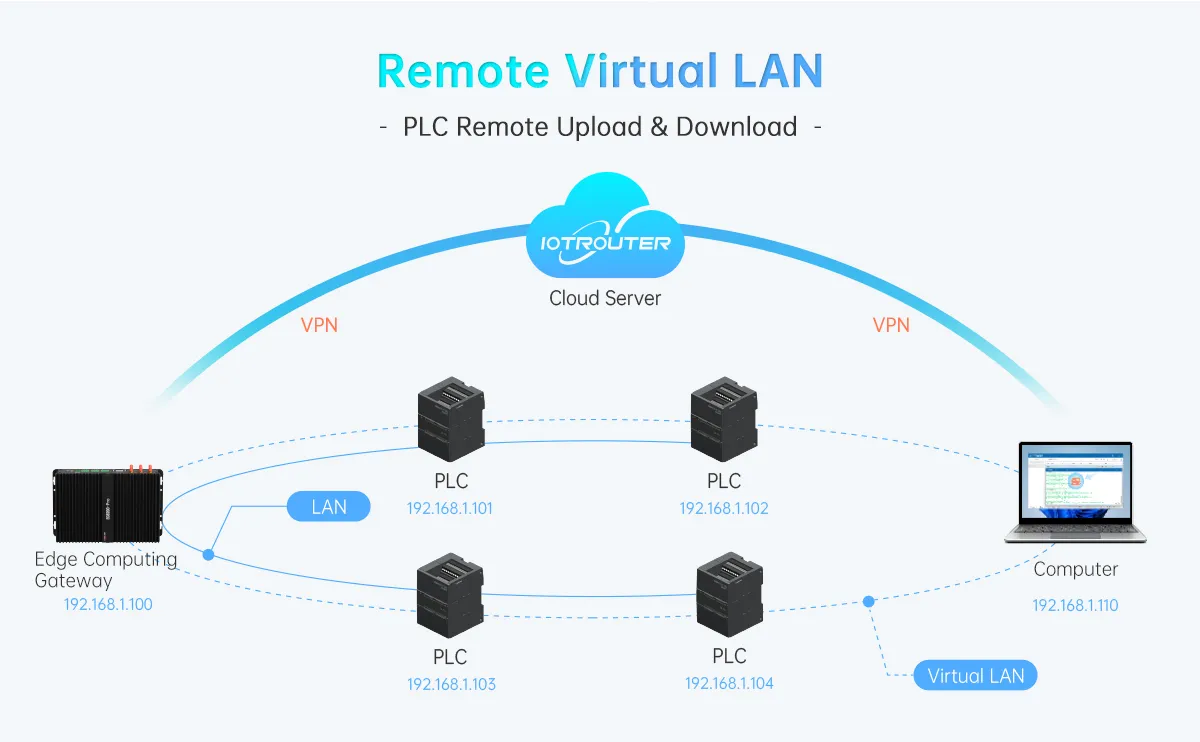
What is the edge computing gateway and edge server?
Edge Gateway(it is also called an edge computing gateway) refers to a device located at the edge of an edge computing network. It is usually located at the last mile or last mile edge node. As an intermediate node, the edge gateway connects terminal devices and cloud servers, providing a fast, secure, and reliable communication method by collecting and forwarding data.
The main function of the edge gateway is to transmit data from the terminal device to the cloud. It can also transmit data from the cloud to the terminal device to achieve two-way communication. The edge gateway has strong computing and storage capabilities, can process and analyze data, and can also provide some edge service functions.
In practical deployments, an edge gateway is typically required when terminal devices use multiple industrial or IoT protocols, when device-level access and management are needed, or when data must be securely transmitted from the field to the cloud under unstable network conditions. In these scenarios, the edge gateway acts as the first control and communication point, handling protocol conversion, basic data filtering, and reliable connectivity before data reaches backend systems.
Edge Server refers to the server device located at the edge of the edge computing network, which is usually located at the back end of the edge gateway. Edge servers are mainly used to process and store data in edge computing networks and provide some edge service functions. Edge servers have high computing and storage capabilities and can process, analyze, and store data. They can also provide some applications and services, such as video stream distribution, content caching, real-time data analysis, etc.
What is the difference between an edge gateway and an edge server?
Edge gateways and edge servers overlap in function, but edge gateways are more focused on data transmission and communication, while edge servers are more focused on data processing and storage.
Edge gateways are typically located at the edge of the network and are tightly connected to end devices to connect and transmit data.
Edge servers are located at the back end of the edge gateway and are responsible for processing and storing data in the edge computing network, as well as providing a number of edge service functions to provide efficient data interactions between end devices and cloud servers.
Edge Gateway vs Edge Server Comparison
| Feature | Edge Gateway | Edge Server |
|---|---|---|
| Primary Role | Data transmission and communication | Data processing and storage |
| Deployment Location | Network edge, close to end devices (last mile) | Backend of the edge gateway |
| Connection to Devices | Directly connected to sensors and terminal devices | Usually connected through edge gateways |
| Computing Capability | Moderate | High |
| Storage Capability | Limited to moderate | Large-capacity storage |
| Data Processing | Basic local processing and filtering | Complex data processing and analytics |
| Communication Function | Two-way communication between devices and the cloud | Focused on service delivery and data handling |
| Edge Services | Data collection, protocol conversion, security, and local decision-making | Content caching, video streaming, and real-time analytics |
| Typical Use Cases | IoT gateway, industrial gateway, smart transportation | Edge computing platform, micro data center |
| Core Purpose | Bridge between end devices and cloud | Provide high-performance edge computing services |
Although edge servers provide strong computing and storage capabilities, they are not designed to directly manage large numbers of field devices. Edge servers usually lack native support for industrial protocols and direct device access. Without an edge gateway, tasks such as device connectivity, protocol conversion, and secure data ingestion become complex and difficult to maintain in real-world environments.
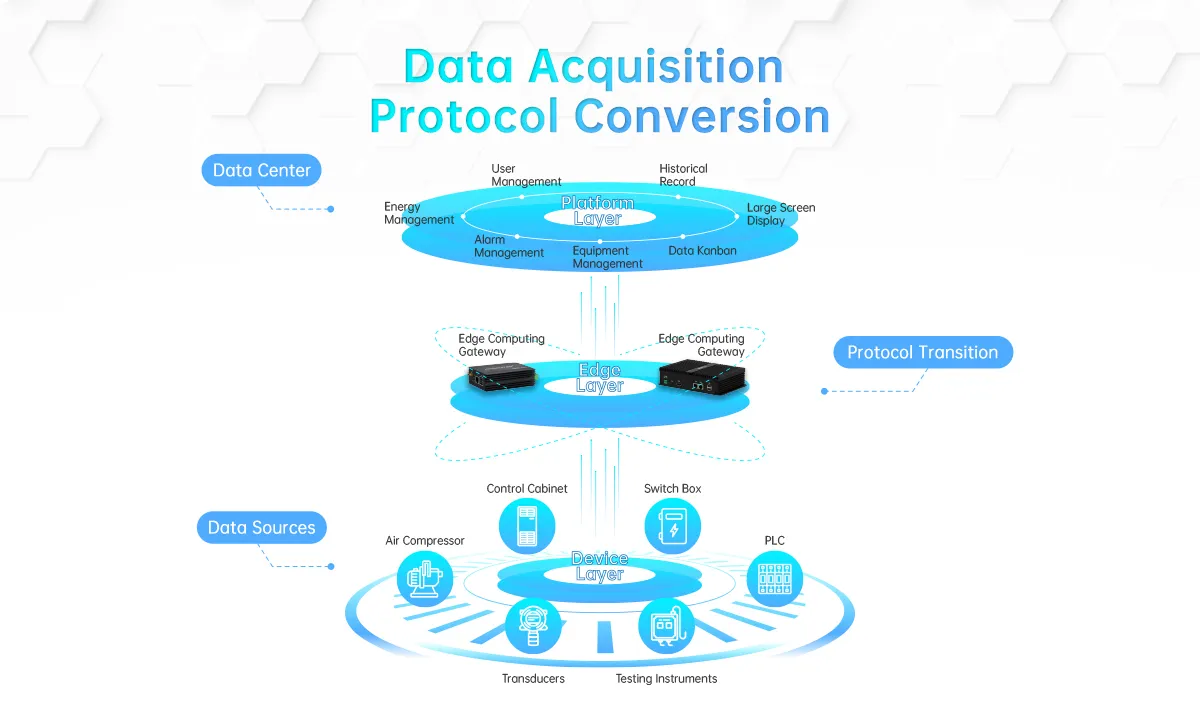
The edge service functions provided by the edge gateway include, but are not limited to:
1. Data collection and transmission: The edge gateway can collect data from terminal devices and transmit it to the cloud server for further processing and analysis.
2. Local data processing: Edge gateways can perform data processing and analysis to a certain extent, reducing dependence on cloud servers and improving data processing efficiency and real-time performance.
3. Security enhancement: Edge gateways can enhance data security through data encryption, access control, and other measures to protect data from unauthorized access and tampering.
4. Edge computing collaboration: Edge gateways can work collaboratively with other edge devices and edge servers to jointly complete data processing and analysis tasks, improving the performance and efficiency of the entire edge computing system.
5. Edge sensing and decision-making: The edge gateway can sense and make decisions based on the status and environmental information of the terminal device, and implement some automated or intelligent functions, such as smart homes, smart transportation, etc.
From a system design perspective, edge gateways and edge servers address different requirements. When the primary need is device access, protocol handling, and secure data transmission, an edge gateway is essential. When the main requirement is high-performance computing or data-intensive processing, an edge server is more suitable. In many industrial and IoT deployments, edge gateways and edge servers are used together to balance device connectivity and computing performance.
To sum up, the edge gateway and edge server are different. The edge gateway is an intermediate node connecting the terminal device and the cloud server, which mainly provides data transmission and communication functions. While the edge server is the computing and storage node in the edge computing system, it mainly provides data processing and storage functions. And provide some edge service functions. Together, they form the edge computing infrastructure, providing convenience and efficiency for data interaction between terminal devices and cloud servers.
Further Reading for System Designers
For system designers and engineers planning real-world edge computing deployments, understanding the role of an edge gateway is only the first step. Practical system design often involves additional considerations such as device protocol compatibility, local data processing requirements, network reliability, and long-term system maintainability.
To explore these aspects in more depth, system designers may find it useful to review topics such as how edge gateways handle industrial protocols, how edge gateways and cloud servers work together, and how edge gateways are selected based on performance, operating systems, and deployment environments. These topics are especially relevant in industrial IoT and large-scale edge computing systems, where stable device connectivity and predictable behavior are critical.