
You might think the most dangerous moment for an elevator is when a malfunction occurs. Wrong. The real danger lies in those tiny anomalies that quietly accumulate every day, unnoticed. Because these signals are too weak and too frequent, the traditional approach of sending all raw data to the cloud often results in delayed responses.
But today, I want to share a counterintuitive fact: an elevator is not just a “machine”, it is a “living entity” that should be monitored around the clock. And the one monitoring it is not the cloud, not the server room, but the edge brain using predictive elevator maintenance with edge computing and AI right on the elevator itself that can think—enabling real-time elevator diagnostics and predictive alerts.
Being Forewarned is More Valuable Than Firefighting
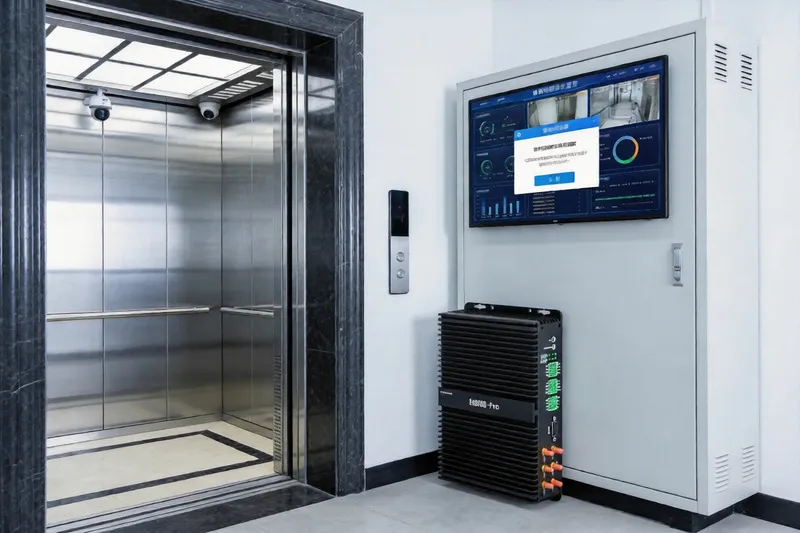
Placing computing next to the elevator machine room via an industrial gateway means millisecond-level decisions no longer rely on distant servers. Edge nodes capture all signals in real time—current, vibration, door opening times—and immediately extract features and run lightweight models to issue warnings before a component reaches an irreversible state. For situations like entrapment or overshoot that require second-level responses, this on-site judgment enabled by edge computing and AI for predictive elevator maintenance can directly determine whether people are rescued promptly.
Reduce Noise, Focus on Valuable Information
Uploading all raw traffic to the cloud is both wasteful and risky. Predictive elevator maintenance with edge computing and AI performs filtering, compression, and key segment extraction locally, sending only processed anomaly summaries and necessary video clips. This not only saves bandwidth but also ensures that management platforms and maintenance personnel focus on decision points that truly matter, instead of being buried in massive logs. This approach is also known as AI-powered predictive elevator monitoring, ensuring valuable alerts reach the right personnel.
On-Site Robustness Matters More Than Technical Tricks
Elevator machine rooms are complex environments, with high temperatures, dust, and electromagnetic interference. Gateways used for monitoring must have industrial-grade reliability, breakpoint resume, watchdogs, and local storage. Moreover, in retrofit scenarios for older elevators, they must non-invasively access multiple protocols and unify signals from different brands and generations of mainboards. Only then can predictive maintenance with edge computing and AI be effectively applied as a practical solution, sometimes referred to as intelligent elevator edge monitoring.
Why Has IOTRouter’s Gateway Become the “Default Choice” for Elevators?
There are many gateways on the market, but smart elevator scenarios are an extremely demanding test. They require absolute stability (7×24-hour uninterrupted operation), extreme compatibility (handling Mitsubishi, Otis, Schindler, and other brands and generations), and sufficient intelligence (capable of running AI algorithms). IOTRouter’s EG series edge computing gateways have been honed in such real-world conditions to support predictive elevator maintenance with edge computing and AI.
It doesn’t feel like an external device, but more like a “universal translator” and a “local commander.” With its rich built-in protocol stack (such as Modbus, BACnet, Siemens S7, etc.), it can seamlessly interface with any brand of elevator mainboard or sensor, understanding their “language.”
More importantly, it’s built-in streaming programming environment and function computing capability allow engineers to deploy complex diagnostic logic and alert rules on the gateway through graphical drag-and-drop, without diving deep into code, achieving truly personalized edge intelligence for predictive elevator maintenance—also described as AI-enabled elevator predictive alerts.
For example, in retrofitting older elevators, there’s no need to replace the expensive main control system. Simply using an EG gateway to collect key signals can digitalize operational status and enable predictive maintenance with edge computing and AI, at only a fraction of the cost of a full replacement.
This is where edge computing truly shines in the implementation of smart cities: activating the maximum potential of existing facilities with minimal intrusion. This approach is also known as real-time elevator condition monitoring with AI.

Maintenance is No Longer Passive Nighttime Repairs
The system transforms maintenance from reactive emergency repairs to planned interventions. Equipment is no longer serviced only when an alarm occurs, but is maintained based on trend reports. Inventory, personnel scheduling, and work order generation are all more organized. For property managers, regulatory bodies, and citizens, this shift to predictive elevator maintenance with edge computing and AI—or AI-powered elevator maintenance planning—is far more valuable than merely saving maintenance costs.
Safety Is Not a Contradiction
Some worry that edge devices increase the attack surface; the reality is the opposite. Keeping sensitive data locally and only uploading summaries, combined with gateway-level firewalls and encrypted transmission, reduces overall exposure. Moreover, fast local responses reduce reliance on external networks, making predictive maintenance with edge computing and AI safer and more reliable, also referred to as intelligent elevator edge protection.
FAQs
Q1: If the gateway loses power, does monitoring fail?
A: High-quality gateways support local caching and watchdogs. After a power outage, they can catch up on missed reports and rely on the elevator’s backup power to maintain core logic for predictive maintenance with edge computing and AI.
Q2: What happens if the edge computing gateway loses power?
A: This is exactly why design matters. EG series gateways feature hardware watchdogs and local storage. After an unexpected power outage, they can quickly resume operation and report any alerts missed during downtime once communication is restored, maintaining predictive elevator maintenance with edge computing and AI continuity.
Conclusion
Smart elevator monitoring is not about piling up bigger databases and calling it intelligence. The real shift lies in placing decision-making close to the risk source, giving elevators self-awareness and on-site decision-making ability.
As a result, thousands of elevators in the city are no longer isolated, waiting for accidents to happen, but become controlled units that actively report their health status. Technology is not the goal; ensuring citizens’ daily travel safety and efficiency through predictive elevator maintenance with edge computing and AI—or AI-enabled predictive elevator monitoring—is the tangible urban warmth we aim to achieve.