
Table of Contents
ToggleWhen enterprises deploy LoRaWAN networks, common issues include coverage blind spots, frequent node disconnections, battery life far below expectations, and unresponsive or severely delayed downlink commands.
These problems are usually not due to flaws in LoRaWAN technology itself, but rather a lack of systematic link planning and parameter tuning during deployment.
This article draws on experience from multiple real-world projects (including Industrial IoT LoRaWAN deployment scenarios) to discuss gateway placement, radio parameter configuration, node power management, and downlink control.
All values in this article are typical reference values. Actual deployment should be based on on-site measurements and local regulations.
1. LoRaWAN Gateway Placement & Coverage Optimization
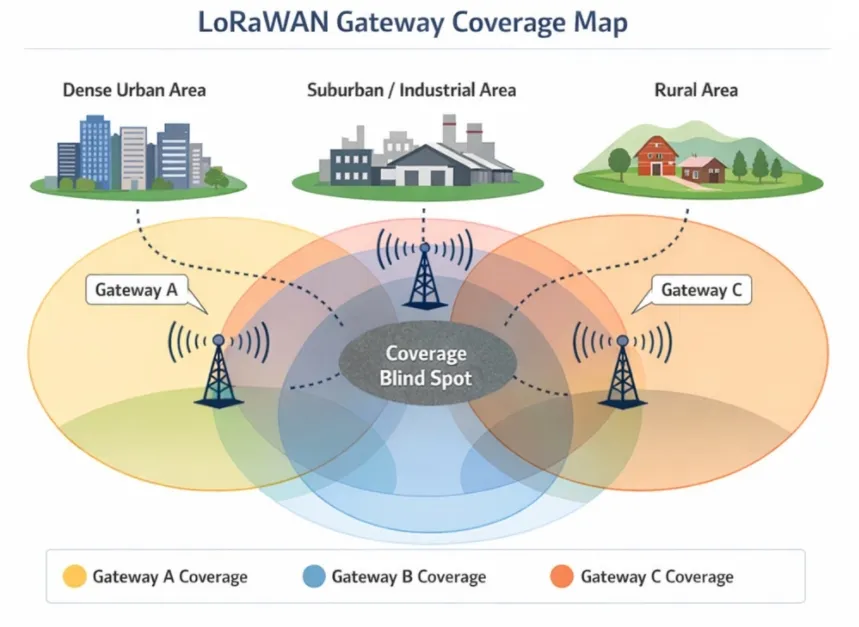 Link budget calculations provide only a theoretical reference; actual coverage must still be verified through on-site drive tests.
In urban environments, buildings may add 15–25 dB of penetration loss. For some modules, when battery voltage drops, transmit power may fall from 14 dBm to 12 dBm or lower.
Gateway spacing reference (typical values) :
| Scenario | Recommended Spacing | Installation Tips |
|---|---|---|
| Dense urban | 1.5–2 km | Above obstacles, avoid blocking |
| Suburban/industrial park | 3–5 km | Above obstacles, avoid blocking |
| Rural/remote | 8–12 km | Antenna height 15–30 m (depends on terrain; theoretical reference only – actual coverage affected by terrain, vegetation, and antenna height) |
Practical advice:
-
Before finalizing gateway locations, use a handheld test node to perform a 360° drive test around candidate positions.
-
Log RSSI and SNR. Areas where SNR approaches 0 or becomes negative may become LoRaWAN coverage blind spots or zones with degraded communication quality.
2. LoRaWAN Node Parameter Configuration (SF/BW/CR) for Reliable Coverage
Spreading factor (SF), bandwidth (BW), and coding rate (CR) directly affect data rate, coverage, and interference immunity.
Many beginners mistakenly believe that using SF12 gives the longest coverage. The trade-off is that airtime increases about 20 times (compared to SF7), and transmit energy consumption also increases significantly (depending on module power consumption and payload length). Additionally, long channel occupancy significantly raises collision probability.
Typical parameter configuration reference :
| Scenario | SF | BW | CR | Airtime (50 bytes) | Condition |
|---|---|---|---|---|---|
| Indoor/close-range high-density | 7 | 250 kHz | 4/5 | ~40 ms | RSSI > -80 dBm |
| General urban coverage | 9 | 125 kHz | 4/5 | ~200 ms | SNR 5–10 dB |
| Edge coverage | 11 | 125 kHz | 4/5 | ~800 ms | SNR -5–5 dB |
| Deep coverage / underground | 12 | 125 kHz | 4/8 | ~1400 ms | SNR < -5 dB |
Case study: In a smart parking project, using SF10 for all nodes resulted in 37% uplink collision rate during peak hours. After changing to dynamic SF selection based on real-time RSSI (SF7 for RSSI > -80, SF9 for -100 to -80, SF10 only for < -100), the collision rate dropped to below 9% (typical example).
ADR (Adaptive Data Rate) can automatically adjust parameters, but its convergence typically requires 10–20 uplinks. Different network servers (e.g., TTN, ChirpStack, AWS IoT Core for LoRaWAN) have significant implementation differences, so convergence speed may vary. For detailed LoRaWAN ADR configuration, refer to your network server’s documentation.
Note: In scenarios with frequent node mobility or high speed, ADR may struggle to stabilize. It is advisable to manually adjust parameters based on real-time RSSI. For critical devices, fix SF and transmit power directly.
3. LoRaWAN Node Power & Battery Life Optimization
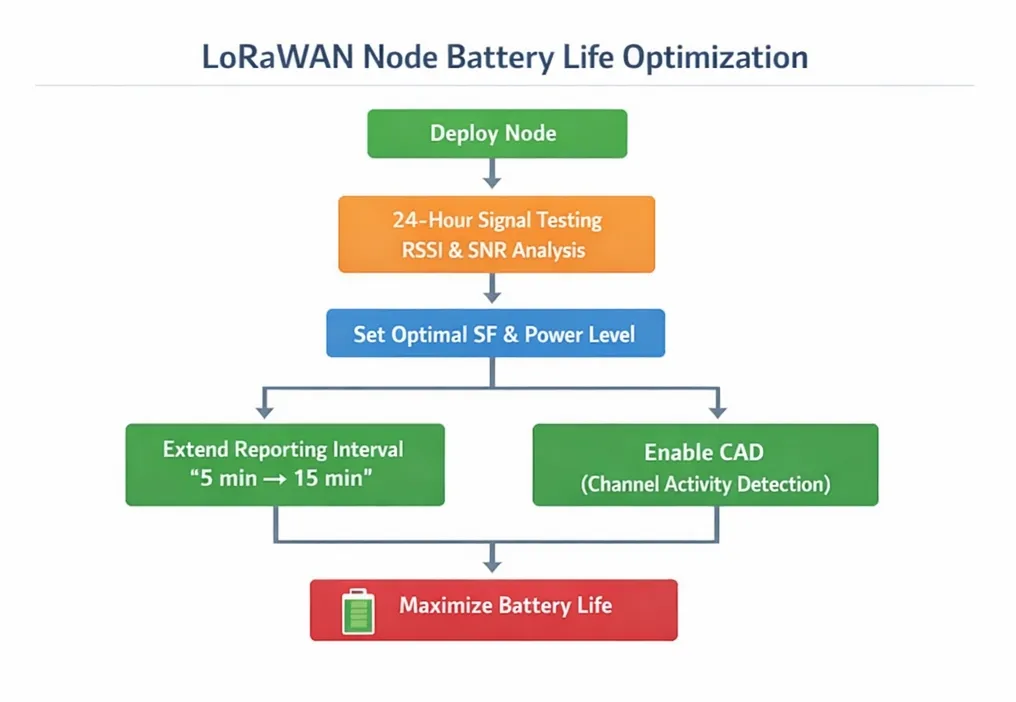
Insufficient battery life is often not due to high single-transmission power consumption, but rather to inefficient retransmissions and overly frequent wake‑ups.
Static nodes (e.g., water meters, gas meters, soil sensors):
-
After deployment, run a 24‑hour “probing phase”.
-
Send one packet per hour and record the RSSI and SNR returned by the gateway.
-
Take the median value, then fix the SF and power accordingly.
-
Keep the reporting interval as long as possible. For example, changing from 5 minutes to 15 minutes can significantly extend battery life in typical cases.
Mobile nodes (e.g., cold‑chain pallets, personnel tags):
-
ADR is recommended, but note that different network servers have different ADR convergence speeds.
-
In frequent roaming scenarios, ADR may not stabilise; adjust based on actual measurements.
Power‑saving technique – CAD (Channel Activity Detection) :
-
In high‑density scenarios, CAD listens to the channel before transmission, thereby reducing collisions and retransmissions (a key method for LoRaWAN uplink collision mitigation).
-
Although CAD itself consumes a small amount of current (a few mA), in high‑density environments, the energy saved by avoiding retransmissions is usually more significant.
Case study: In a chemical plant with 240 pressure nodes, fixed SF10 and 5‑minute reporting gave only 8 months of battery life. After switching to dynamic SF selection and extending the reporting interval to 15 minutes, battery life extended to 22 months (typical example).
4. LoRaWAN Downlink Management & Security Strategies
Join method selection – OTAA vs ABP:
-
Prefer OTAA. OTAA uses dynamic session keys and the DevNonce mechanism to prevent replay attacks. For a detailed LoRaWAN OTAA vs ABP security comparison, OTAA is always recommended for exposed nodes.
-
ABP is recommended only for pure‑uplink nodes inside controlled cabinets.
-
In high‑security scenarios (finance, critical infrastructure), even inside cabinets, OTAA should be mandatory with periodic key rotation (e.g., every 3 months).
Join storm problem:
-
When a large number of nodes power on simultaneously and initiate OTAA Join requests within the same gateway coverage area, the uplink channels may become instantly saturated.
-
Solutions include staggering the power‑on times or implementing random backoff in the node firmware (delay 0–300 seconds after power‑on before joining).
Downlink congestion solutions:
-
For example, in the European 868 MHz band, the 1% duty cycle limits downlink transmissions to no more than 36 seconds per hour.
-
When the number of nodes exceeds 500, and each requires periodic downlink acknowledgements, the downlink queue tends to build up. To avoid this:
-
Use unconfirmed uplinks whenever possible.
-
Send downlink commands only when necessary.
-
In high‑density scenarios, send downlink commands in batches or at staggered times to avoid instantaneous queue buildup (effective LoRaWAN downlink congestion solutions).
-
5. LoRaWAN Deployment Case Studies
| Industry | Initial Problem | Optimization Measures | Result (typical example) |
|---|---|---|---|
| Industrial tank monitoring | 240 nodes, battery drained in 8 months | Dynamic SF + reporting interval 5 min → 15 min | Battery life extended to 22 months |
| Smart city weather station | Summer gateway internal temperature 75°C, sensitivity degraded | Sun shield + small fan forced ventilation | Temperature reduced, sensitivity restored |
| Agricultural livestock ear tags | GNSS+LoRa reporting every 2 minutes, battery lasted 3 days | Geofencing: disable GNSS inside the fence | Battery life extended to 45 days |
6. LoRaWAN Deployment FAQ
Q: How to quickly locate LoRaWAN coverage blind spots?
Typical approach: Use a portable spectrum analyzer with a directional antenna to measure the noise floor and co‑channel interference. Most blind spots are not due to excessive path loss, but rather interference from sources such as poor‑quality LED power supplies or microwave ovens (typical case).
Q: How to reduce uplink collisions in high-density LoRaWAN networks?
Reference steps:
-
Reduce reporting frequency.
-
Add a random offset to each node’s reporting interval (base period ±20%).
-
Add more gateways to distribute channel load.
Actual effectiveness depends on the specific scenario.
Q: How do extreme temperatures affect LoRaWAN node battery life?
The battery is a key factor in node power optimisation. For standard lithium thionyl chloride batteries, capacity at -30°C drops to 30–50% of room‑temperature capacity (typical value – refer to battery manufacturer data), and internal resistance rises sharply. Low‑temperature variants (e.g., industrial‑grade low‑temperature lithium batteries) are required. Transmit power also drifts with temperature; one domestic module measured dropped from 14 dBm to 11.5 dBm at +70°C (reference value). Before mass deployment, conduct full‑temperature calibration tests in an environmental chamber.
Q: What regulatory differences should be considered for cross-border LoRaWAN deployment?
Allowed frequency bands and duty cycles vary:
-
EU: 868 MHz / 1% duty cycle.
-
US: 915 MHz – requires compliance with FCC sub‑band and frequency hopping rules.
-
China: 470–510 MHz with transmit power limits.
The above information is for reference only – always check the latest local regulations before deployment. Node firmware should support remote switching of band parameters via downlink commands.
7. Key Takeaways for LoRaWAN Enterprise Deployment
The core of enterprise‑grade LoRaWAN deployment lies not in complex theoretical calculations, but in the following:
-
Verify coverage boundaries through on‑site drive tests rather than relying solely on link budget formulas.
-
Dynamically or manually optimise SF/BW/CR to avoid overusing high SF.
-
Extend battery life through probing phases, reasonable reporting intervals, and CAD mechanisms.
-
Prefer OTAA, control downlink load, and avoid Join storms.
Link budgets and chip datasheets provide initial references. Actual deployment still requires on‑site measurements and continuous tuning to ensure network stability and long node life.
Disclaimer: All technical parameters, case data, and regulatory information in this document are typical reference values and do not constitute guarantees. Actual performance is subject to specific hardware, software, environmental conditions, and legal compliance. Adequate testing and consultation with local regulatory authorities should be performed before deployment.