
This Industrial Gateway Selection Guide was born from a question. Yesterday, someone asked me: “Our chip is several generations behind the RK3588-based industrial gateway. How can we compete?”
My answer was straightforward: chip performance is only half the story. The other half is how the product is defined, how it’s deployed, and how it actually solves the customer’s problems.
In industrial systems, hardware performance is just the foundation. Software architecture, system design, and deployment efficiency are just as important in determining the real value of a device. Today, I want to explain this issue clearly.
Acknowledging the Chip Performance Gap
Let’s be honest: the chip performance difference is real. Here’s a comparison of the EC Series and an RK3588-based industrial gateway:
| Feature | EC100 | EC300 | EC500 | RK3588 Gateway |
|---|---|---|---|---|
| CPU | 3×Cortex-A7 @1.2GHz | 4×Cortex-A53 @1.8GHz | 4×A72+4×A53 | 4×A76+4×A55 |
| GPU | None | Mali G52 2EE | Mali G52 MC3 | Mali-G610 |
| NPU | None | 1 TOPS | 6 TOPS | 6 TOPS |
| RAM | 512MB | 2GB | 8GB | Up to 32GB |
| Real-time core | None | None | None | Cortex-M0 (independent) |
| Typical positioning | Entry-level | Mainstream | High-performance edge | Flagship AI edge |
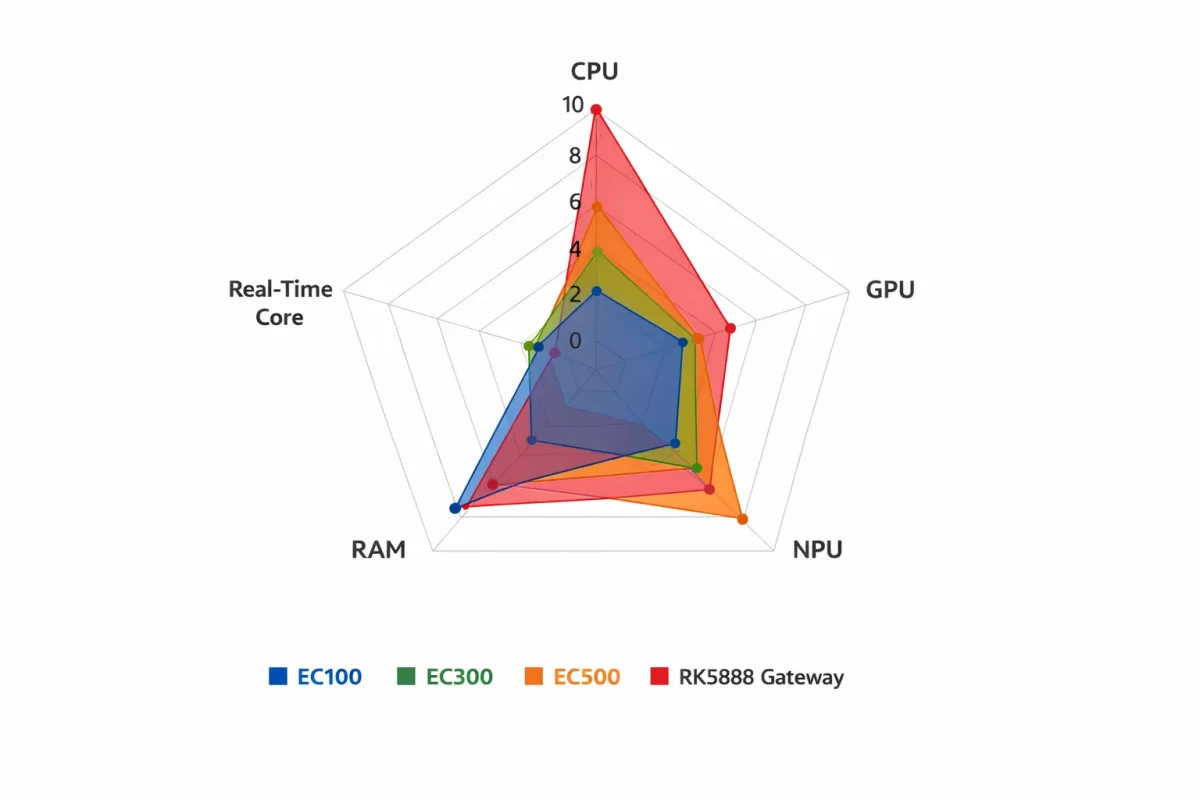 Clearly, the RK3588 gateway leads across CPU, GPU, memory, and real-time cores. From a purely hardware perspective, it’s the performance ceiling.
But this is only half the story. Many engineers choose devices purely based on specs, only to find that the extra power goes unused in real projects. Strong chips don’t automatically make strong products.
Chip Performance ≠ Product Value
In industrial systems, chip performance is only one part of the equation. System architecture, software ecosystem, deployment speed, and maintenance efficiency all determine the actual value of a gateway.
RK3588-based gateways aim for maximum performance, handling heavy AI inference, complex machine vision, strict real-time control, or multiple containerized services.
The EC Series, by contrast, emphasizes flexibility and right-sizing. From simple data acquisition to medium-scale edge computing, engineers can pick EC100, EC300, or EC500 based on project complexity and budget.
It’s not about better or worse—it’s about the right tool for the right job. I’ve seen many projects where engineers insist on high-performance devices, thinking “more is always better.” In practice, 80% of that performance remains unused, budgets get wasted, and problems remain unsolved.
Core Strengths of the EC Series
One of the biggest advantages of the EC Series is cost-effectiveness. For example, in a utility data acquisition project with 100 nodes, each collecting 20 meters of data, an RK3588 gateway would be overkill. The EC100 delivers sufficient performance while significantly reducing overall system cost, letting engineers allocate budget to other critical nodes or system expansion.
Another key strength is fast deployment. The EC Series comes preloaded with Node-RED visual programming and NeuronEX lightweight edge software, so engineers can configure most industrial data acquisition and protocol conversion tasks without deep firmware development. In many cases, tasks that would traditionally take two weeks can be completed in two days.
A mature software ecosystem is equally important. EC Series gateways support mainstream industrial protocols, remote management, batch updates, fault diagnostics, and log monitoring. Combined with a low-code development environment, these capabilities have been validated in multiple real-world projects. Hardware alone cannot provide this level of operational reliability.
Finally, the product lineup is flexible. Not every project requires flagship-level performance.
-
EC100 is ideal for simple, cost-sensitive data acquisition tasks.
-
EC300 balances performance and cost for medium-scale edge computing.
-
EC500 supports light AI inference, multi-protocol handling, and local data analysis.
This approach ensures engineers only pay for the performance they actually need.
Industrial Gateway Selection Guide: How to Choose the Right Gateway
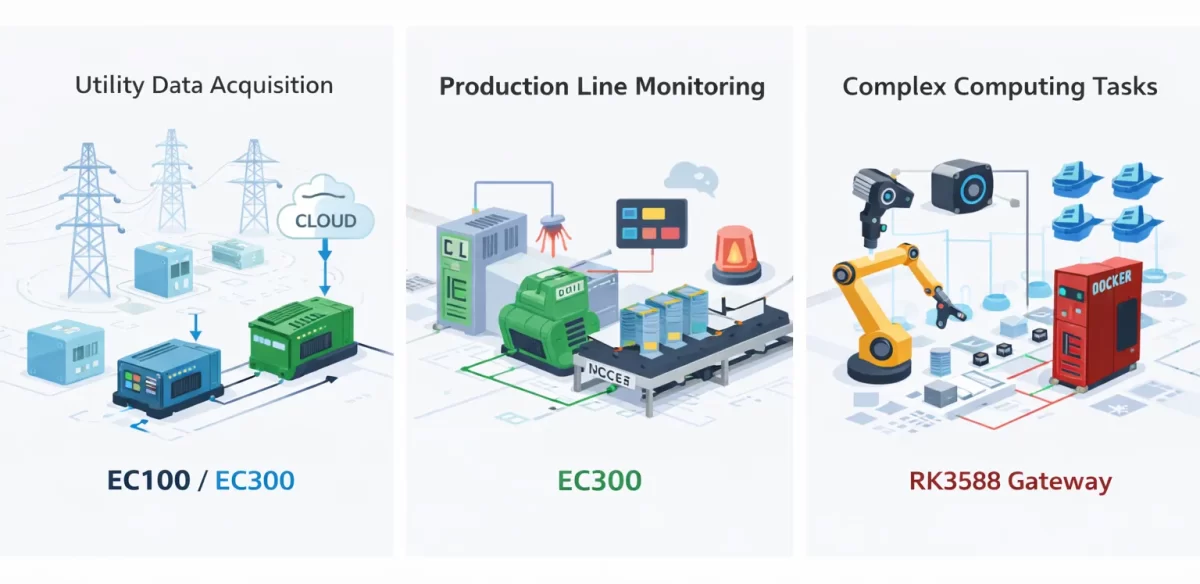
In fact, the industrial gateway selection guide is not complex. In practice, choosing an industrial gateway is about matching performance to project needs.
For example, in a utility data acquisition deployment with 100 substations, each uploading data from 20 meters to the cloud, an EC100 or EC300 is sufficient. High-end AI computation or complex processing is not required.
In a factory production line monitoring scenario, where real-time PLC data must be collected and simple alarm logic applied, an EC300 provides just the right balance. Node-RED simplifies the configuration of alarms and accelerates deployment.
Only in scenarios involving machine vision inspection, strict real-time control, or multiple containerized services would a flagship RK3588-based gateway be justified. These tasks demand high computation and strict timing, making high-spec devices necessary.
Right Tool for the Right Task
A simple analogy helps: an RK3588 gateway is like a high-end workstation designed for heavy computation. The EC Series is like a modular industrial node, configured to the task, balancing cost, stability, and deployment speed.
It’s similar to choosing a vehicle: a pickup for hauling, an SUV for family trips, and a sports car for racing. Sending a construction worker to move bricks in a Ferrari is overkill, just as using an overpowered gateway for simple data collection wastes resources.
Key Takeaways
Choosing an industrial IoT gateway isn’t about picking the highest performance device—it’s about selecting the device that fits your project needs. Chip performance sets the ceiling, but product definition, deployment efficiency, and software ecosystem define real value. Engineers should consider project requirements, deployment, and maintenance efficiency, and real-world validation. The EC Series provides proven stability, cost-effectiveness, and fast deployment, making it a reliable choice for most industrial scenarios.