
What is a RTU?
RTU is the abbreviation of Remote Terminal Unit (remote measurement and control terminal), which is responsible for monitoring and controlling on-site signals and industrial equipment. It is the core device that constitutes the enterprise’s comprehensive automation system. It usually consists of signal input/output modules, microprocessors, wired/wireless communication equipment, power supplies, and enclosures.
It is controlled by the microprocessor and supports network systems. Through its own software (or intelligent software) system, it can ideally realize the telemetry, remote control, remote signaling and remote adjustment functions of the enterprise’s central monitoring and dispatching system for primary instruments at the production site.
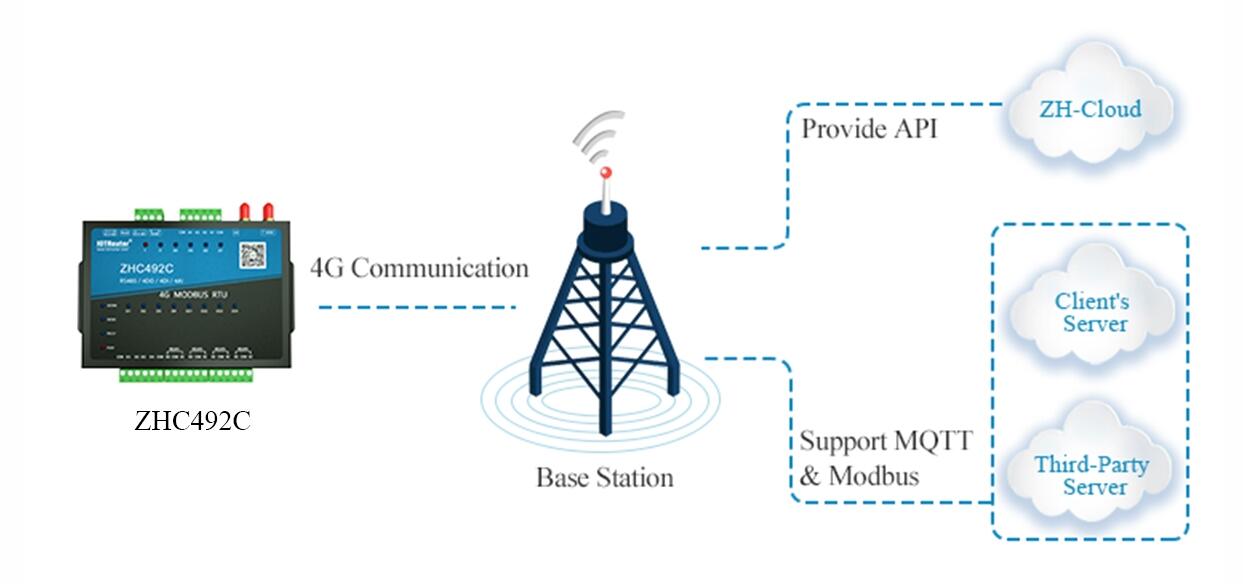
An RTU can consist of several, dozens or hundreds of I/O points and can be placed on-site near the measurement point. It has at least the following two functions: data collection and processing, data transmission (network communication). Of course, many RTUs also have PID control function or logic control function, flow accumulation function, etc.
Composition
The hardware of RTU mainly includes functional modules such as CPU, memory, and various input and output interfaces. These modules are integrated into the circuit board, and the connection of each functional module of the RTU is completed through circuit board wiring.
The CPU is the central system of the controller and is responsible for processing various input signals. After calculation and processing, the output is completed. The memory is the RTU memory system, used to store various temporary or permanent data. RTU generally includes various interfaces such as switching input, switching output, analog input, analog output, and RS485 communication.
Functions
1. Zorg voor meerdere digitale interfaces en meerdere analoge interfaces;
2. Verzamel de statuskwantiteit en stuur deze naar de externe locatie, met foto-elektrische isolatie, en externe signaalveranderingen worden eerst verzonden;
3. Verzamel gegevens en stuur ze naar een externe locatie met foto-elektrische isolatie;
4. Verzamel direct de stroomfrequentie van het systeem om de spanning, stroom, actief vermogen en reactief vermogen te meten en stuur dit naar de externe locatie en bereken de voorwaartse en achterwaartse vermogensniveaus;
5. Verzamel elektrische pulsmetingen en stuur ze naar een externe locatie met foto-elektrische isolatie;
6. Gebeurtenissequentierecords verzamelen en op afstand versturen;
7. Afstandsbediening ontvangen en uitvoeren en terugkeren naar school;
8. Accepteer commando's op afstand en kies ervoor om verschillende soorten informatie te verzenden;
9. Externe/lokale instellingen kunnen worden uitgevoerd;
10. Programma voor zelfdiagnose en zelfherstel;
Characteristics
Uiterst sterk aanpassingsvermogen aan de omgeving, werktemperatuur -40℃-70℃, omringende vochtigheid 5%-95%RH;
Extreem sterk vermogen tegen elektromagnetische interferentie;
Meerdere standaard communicatieprotocollen;
Rijke communicatie-interfaces, met ondersteuning voor meerdere communicatiemethoden en lange communicatieafstand;
Het wordt wijd gebruikt in watermilieubescherming, stroomverzending, gemeentelijke verzending en andere industrieën met verre signalering, telemetrie en afstandsbedieninggebieden.
Toepassingsscenario's
Compared with the commonly used programmable controller PLC, Remote Terminal Unit usually has excellent communication capabilities and larger storage capacity, is suitable for harsher temperature and humidity environments, and provides more computing functions. RTU products are widely used in SCADA systems in oil and gas, water conservancy, electric power dispatching, municipal dispatching and other industries.
Today, this Remote Terminal Unit technology is developing in an intelligent direction. The intelligent RTU can automatically determine whether the acquired data needs to be reported to the central control station immediately, or whether it can be temporarily retained locally and then transmitted later, or until the central control station requires it.
De intelligent RTU can automatically detect the interruption of communication and immediately start saving data to the memory, so that the communication network can be used most effectively. The intelligent RTU can also transmit critical data to several central control stations at the same time. In addition, since security is the biggest issue in current communication networks, intelligent RTU can encrypt data before transmission and can also deny access from unknown addresses.