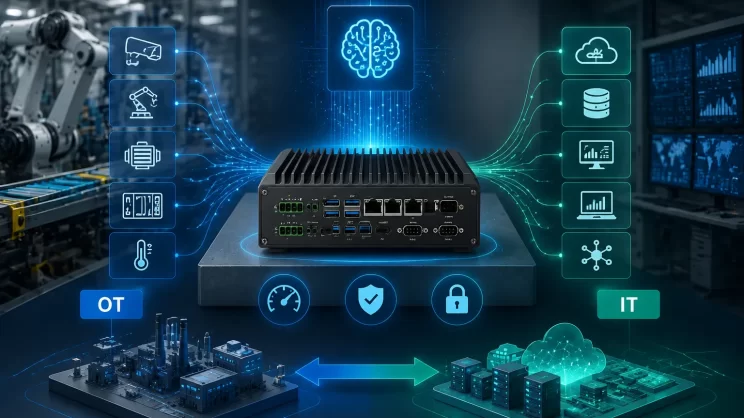
Industrial gateway selection often comes down to one question: How many devices can a gateway connect?
In real-world projects, three factors matter more: which communication protocols the field devices use, whether PLCs need to be connected, and whether the required signals are digital or analog.
Once these three requirements are clear, it becomes much easier to choose between the EM100 и EM300 and determine the right I/O expansion modules for the application.
1. EM Series: A Modular Edge Gateway System
The EM Series is a new generation of expandable modular edge gateways (FlowPLC) developed by IOTRouter. Designed for industrial environments, it combines edge computing, data acquisition, and on-site control in one system.
Each system consists of a main unit and DIN-rail I/O expansion modules. Add or remove modules according to the number of I/O points required at the site, without complex hardware modifications or rewriting the application logic.
This architecture brings together three key capabilities.
1. Millisecond-Level Data Acquisition and Control
I/O modules can be installed close to field devices, with data exchanged with the main unit over the system bus. Data acquisition, device coordination, and control logic are handled locally, forming a closed-loop control system at the edge.
2. Comprehensive Industrial Protocol Support
The EM Series supports a wide range of industrial protocols, from Modbus to major PLC brands such as Siemens, Mitsubishi, Omron, Inovance, and Delta. It also supports CNC systems from FANUC, Mitsubishi, and Siemens, along with industry-specific protocols such as IEC 104, DL/T 645, HJ 212, and CJ 188.
3. Low-Code Development and Remote Maintenance
Build application logic using drag-and-drop flow programming, with JavaScript available for further customization. Combined with remote management capabilities, users can modify configurations and upgrade firmware without visiting the installation site.
Traditional industrial gateways often have fixed I/O configurations, separate data acquisition and control functions, and relatively high development requirements. The EM Series integrates data acquisition, control, communication, management, and maintenance into one system, significantly simplifying industrial integration and digitalization projects.
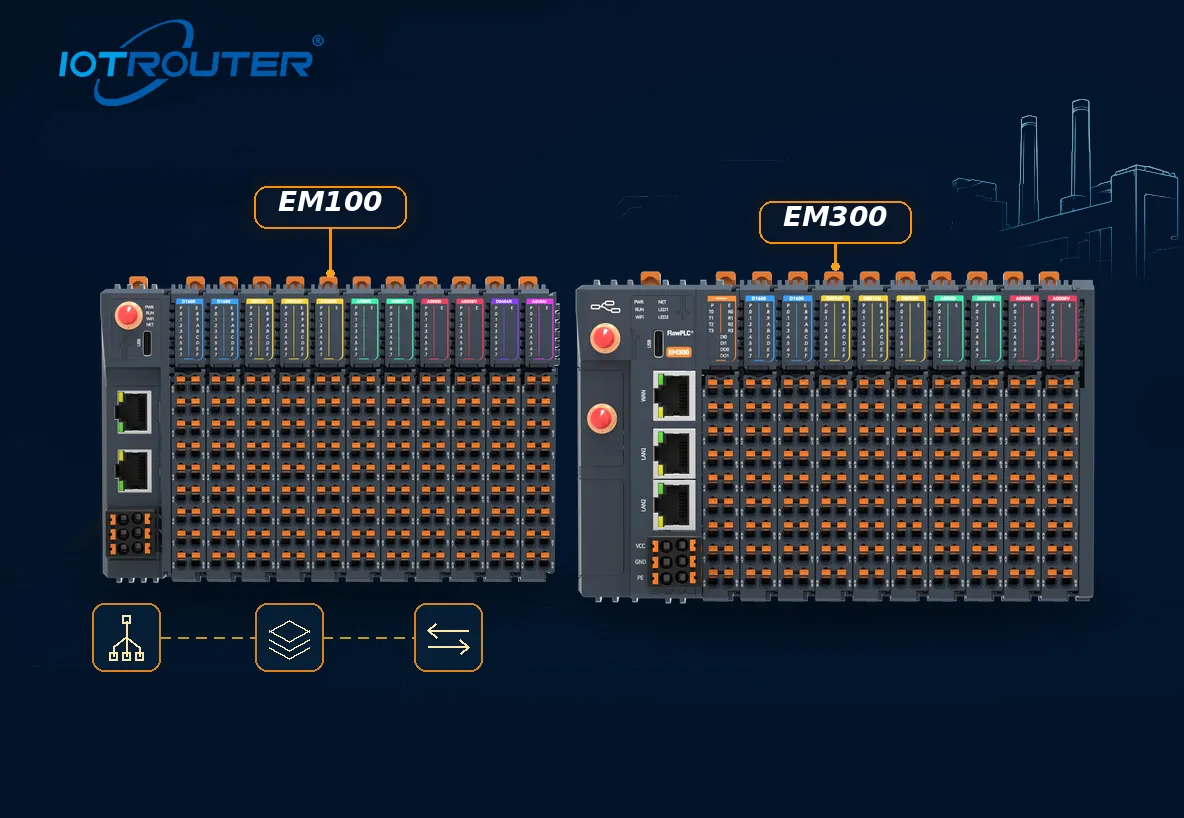
2. EM100 vs. EM300: Choosing the Right Industrial Gateway
The EM Series includes two product lines, covering applications from basic device connectivity to comprehensive on-site data acquisition and control. Each model provides a different solution based on project requirements.
EM100 — Basic Connectivity
Core Configuration: ESP32 dual-core processor, with 8 MB Flash and 16 MB PSRAM. Supports Modbus TCP, Modbus RTU, MQTT, and TCP for Modbus data acquisition and protocol conversion.
Typical applications include:
- Modbus Data Acquisition: Operates as an RTU master to read data from connected instruments and energy meters.
- Преобразование протокола: Converts Modbus RTU data to Modbus TCP or MQTT, allowing data from existing equipment to be integrated with cloud platforms.
- Connectivity for Distributed Sites: Suitable for pump stations, weather stations, and individual machines where the number of data points is limited, and equipment is spread across multiple locations.
EM300 — Integrated Data Acquisition and Control
Core Configuration: RK3506J triple-core processor (3 × Cortex-A7 @ 1.2 GHz), with 512 MB RAM and 512 MB storage. Supports MicroSD expansion up to 32 GB, along with visual programming and JavaScript custom development.
Its industrial interfaces and extensive protocol support make it suitable for more complex data acquisition and control applications.
Compared with the EM100, the EM300 adds four key capabilities:
- Four Fully Isolated RS485 Ports: Supports multiple devices operating in parallel, with electrical isolation between ports.
- Built-in Digital I/O: Includes 2 DI and 2 relay DO channels, allowing digital signals and alarm points to be connected without using expansion modules.
- Broader Industrial Protocol Support: Extends beyond Modbus to PLCs from Siemens, Mitsubishi, Omron, Inovance, and Delta; CNC systems from FANUC, Mitsubishi, and Siemens; and industry protocols such as IEC 104, DL/T 645, HJ 212, and CJ 188.
- Local Processing and Data Protection: Supports visual programming, JavaScript custom development, store-and-forward when the network is disconnected, and 10-second power-loss protection.
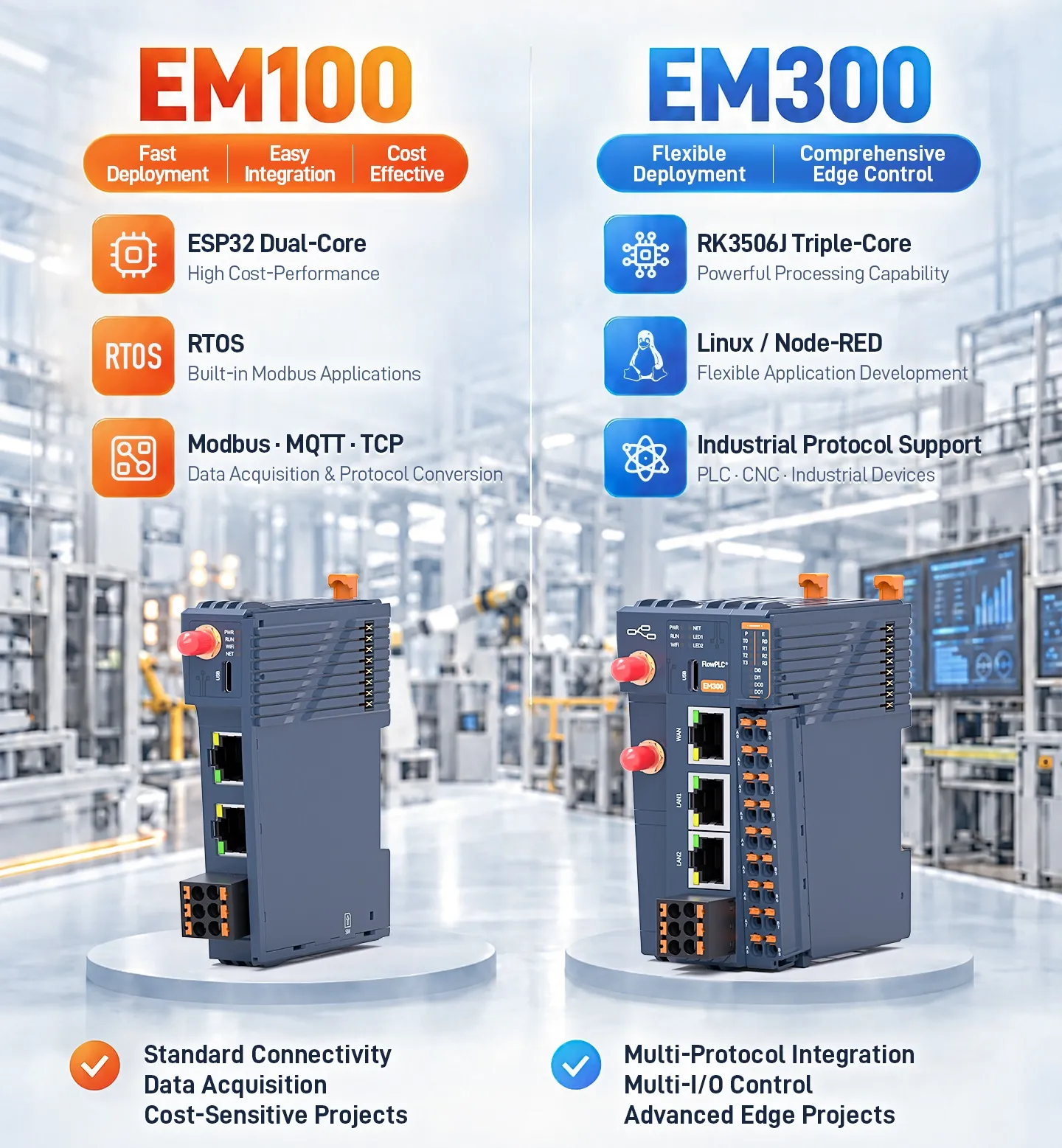
EM100 vs. EM300: Key Differences
| Спецификация | EM100 | EM300 |
|---|---|---|
| Позиционирование | Quick deployment · Easy to use · Cost-effective | Flexible deployment · Integrated acquisition and control · Broad compatibility |
| Процессор | ESP32 Xtensa LX7 Dual-Core | RK3506J 3 × Cortex-A7 @ 1.2 GHz |
| Flash / RAM / Storage | 8 MB Flash / 16 MB PSRAM | 512 MB RAM / 512 MB Storage |
| расширение памяти | Not specified | MicroSD up to 32 GB |
| Ethernet / Wireless | 1 × 10/100 Mbps Ethernet · Wi-Fi 4 · 4G Cat.1 | 1 WAN + 2 LAN (10/100 Mbps) · Wi-Fi 6 · 4G Cat.1 |
| Последовательные порты | 1 × RS485 | 4 × fully isolated RS485 |
| Built-in I/O | Not specified in the hardware interface specification | 2 DI + 2 relay DO |
| Протоколы | Modbus TCP, Modbus RTU, MQTT, TCP | Modbus + PLC + CNC + industry-specific protocols |
| Best-Fit Applications | Standard device connectivity, basic data acquisition, and cost-sensitive projects | Multi-protocol integration, multiple I/O points, complex data acquisition and control, and remote maintenance |
3. Modular I/O Expansion Modules: Digital and Analog Signals
Signals such as digital inputs, digital outputs, and analog signals are represented directly by electrical levels or current values rather than communication protocols. These signals are connected through I/O expansion modules.
The EM Series offers ten module models across five functional categories:
Цифровой вход (DI)
D1600: 16 channels, compatible with NPN and PNP signals, with full isolation. Used to collect signals from switches, limit switches, magnetic door contacts, and equipment status feedback.
Цифровой выход (DO)
- D0016P (PNP) / D0016N (NPN): 16 channels each, with a maximum output of 0.5 A at 24 V per channel. Select PNP or NPN according to the controller’s output requirements.
- D0008R: Eight Omron relay channels, with load ratings of 300 mA at 125 VAC and 1 A at 30 VDC. Can directly switch AC loads and is suitable for alarms, start/stop commands, and valve control.
Аналоговый вход (AI)
A0800I: Eight channels of 4–20 mA current input with 16-bit resolution. Connects to 4–20 mA transmitters for temperature, pressure, flow, and liquid-level measurement.
Аналоговый выход (AO)
A0008I: Eight channels of 4–20 mA current output with 12-bit resolution. Provides setpoint signals for control valves, variable frequency drives, and other equipment.
Mixed I/O
- A0404I: Combines four analog current inputs and four analog current outputs.
- D0404R: Combines four dry-contact digital inputs and four relay outputs. Suitable for applications with fewer I/O points that require both input and output functions.
Example: Building an Integrated I/O System
A single EM300 combined with three expansion modules — D1600, A0800I, and D0008R — provides:
- 4 × RS485 ports
- 16 × digital inputs
- 8 × analog inputs
- 8 × relay outputs
This creates a complete data acquisition and control unit, with data collection, processing, and control all handled within the same DIN-rail system. No separate remote I/O station is required.
All expansion modules share a standard size of 19 × 100 × 80 mm, support DIN-rail mounting, and operate from -40°C to +85°C. They can be installed close to field equipment and connected to the main unit through the system bus.
One main unit supports up to 16 expansion modules, making it easy to add I/O capacity as project requirements grow.
The main unit also supports a wide 9–36 V DC power input and an operating temperature range of -40°C to +85°C. The EM300’s RS485, DI, and DO interfaces are fully isolated, while the expansion modules provide 8 kV ESD protection.
4. Industrial Gateway Selection: How to Choose the Right Model
Selection Summary:
- EM100 is suitable for standard device connectivity, basic data acquisition, and cost-sensitive projects.
- EM300 is designed for multi-protocol integration, multiple I/O points, more complex edge data acquisition and control, and remote maintenance.
For industrial gateway selection, projects can generally be divided into three categories based on the scale and requirements of the installation.
Single Devices and Distributed Sites
Examples include pump stations, weather stations, and individual machines.
When there are only a few devices, communication protocols are relatively simple, and budget is a consideration, one EM100 with a small number of DI and AI expansion modules is generally sufficient.
Multi-Device Production Workshops
These applications may involve PLCs from different manufacturers and require local data processing and control.
One EM300 can be used, with its four RS485 ports connecting to different devices. The built-in DI and DO channels, together with additional I/O expansion modules, handle digital signals and alarms. Node-RED is used to implement local control logic.
Plant-Wide Multi-Protocol Integration
For facilities that need to integrate PLCs, CNC machines, instruments, and industry-specific protocols, the EM300 serves as the main controller. Multiple groups of I/O expansion modules can be deployed across different areas, with data collected and sent to a centralized platform.
The key to industrial gateway selection is not simply comparing specifications. It is matching the hardware to the actual requirements of the installation.
Once the connected devices, communication protocols, and signal types are identified, the appropriate combination of main unit and I/O expansion modules can be configured.
The IOTRouter EM Series uses three types of hardware to cover these requirements: EM100 for basic connectivity, EM300 for integrated data acquisition and control, and modular I/O expansion modules for field signal acquisition.
Together, they provide a scalable industrial data acquisition solution, from individual instruments to plant-wide multi-protocol integration.