
In large-scale photovoltaic (PV) power plants, a PV Power Plant Communication Gateway is the core device for implementing Modbus to IEC104 protocol conversion and ensuring accurate data integration into grid dispatching. Inverters, combiner boxes, weather stations, and other devices often use different communication protocols, leading to data loss or delayed dispatch commands. Based on multiple real-world projects, this article explores a protocol integration architecture centered on edge computing gateways and provides practical implementation paths and selection guidance.
1. PV Power Plant Communication Gateway: Industry Background
Over the past decade, China’s PV industry has progressed from catching up to leading globally. With subsidy reductions and the arrival of grid parity, the focus has shifted from simply expanding installed capacity to full lifecycle cost reduction, efficiency improvement, and enhanced grid-friendliness.
-
Operational cost reduction: Large plants spanning thousands of acres rely on manual inspections to detect faults, which is inefficient and costly. Digital operation solutions can reduce operation costs by 20–30%.
-
Power generation efficiency optimization: Real-time monitoring of each string and inverter detects degradation, shading, or hot spots, increasing annual output by 3–5%.
-
Grid dispatch response: Plants must quickly respond to dispatch commands, participate in peak shaving and frequency regulation, and stabilize the smart grid.
These requirements highlight the importance of PV Power Plant Communication Gateways as reliable data hubs.

2. Plant Communication Architecture with PV Power Plant Communication Gateway
Automation requires devices to communicate and understand each other. PV plant communication architecture is divided into on-site communication и external communication, corresponding to southbound acquisition and northbound transmission in industrial IoT.
2.1 Southbound Data Acquisition: Device Protocols
In PV arrays, core devices are inverters. Early inverters often used proprietary protocols, complicating centralized monitoring. Modbus (RTU over RS485, TCP over Ethernet) is now a de facto standard, supported by most inverters, combiner boxes, weather stations, and meters to report voltage, current, power, energy, temperature, etc. These are aggregated through the PV Power Plant Communication Gateway before uploading.
In step-up or packaged substations, protection devices and IEDs increasingly use IEC 61850. Multi-protocol gateways integrate IEC 61850 with other on-site protocols for unified dispatch system access.
2.2 Northbound Transmission: Grid Dispatch Standards
Edge computing gateways send collected data via IEC 60870-5-104 (IEC104) to grid dispatch or SCADA systems. IEC104 supports general interrogation, spontaneous data upload, remote control, and remote setting, ensuring telemetry and telecontrol accuracy.
MQTT is often used for cloud upload, requiring modern gateways to support multiple protocol stacks. The PV Power Plant Communication Gateway acts as a unified interface, distributing diverse data to SCADA or cloud platforms.
3. Technical Implementation: Protocol Conversion at the Edge
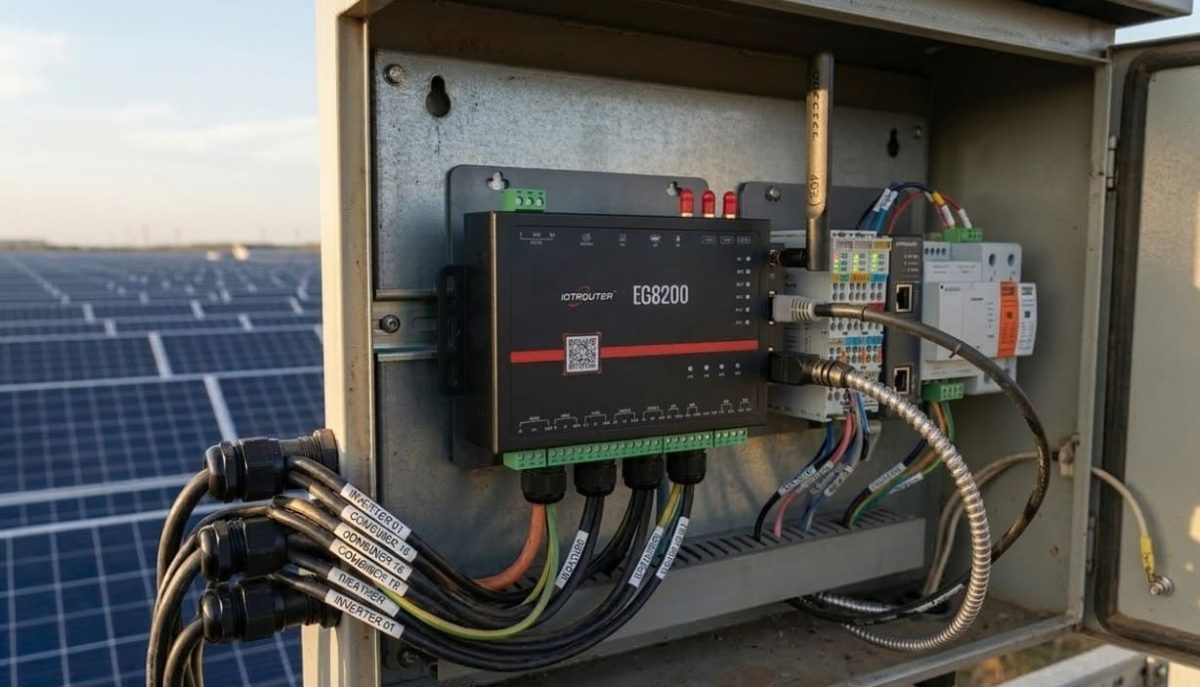
Traditional centralized solutions consolidate all protocol conversion tasks on a central server, leading to single points of failure, high network latency, and bandwidth pressure. Edge computing gateway architectures allow each PV array section to have its own “translator and brain,” performing protocol conversion directly at the array or substation level using PV power plant communication gateways.
Case Study: Digital Transformation of a 200MW PV Plant in Northwest China
The plant has a total installed capacity of 200MW, with over 2,000 string inverters distributed across dozens of array sections. Inverters in each array are connected via RS485 bus using Modbus RTU. The main challenges:
-
Data silos: Different batches of 2,000 inverters; some old devices only support Modbus RTU, new devices support Modbus TCP, making unified collection difficult.
-
Dispatch compliance risk: Provincial dispatch requires IEC104 data, but the original system only outputs proprietary protocols, requiring additional protocol conversion servers, increasing cost and failure points.
-
Delayed operational response: Faults detected via manual inspection took an average of 4 hours to locate.
Solution selection: The owner evaluated three paths: replacing old devices (too costly), deploying a central protocol conversion server (risk of single point failure), and using PV power plant communication gateways for on-site conversion. They chose the edge gateway solution, as it protects existing investments and distributes fault risk across the array sections.
Развертывание
A QUECTEL chipset-based industrial 4G edge computing gateway was deployed in each array communication cabinet. This device supports multi-protocol conversion, connecting Modbus RTU/TCP, IEC 61850, and uplinking via IEC104 and MQTT. Workflow:
-
Data aggregation: The PV communication gateway polls all inverters in the array via dual independent RS485 interfaces. With dual parallel collection at 19200bps or above, a single gateway can manage up to 64 string inverters, with polling cycles <2s.
-
Edge processing: The industrial-grade ARM processor cleans, aggregates, detects anomalies, and generates alerts locally. For example, total array power is calculated from DC voltage, current, and the conversion efficiency of each inverter. Local computation reduces over 90% of unnecessary polling on the main server. Observed latency from collection to local alert output is <50ms, nearly 20× faster than cloud processing.
-
Protocol conversion: The gateway includes a visual programming platform that maps Modbus data points to IEC104 Information Object Addresses (IOA) via drag-and-drop. Active power maps to telemetry points, emergency stop states to telecontrol points. On-site configuration time is reduced from 3 days to 4 hours per gateway. For IEC104 uplink, precise timestamping (CP56Time2a) is supported via NTP or GPS, achieving millisecond-level precision for incident tracing.
-
Reliable upload: The PV power plant communication gateway acts as an IEC104 server, responding to master station connections and general interrogations, and supporting spontaneous event uploads. MQTT can upload data to the cloud concurrently. Using “Report by Exception” filtering reduces over 95% of unnecessary heartbeat data, cutting monthly data per array from 5GB to under 800MB. The gateway can store up to 7 days of historical data locally for automatic retransmission if the network is down, ensuring zero data loss.
Post-deployment benefits:
-
Data collection completeness increased from 92% to over 99.5%.
-
Fault localization time reduced from 4 hours to under 30 minutes.
-
Dispatch communication passed provincial grid network tests on the first try.
-
Investment savings of ~60% compared to replacing equipment, with ROI <2 years.
-
4G network costs reduced by ~30% annually.
4. FAQs
Q1: The plant has both old inverters (Modbus RTU) and new devices (Modbus TCP), plus third-party weather stations. Can PV power plant communication gateways manage all devices without replacement?
A1: Yes. Industrial gateways with multiple RS485 and Ethernet ports can connect to Modbus RTU, Modbus TCP, etc., locally unify the data format, and upload via northbound interfaces (MQTT or IEC104). In multiple retrofitting projects, this approach protects existing investments and reduces transformation time by over 50%.
Q2: The grid requires IEC104, but the monitoring platform uses proprietary protocols. Is conversion complex?
A2: The key is to use gateways with visual configuration support. Data points (e.g., total active power) can be mapped to IEC104 standard addresses via drag-and-drop. The gateway automatically handles conversion and encapsulation. On-site debugging time is reduced by 70% on average.
Q3: Sites are dispersed, and fiber installation is costly. How to ensure stability using 4G?
A3: Core strategy: “edge processing, upload on demand.” Gateways calculate statistics locally and only upload changed or requested data, significantly reducing unnecessary traffic. Industrial 4G gateways based on high-performance chipsets like QUECTEL ensure stable connections in harsh environments, making remote substation monitoring reliable without fiber.
5. Selection Matrix: Gateway Configurations
| Scenario | Core Challenge | Recommended Configuration | Gateway Type |
|---|---|---|---|
| Large ground-mounted plant | High dispatch compliance, many inverter points | IEC104 forwarding, multi-port isolation, dual RS485 <2s polling, native Modbus→IEC104 mapping | PV communication gateway / comprehensive power gateway |
| Step-up/combiner substation | Local monitoring & interlock, real-time control | DI/DO, second-level logic, optional AI interface, NTP/GPS sync | Remote substation monitoring gateway |
| Distributed rooftop PV | Cost-sensitive, rapid cloud upload | MQTT/JSON, remote web config, 4G, report by exception | Distribution automation gateway / lightweight edge gateway |
In the 200MW project, EG8200 series gateways achieved >99.5% data delivery, <0.5% fault rate over 18 months.
6. Future Outlook: From Connectivity to Intelligence
Edge gateways support AI deployment for predictive maintenance and power forecasting. Neural network models can predict branch faults a week in advance (>90% accuracy) and short-term power for trading (5–8% revenue improvement). Some gateways allow source-level customization for integrators or owners.
Future gateways will integrate protocol conversion, edge computing, and AI analytics, serving as intelligent nodes in next-generation PV systems.
Заключение
Communication gateways are central to Modbus–IEC104 integration and edge data processing in large PV plants. Accurate data collection and timely handling of power fluctuations ensure stable operation and efficient power generation.