
What is the Packet Loss in Data Acquisition
Packet loss is a common issue in industrial data acquisition, energy monitoring, MES systems, and IoT deployments. It may look like a small communication interruption, but it can lead to missing measurement points, broken production records, or control logic temporarily entering a “blind spot.” As device diversity increases and communication paths grow more complex, packet loss becomes even more frequent.
Across RS485, Ethernet, WiFi, 4G, MQTT, Modbus, or proprietary protocols, packet loss generally indicates that a certain part of the communication chain is unable to maintain stable transmission. Understanding this helps prevent repeated cable replacements, device reboots, or guesswork during troubleshooting.
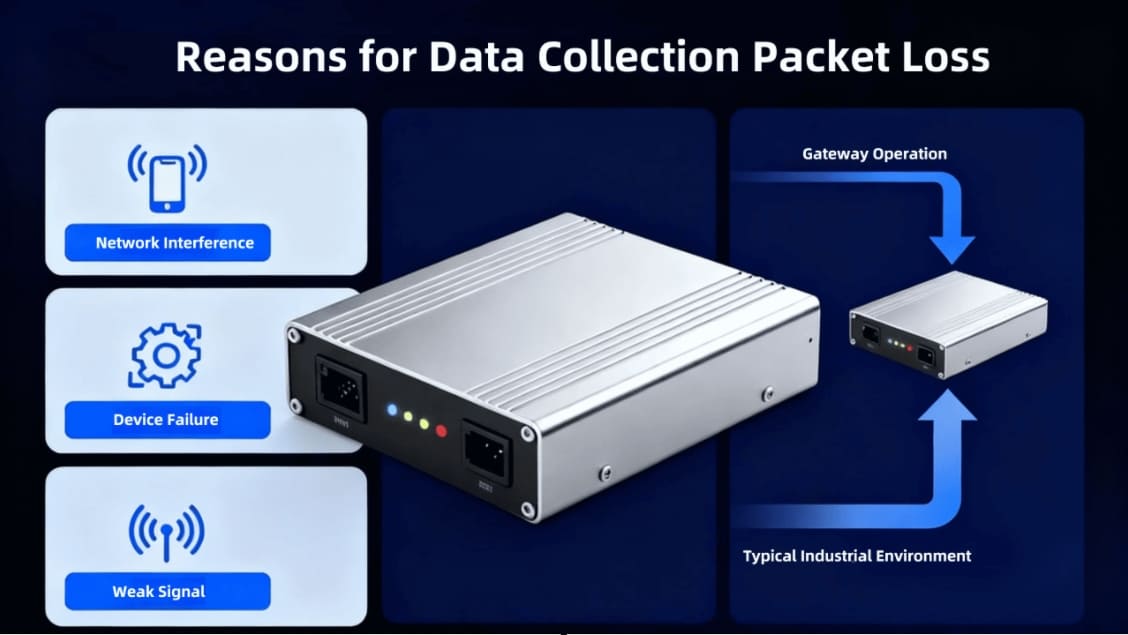
Typical Symptoms in Data Acquisition Links
1)Devices suddenly returning no values
2) Intermittent data uploads
3) Gateway logs containing timeout messages
4) Occasional CRC errors on the supervisory system
5) Blank periods in PLC or meter readings
These often point to instability along the link. Common underlying causes include the following.
Common Causes Behind Data Acquisition Packet Loss
● Physical layer quality
Long or thin cables, loose connectors, too many converters, electromagnetic noise, or missing termination resistors can distort signals. RS485 is particularly sensitive to distance and impedance mismatch.
● Device processing limitations
High polling frequency, dense protocol requests, or simultaneous multi-device collection may exceed a device’s processing capacity. Lower-end modules are more prone to overload in such conditions.
● Protocol mismatches
Examples include mismatched baud rates, slow device response causing timeouts, half-duplex timing issues, or long internal polling cycles inside the device.
● Network instability
This is more common in wireless links: 4G signal fluctuation, base-station switching, NAT session interruptions, WiFi congestion, switch packet loss, or broadcast storms. These do not always cut the connection entirely, but they create intermittent gaps.
In many cases, packet loss has already been present for a long time; the system simply becomes aware of it only when continuous alarms appear.
Data Acquisition Packet Loss Troubleshooting
Solving packet loss requires systematic elimination rather than assumptions. An effective approach usually follows a bottom-up structure.
Step 1 — Confirm the Data Source and Response Behavior
Some devices require additional processing time. A timeout does not always indicate communication failure.
Step 2 — Simplify the Data Acquisition Link
Reducing a 300-meter RS485 cable to a few meters, testing a single device instead of multiple, or isolating the gateway with one endpoint helps identify whether the issue lies in physical quality or interference.
Step 3 — Check Wiring, Grounding, and Termination
Incorrect grounding and impedance mismatch are among the most common causes of packet loss in real deployments.
Step 4 — Adjust Polling Strategies Based on Device Capability
Excessively high polling frequency, long protocol frames, or too many simultaneous device requests can exceed what industrial equipment is designed to handle.
Step 5 — Optimize Network Transmission for Stable Data Acquisition
Reducing upload frequency, adding buffer depth, improving access-point stability, reducing NAT layers, adjusting MQTT QoS, using higher-quality antennas, or switching from WiFi to wired connections can significantly improve stability.
By following these steps, most packet loss issues can be located and solved without repeatedly replacing hardware.
Preventing Data Acquisition Packet Loss Through Hardware Capability
In many deployments, packet loss ultimately relates to equipment capability. Industrial-grade gateways often provide features that improve stability, including:
1) Higher-performance processors to avoid response delays
2) Protocol task scheduling to prevent burst congestion
3) Isolated industrial RS485 transceivers for better noise immunity
4) Automatic retransmission, buffering, and resume mechanisms
5) Adaptive switching between Ethernet and 4G
In environments with noise, multiple devices, or complex protocols, these features play a critical role in keeping data transmission stable.
ЧАСТО ЗАДАВАЕМЫЕ ВОПРОСЫ
Q1: Why does packet loss occur only at certain times?
Often due to temporary interference, network congestion, or polling conflicts.
Q2: Is packet loss caused by the gateway or the device?
This cannot be determined from symptoms alone. The link needs to be shortened and load reduced to identify the bottleneck.
Q3: Does reading RS485 multiple times prevent packet loss?
It can mask the issue but does not address the underlying cause.
Q4: Will switching 4G carriers stop packet loss?
It may help, but antenna installation quality and device stability are often more critical.
Q5: Why do CRC errors appear on the supervisory system?
This usually indicates frame distortion caused by noise, impedance mismatch, or timing issues during transmission.
Заключение
Packet loss is not a single issue but the combined result of environment conditions, device capability, protocol behavior, and network stability. Effective troubleshooting follows a clear sequence: физический уровень → link load → protocol timing → network transmission strategy.
A stable data acquisition pipeline ultimately relies on high-quality hardware, proper wiring, and reasonable polling strategies. Understanding how packet loss forms makes the entire data system more predictable and easier to maintain.